


How is Ammonia Prepared in the Laboratory? Ammonia is a gas that can be prepared in the laboratory using simple materials and procedures. One common method involves heating ammonium chloride (NH₄Cl) with calcium hydroxide (Ca(OH)₂). Here's a step-by-step guide: Materials Needed: Ammonium chloride (NRead more
How is Ammonia Prepared in the Laboratory?
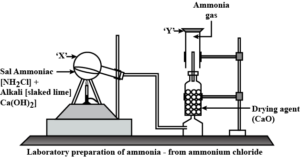
Ammonia is a gas that can be prepared in the laboratory using simple materials and procedures. One common method involves heating ammonium chloride (NH₄Cl) with calcium hydroxide (Ca(OH)₂). Here’s a step-by-step guide:
Materials Needed:
- Ammonium chloride (NH₄Cl)
- Calcium hydroxide (Ca(OH)₂) – also known as slaked lime
- Test tube or boiling tube
- Bunsen burner or a heating source
- Delivery tube
- Gas jar or collecting bottle
- Water trough
- Clamp stand and holder
Steps to Prepare Ammonia:
- Set Up the Apparatus:
- Fix the test tube or boiling tube in the clamp stand.
- Connect a delivery tube to the test tube. The other end of the delivery tube should be placed in an inverted gas jar or collecting bottle over a water trough.
- Mix the Chemicals:
- Add a small amount of ammonium chloride (NH₄Cl) into the test tube.
- Add an equal amount of calcium hydroxide (Ca(OH)₂) to the test tube.
- Heating the Mixture:
- Heat the test tube gently using a Bunsen burner. Be careful to heat it evenly and avoid direct, intense heat to prevent cracking of the tube.
- Chemical Reaction:
- When you heat the mixture, a chemical reaction occurs: 2NH4Cl+Ca(OH)2→2NH3+CaCl2+2H2O
- In simple terms, ammonium chloride reacts with calcium hydroxide to produce ammonia gas, calcium chloride, and water.
- Collecting Ammonia Gas:
- As the reaction proceeds, ammonia gas (NH₃) is released.
- The gas travels through the delivery tube and can be collected by displacing water in the gas jar. This method works because ammonia is less dense than water and will rise to fill the jar.
- Observations:
- You will notice a pungent smell, which is characteristic of ammonia.
- Ammonia gas is colorless and highly soluble in water, so you need to collect it quickly.
Safety Precautions:
- Always conduct this experiment in a well-ventilated area or under a fume hood to avoid inhaling the gas.
- Handle the chemicals with care and use safety goggles and gloves.




Consciousness and AI The concept of consciousness poses a fundamental challenge to AI development. While AI systems can mimic human intelligence in many ways, truly understanding and replicating consciousness remains elusive. This raises questions about the nature of intelligence itself and whetherRead more
Consciousness and AI
See lessThe concept of consciousness poses a fundamental challenge to AI development. While AI systems can mimic human intelligence in many ways, truly understanding and replicating consciousness remains elusive. This raises questions about the nature of intelligence itself and whether consciousness is a necessary component of advanced cognition.
If AI were to achieve consciousness, it would fundamentally alter our understanding of what it means to be human and could have profound ethical implications. Conversely, the pursuit of conscious AI could drive groundbreaking discoveries about the human brain and mind. Ultimately, the relationship between consciousness and AI is a complex and ongoing area of exploration with far-reaching consequences.