


Credit creation is the process by commercial banks to increase the money supply of a country or monetary region. In most modern economics, most of the money supply is in the form of bank deposits. So credit creation is also known as ‘Deposit Creation.’ Commercial banks create credit by advancing loaRead more
Credit creation is the process by commercial banks to increase the money supply of a country or monetary region. In most modern economics, most of the money supply is in the form of bank deposits. So credit creation is also known as ‘Deposit Creation.’
Commercial banks create credit by advancing loans and purchasing securities. Banks use public deposits to lend money to businesses or individuals. It doesn’t mean they simply lend the money which they deposit. Banks use a method which is called fractional reserve banking. Where they use a portion of the deposit to provide loans with high interest rates.
Basic concepts of credit creation:-
- Cash Reserve Ratio (CRR):- CRR is the percentage of total deposits that the banks must hold in cash reserve to meet the deposits’ demand for cash.
- Credit multiplier: A bank can create multiple times credit. For a certain amount, a bank can lend to many individuals or businesses. And this business lends to someone again. This circular process is never-ending. It generates more and more money.
- Legal Reserve Ration (LRR):- The minimum ration of deposit legally required to be kept as cash or in liquid form by the banks.
Now let’s understand the process by the Example:–
Assume, A person deposits Rs.10,000 in Bank ‘A’. As required the banks keep LRR 20% of the deposit of Rs. 2000 and Then Bank ‘A’ lends the remaining amount to Bank ‘B’ (10,000-2,000 = Rs.8,000)
Again, Bank ‘B’ keeps LRR 20% of Rs.8,000 means Rs.1,600 then lends the remaining amount to any business. (8,000- – 1,600 = Rs.6,400)
The money goes on multiplying in this way this process continues till new deposits become nil.
Ultimately, Total money creation = INITIAL DEPOSIT * 1/LRR%
10,000 * 1/20% = Rs. 50,000
See less
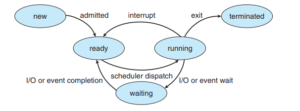

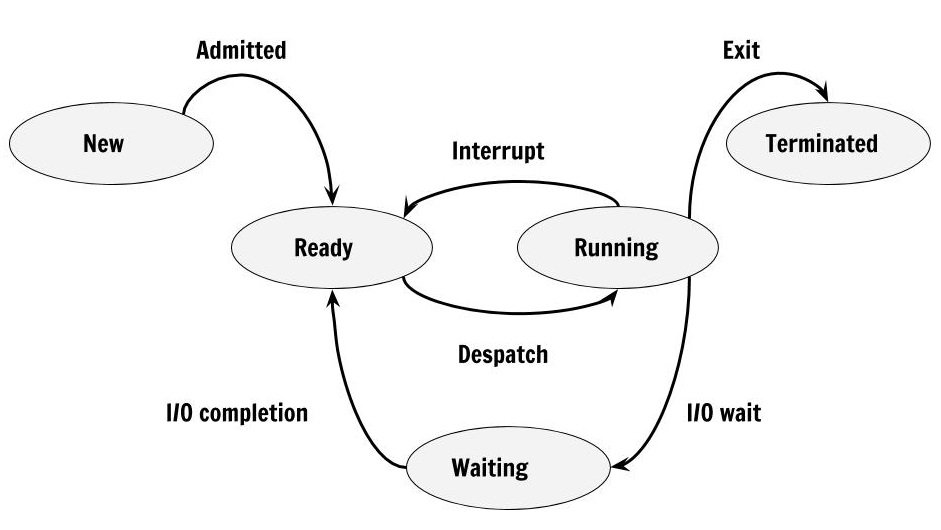
New: Description: The process is being created. In this state, the operating system is setting up the process control block (PCB), memory allocation, and other necessary resources. Example: When you start a new application, it begins in the new state while the OS sets up its environment. ReadRead more
- New:
- Description: The process is being created. In this state, the operating system is setting up the process control block (PCB), memory allocation, and other necessary resources.
- Example: When you start a new application, it begins in the new state while the OS sets up its environment.
- Ready:
- Description: The process is prepared to run but is waiting for CPU allocation. It has all the resources it needs except the CPU.
- Example: Multiple processes might be in the ready state, waiting their turn to be executed by the CPU.
- Running:
- Description: The process is currently being executed by the CPU. At this moment, the CPU is actively working on the instructions of this process.
- Example: When the CPU starts executing the instructions of a text editor, the text editor process is in the running state.
- Waiting (or Blocked):
- Description: The process cannot continue executing until some external event occurs (such as an I/O operation completion). It is not ready to use the CPU until this event is resolved.
- Example: If a process needs to read data from a disk, it will move to the waiting state until the disk I/O operation is completed.
- Terminated (or Exit):
- Description: The process has finished its execution. This state means that the process has completed its task and is being removed from the process table.
- Example:When you close an application, the process goes into the terminated state after finishing its execution and cleanup activitie
See less