

Why Constitution of India seems to be federal in form but in actual it is unitary?


India is tha vast democratic country direction and control of election process vested in election commission of India which is the independent constitutional body. Election for centre and state is a long term policy making process. Let's understand the small difference for conducting the simultaneouRead more
- India is tha vast democratic country direction and control of election process vested in election commission of India which is the independent constitutional body.
- Election for centre and state is a long term policy making process.
- Let’s understand the small difference for conducting the simultaneous election and frequent election
- Frequent election may take more time, attention, energy and resources for conducting regulating the election throughout the various states and local areas .there is no year without conducting some election.
- Whereas simultaneous elections may reduce such time , energy and resources as a result political party can engage such time and attention towards policy making, implementations , growth and good governance of democracy.
- Conducting Simultaneous elections also some challenges like power of centre over state .
- More officers,EVM machine trained and skilled officer at one time.etc.




![[Deleted User]](https://mainsanswerwriting.com/wp-content/plugins/WPQA/images/default-image.png "[Deleted User]")

The Constitution of India is quasi – federal where it has some federal characteristics and some unitary characteristics. In theory, it establishes a federal system by dividing powers between the central and state governments through three distinct lists in the Seventh Schedule: the three lists namelRead more
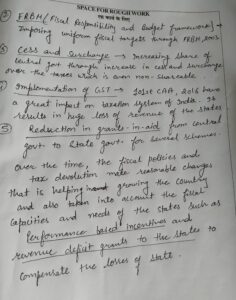
The Constitution of India is quasi – federal where it has some federal characteristics and some unitary characteristics. In theory, it establishes a federal system by dividing powers between the central and state governments through three distinct lists in the Seventh Schedule: the three lists namely the Union List, Stated List and Concurrent list. From this division, there seems to be a clear cuts federal structure guaranteeing that states are sovereign with regard to some issues. But in fact it can be seen that the constitution of Indian is has a tilt towards the unitary form. Some of these characteristic include; The Concurrent List that allows the central government to override the state laws, Article 356 giving the central government the power to dismiss state governments, Financial control and emergency powers are centralized, all of which show the unitary nature. Further, constitution provides the single constitution single citizenship and the power of the Parliament to redraw state boundaries to illustrate central dominance. Another feature depicts the structural aspect of unitary state that is the central government exercise of prerogatives in sensitive sectors such as defense, foreign affair, and communication, besides the Governor, being the representative of President in the state. Hence having federal structure at the constitution level the political system of India can be defined predominantly unitary due to centralisation of powers with the central government.
See less