

Emphasize how pressure organizations have helped India’s participatory democracy grow.
Mains Answer Writing Latest Questions

Preeti SinghBegginer
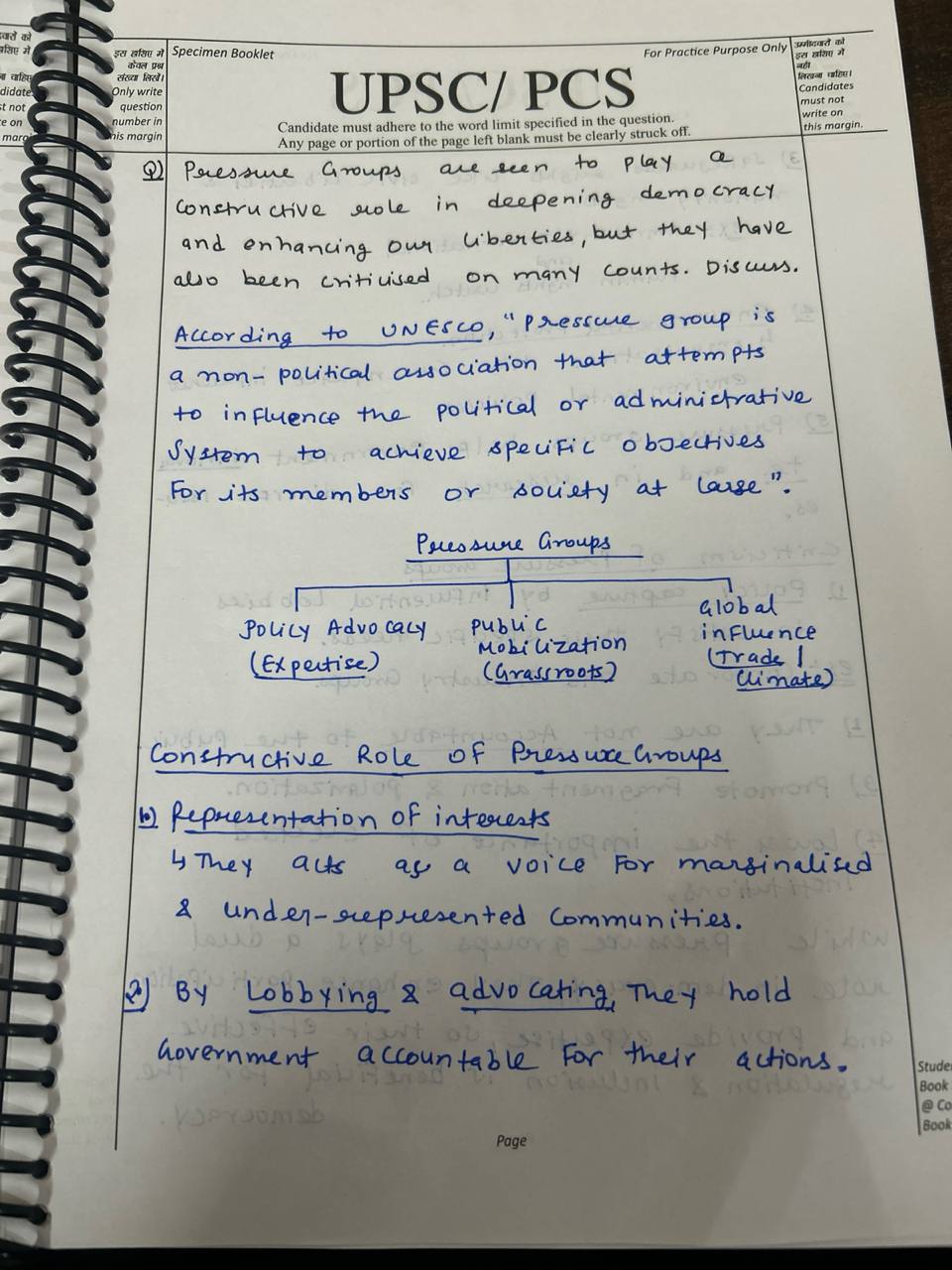
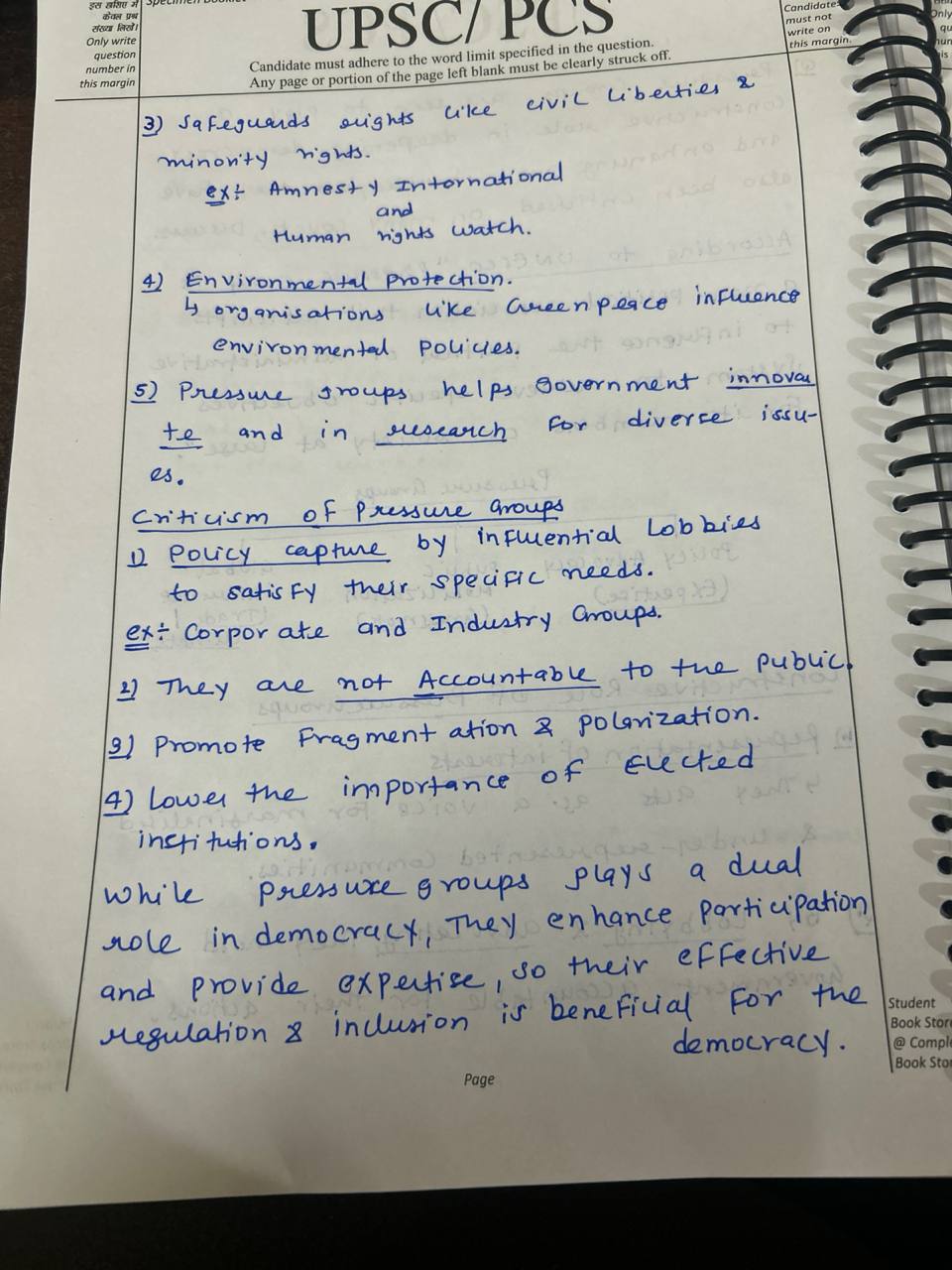
Although they have been attacked extensively, pressure organizations are thought to contribute positively to the advancement of democracy and our rights. Talk about.


Nandani NainaBegginer
-
A cooperative is a voluntary association of individuals having common needs, who join hands for the achievement of common economic interest. It aims to provide support to its members, with focus on the interest of the poorer sections of society, through the principle of mutual help. There are differRead more
A cooperative is a voluntary association of individuals having common needs, who join hands for the achievement of common economic interest. It aims to provide support to its members, with focus on the interest of the poorer sections of society, through the principle of mutual help. There are different types of cooperatives working in India viz. Consumers’ Cooperatives Societies, Producers’ cooperative societies, Cooperative Credit Societies, Cooperative Farming Societies and Housing Cooperative Society.
Significance of Cooperatives in India:
- Enhancing Social Cohesion: Unlike other processes of social cohesion that are public and involve a third party, the cooperative way is natural, intimate, private and does not involve a third party. It makes cooperation, in the cooperative, an alternative approach to social cohesion.
- Social empowerment: It promotes equal rights, enhances bargaining power of the poor, promotes leadership as all members are equal and free for their rights as well as Cooperative institutions elect their leaders democratically.
- Promoting Financial inclusions: Cooperatives have been revolutionary institutions in providing credit to farmers at cheaper rates and substituting the role of moneylenders and other non-institutional suppliers of credit from the rural scene.
- Reduce inequality of wealth: It helps in facilitating equal distribution of wealth by enhancing accessibility to loans at affordable rates and providing financial and other assistance to marginalized and economically weak sections.
- Role of Cooperatives in Indian Agriculture: It helps in provision of credit, input delivery and its effective usage, processing and marketing of agricultural produce, storage facilities and information sharing.
Recently, the Union Government has created a separate Ministry of Cooperation to be led by the Union Home Minister to give impetus to cooperatives as:
- It will provide a separate administrative, legal and policy framework for strengthening the cooperative movement in the country.
- It will help deepen cooperatives as true people based movements reaching up to the grassroots.
- It will work to streamline processes for Ease of Doing Business for cooperatives and enable development of Multi-State Cooperatives.
- Under the new Ministry, the cooperative movement would get the required financial and legal power to penetrate all over India.
However, the Supreme Court has declared some portions of Part IXB, introduced in the Constitution by the 97th Amendment Act of 2012, which provided the terms for running cooperative societies in a single state as unconstitutional. This has created doubts regarding the role of the newly created Ministry of Cooperation as it will now have powers to frame rules only for multi-state cooperatives or for those cooperatives, which are working in Union Territories. Notwithstanding the legal challenges, there is a need for a strong cooperative movement for developing the rural and agriculture sector of India. For this, various other measures like structural reforms in terms of winding up weaker and inefficient societies and merging stronger and efficient societies, promoting multipurpose societies, ensuring efficiency in functioning, capacity building and promoting transparency for making the cooperative more effective and realizing its objectives are needed to be taken at both levels- union and state- in the spirit of cooperative federalism.
See less


-
Tata Consultancy Services (TCS), an Indian multinational IT consulting and business services company, announced a significant layoff of around 15,000 employees in January 2020. The layoffs were reportedly a response to the company's efforts to reduce costs and improve profitability amid the ongoingRead more
Tata Consultancy Services (TCS), an Indian multinational IT consulting and business services company, announced a significant layoff of around 15,000 employees in January 2020. The layoffs were reportedly a response to the company’s efforts to reduce costs and improve profitability amid the ongoing COVID-19 pandemic.
The primary reasons behind the layoffs at TCS were:
- Cost-cutting measures: TCS aimed to reduce its costs to maintain profitability in a challenging business environment. The company faced downward pressure on its margins due to the pandemic, which led to a decline in demand for its services.
- Rebalancing operations: The layoffs were also part of TCS’s efforts to rebalance its operations and optimize its workforce. The company sought to adjust its employee base to match the changing needs of its clients and the market.
- Automation and digitalization: TCS is investing heavily in automation and digitalization to improve efficiency and reduce manual labor costs. The layoffs may have been a step towards achieving this goal by eliminating redundant positions and creating new roles that focus on high-value tasks.
- Client-driven changes: The company may have received feedback from clients that certain skills or services were no longer required, leading to a re-evaluation of its workforce and a reduction in positions that were not aligned with client needs.
- Shift to higher-margin services: TCS has been focusing on higher-margin services, such as cloud computing, data analytics, and digital transformation, which require different skill sets and expertise. The layoffs may have been an opportunity for the company to retrain employees for these new areas or exit positions that were not aligned with this strategic shift.
It’s worth noting that TCS has historically been known for its strong employee retention rates, and the company has implemented various programs to support employees who were impacted by the layoffs, including outplacement assistance, career counseling, and training programs.
See less

Nandani NainaBegginer
Certain sections of Article 22 have been argued to pose “fundamental dangers” to Indian citizens rather than being Fundamental Rights. Talk about the light of the controversy surrounding India’s legislation pertaining to preventive detention.
-
Article 22 of the Indian Constitution ensures protection of life and personal liberty by providing protection against arrest and detention in certain cases. However, certain provisions of the article are argued to be the fundamental dangers to the citizens of India. The first two clauses of this artRead more
Article 22 of the Indian Constitution ensures protection of life and personal liberty by providing protection against arrest and detention in certain cases. However, certain provisions of the article are argued to be the fundamental dangers to the citizens of India.
- The first two clauses of this article, i.e. Article 22(1) and 22(2), provide certain safeguards to an arrested person viz. informing the person about the grounds of arrest, right to be defended by a legal practitioner of one’s choice and producing the arrested person before a magistrate within 24 hours. However, Article 22(3), which is related to preventive detention, provides exceptions to the safeguards mentioned under these two clauses of the article.
- Moreover, under Article 22(6), the authority may not even disclose facts related to grounds of preventive detention if it considers such disclosure against public interest.
- There is also a provision for preventive detention beyond the stipulated three months if a duly constituted Advisory Board, in its opinion, finds sufficient cause for the same. Further, a law passed by the Parliament may also provide for preventive detention beyond the three-month period.
In this context it is also argued that there has been reckless use of the preventive detention law, as evident from the following:
- It has been observed that various governments routinely extend detentions up to one year on the basis of opinion of advisory boards.
- In a large number of cases, detenus have already spent five to eight months in jail before their detention orders are quashed by the high courts. Also, there is a lack of consistency in the approach of the courts towards these detentions.
- There also seems to be an emerging trend of arbitrary detentions. The Supreme Court guidelines in this regard are being circumvented: converting “law and order” offenses into “public order” issues, invoking detentions to counter the accused’s right to bail and taking shelter in the “subjective satisfaction” of the detention law.
- The courts usually avoid imposing any costs on respective governments for abusing the detention laws, despite a large percentage of them being quashed.
- Most of the preventive detention laws have been used against the economically marginalized for years.
The objective of preventive detention is not to punish but restrain a person without trial to prevent public disorder. But it is imperative that the State does not arbitrarily resort to it to deal with all and sundry law and order problems, which could be dealt with by the ordinary law of the land. The power of preventive detention must be confined to very narrow limits and it must fall within the four corners of Article 21 (due process of law) read with Article 22 (safeguards against arbitrary arrest and detention).
See less


Bhavana NotlaBegginer
-
Indian citizens actively exercise their fundamental rights through various means such as participating in elections, engaging in public debates, and utilizing judicial remedies. By voting, citizens influence policy-making and hold elected officials accountable. Public debates and protests, such as tRead more
Indian citizens actively exercise their fundamental rights through various means such as participating in elections, engaging in public debates, and utilizing judicial remedies. By voting, citizens influence policy-making and hold elected officials accountable. Public debates and protests, such as those seen in recent movements, allow citizens to voice their concerns and advocate for change. Judicial remedies enable individuals to challenge injustices and seek redress, thereby strengthening legal frameworks.
This active engagement promotes societal development by fostering a more informed and participatory citizenry. It enhances governance by ensuring that policies reflect the needs and values of the populace. Consequently, this dynamic interaction between citizens and the state contributes to a more transparent, responsive, and accountable governance structure, driving progress and reinforcing democratic principles in India.
See less


yashpriha RaiBegginer
How did the Kesavananda Bharati case impact the interpretation of Fundamental Rights?
-
In 2023, the judgment of Kesavananda Bharati case completed fifty years. It established the principle concept of 'Basic Structure Doctrine' wherein the Parliament was restricted to overpower and amend the constitution from its base and beyond limits. The outline of the case can be traced in 1950s anRead more
In 2023, the judgment of Kesavananda Bharati case completed fifty years. It established the principle concept of ‘Basic Structure Doctrine’ wherein the Parliament was restricted to overpower and amend the constitution from its base and beyond limits.
The outline of the case can be traced in 1950s and 1960s in Kerala when to diminish the lines of inequality in resource consumption, land reforms were introduced to redistribute land to landless. The government of Kerala imposed restriction on ownership of the religious land of Edneer Mutt, headed by Sh. Kesavananda Bharti, who challenged the Act of Government of Kerala.
Meanwhile,the Parliament of India introduced three major amendments 24th,25th,29th that somehow curtail the powers of judiciary and put constraints on exercising fundamental rights of citizen as well as the operating power to amend the constitution.
Kesavananda Bharti filed a petition to dismantle these amendments as they shake the bedrock of Constitution.Hence, the Supreme Court established the iconic ‘Basic structure Doctrine’
- The largest bench case (13 judges) in Indian history, made sure to keep a check on the Parliament and that every fundamental right is practised without any unfair bonded constraints.
The milestone judgment has safeguarded the aura of democracy and other values and to uphold the supreme charisma of Indian Constitution.
See less


“UCC is a transition step from positive secularism to the ideal of negative secularism.” Elucidate the statement and discuss the implications of the given statement.
-
The concept of secularism sparks intense debate. It encompasses two main concepts. Positive secularism, followed in India, involves the state recognizing religious coexistence and striving to foster a healthy relationship between religions and the state. It prioritizes minority rights and advRead more
The concept of secularism sparks intense debate. It encompasses two main concepts.
Positive secularism, followed in India, involves the state recognizing religious coexistence and striving to foster a healthy relationship between religions and the state. It prioritizes minority rights and advocates for religious pluralism.
Negative secularism, on the other hand, advocates for a strict separation between religion and the state. It dictates that religion should not interfere in state matters, and vice versa. All religions are considered equal in the eyes of the law.
Uniform Civil Code aims to establish a common set of laws for all citizens, replacing personal laws granted to specific religious communities. It ensures equal treatment of all citizens, regardless of their religion.
Indeed it can be inferred that implementation of UCC in India will be the first step towards achieving the ideal of Negative Secularism . Which is idealised as perfect equality .
Implications of implementing UCC in India can be different across different Communities as :-
It is opposed by some minority communities because it seeks to abbrogate their personal religious laws. And they think that this is unnecessary intervention of government in their religious matter.
While some people thinks UCC is necessary for national integration and Equal treatment of people before law .
It is also written in Directive Principles of State Policy in Constitution Article 44 that “The State shall endeavour to secure for the citizens a uniform civil code throughout the territory of India.”
I think that UCC is necessary also for stopping illegal religious conversions and stopping the interference of government in all the religions. A uniform code is required to make a strong legal system which will also be effucient .
See less


SabareesanBegginer
-
Joint sessions of the two houses of Parliament in India, the Lok Sabha and the Rajya Sabha, are permitted by Article 108 of the Indian Constitution. These sessions typically occur under specific circumstances: Deadlock on a Bill: When a bill is passed by one house but rejected by the other, or if thRead more
Joint sessions of the two houses of Parliament in India, the Lok Sabha and the Rajya Sabha, are permitted by Article 108 of the Indian Constitution. These sessions typically occur under specific circumstances:
- Deadlock on a Bill: When a bill is passed by one house but rejected by the other, or if the other house suggests amendments that the originating house does not agree with, a joint session can be called to resolve the deadlock. This also applies if more than six months elapse without the bill being passed by both houses.
- National Emergency: In rare cases, joint sessions may be convened during a national emergency to discuss and pass critical legislation swiftly.
However, joint sessions are not permitted in certain situations:
- Money Bills: Joint sessions cannot be called for money bills. These bills can only be introduced in the Lok Sabha and require its approval. The Rajya Sabha can only make recommendations, which the Lok Sabha may choose to accept or reject.
- Constitutional Amendment Bills: These bills require a separate approval by a two-thirds majority in both houses. Joint sessions are not applicable here as each house must independently agree to the amendments.

A pressure group is an interest group organised to promote the interests of its members and influence the policies of the government without seeking to exercise the formal powers of the government. They use instruments like lobbying, campaigns, polls etc. Role of pressure groups in ensuring participRead more
A pressure group is an interest group organised to promote the interests of its members and influence the policies of the government without seeking to exercise the formal powers of the government. They use instruments like lobbying, campaigns, polls etc.
Role of pressure groups in ensuring participative democracy in India include:
Pressure groups are, therefore, considered an indispensable element of the democratic process, especially, in a highly diverse society like ours, where individuals cannot pursue their interests on their own and need the support of others placed in similar situations to gain greater bargaining power. The presence of pressure groups in a polity reflects its political maturity and inclusive nature, where everyone has a right to influence the policies of the government.
See less