

There have been claims that India’s liberal democratic values, as stated in the Constitution, are being attacked by the sedition statute. Do you concur? (250 words)
Mains Answer Writing Latest Questions

Sharqa TabrezBegginer
How have evolving economic dynamics impacted fiscal relations between the Union and the States in India? Answer in 250 words.


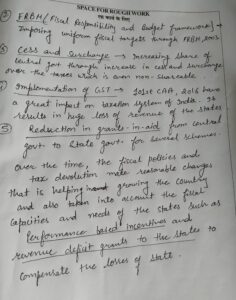

PBBegginer
-

Answer:- The President, the Upper House (Rajya Sabha), and the Lower House (Lok Sabha) make up India's parliament. According to Article 108 of the Constitution, the following circumstances may result in the calling of a joint session of parliament: To break the impasse when a bill is passed by one hRead more
Answer:-
The President, the Upper House (Rajya Sabha), and the Lower House (Lok Sabha) make up India’s parliament.
According to Article 108 of the Constitution, the following circumstances may result in the calling of a joint session of parliament:
- To break the impasse when a bill is passed by one house of parliament and rejected by the other, or
- The bill was received by the other House more than six months ago, but it was not passed because the houses could not agree on the revisions made to it.
The following bills have been approved during combined sittings:
The 1960 Dowry Prohibition Bill.
Bill, 1977: Banking Service Commission (Repeal).
The 2002 Prevention of Terrorism Bill.
Certain Joint Session Exemptions:
Money Bill: Only the Lok Sabha must approve money bills in accordance with the Indian Constitution. The Lok Sabha is open to recommendations from the Rajya Sabha, which it need not take.
Bill for Constitutional Amendment: In accordance with Article 368, both chambers of parliament may change the Indian Constitution with a two-thirds majority. In the event of a dispute between the two houses, a joint session of parliament is not called for.
See less

Vihaan MalhotraBegginer
Examine the key provisions of the Indian Constitution and discuss how they represent the distinct political, social, and historical background of the nation. Emphasize the fundamental ideas that form the basis of the constitutional structure.
-
The Indian Constitution is a comprehensive and detailed document that serves as the supreme law of the land. It reflects India's unique historical, political, and social context through its salient features and key principles. Here’s an analysis of these features and principles: Salient Features ofRead more
The Indian Constitution is a comprehensive and detailed document that serves as the supreme law of the land. It reflects India’s unique historical, political, and social context through its salient features and key principles. Here’s an analysis of these features and principles:
Salient Features of the Indian Constitution
Lengthy and Detailed Document:Extent and Coverage: The Indian Constitution is one of the longest in the world, with 395 articles (now over 450 with amendments), 12 schedules, and numerous appendices. This extensive detailing is to address the complexities of governing a diverse and populous country like India.
Preamble:Vision and Objectives: The Preamble sets out the guiding principles of the Constitution, including justice, liberty, equality, and fraternity. It declares India to be a sovereign, socialist, secular, and democratic republic.
Sovereign, Socialist, Secular, Democratic Republic:Sovereignty: India is an independent nation, free from external control.
Socialism: Reflects the commitment to reducing inequalities and promoting social welfare.
Secularism: Ensures equal respect and treatment of all religions.
Democracy: Ensures a system of government by the people, through regular elections.
Republic: The head of the state (President) is elected, not a hereditary monarch.
Fundamental Rights:Protection of Individual Liberties: Articles 12-35 enumerate Fundamental Rights, including the right to equality, freedom, protection against exploitation, freedom of religion, cultural and educational rights, and the right to constitutional remedies.
Directive Principles of State Policy (DPSP):Social and Economic Democracy: Articles 36-51 outline the goals for the state to achieve social and economic justice, aiming to create a welfare state.
Fundamental Duties:Citizen Responsibilities: Article 51A lists the duties of citizens to promote a spirit of patriotism and uphold the unity of India.
Federal Structure with Unitary Bias:Division of Powers: Division of powers between the Union and States, with a strong central government. During emergencies, the central government can assume greater powers.
Parliamentary System of Government:Executive Accountability: The President is the ceremonial head of state, while the Prime Minister is the head of government. The executive is accountable to the legislature.
Independent Judiciary:Judicial Review: The judiciary can review and invalidate laws and actions of the government that are inconsistent with the Constitution.
Single Citizenship:Unity and Integrity: All citizens of India enjoy a single citizenship, promoting national unity.
Flexible and Rigid:Amendment Process: The Constitution is both rigid and flexible. Some provisions can be amended by a simple majority, while others require a special majority and ratification by at least half of the state legislatures.
Emergency Provisions:Crisis Management: Provisions for declaring a national emergency (Article 352), state emergency (President’s Rule, Article 356), and financial emergency (Article 360) to handle extraordinary situations.
Bicameral Legislature:Two Houses: The Parliament consists of two houses—Lok Sabha (House of the People) and Rajya Sabha (Council of States).
Key Principles Underpinning the Constitutional Framework
Sovereignty:People’s Authority: The Constitution derives its authority from the people of India, as stated in the Preamble.
Social Justice:Equality and Welfare: Emphasizes reducing social and economic inequalities and promoting the welfare of all citizens, especially the marginalized.
Secularism:Religious Neutrality: Ensures that the state does not favor any religion and guarantees freedom of religion to all individuals.
Democracy:Electoral System: Upholds democratic principles through regular, free, and fair elections, ensuring government accountability and representation.
Federalism:Division of Powers: Balances power between the central government and state governments, allowing for regional autonomy within a united framework.
Judicial Independence:Rule of Law: Maintains an independent judiciary to uphold the rule of law and protect the rights of citizens.
Fundamental Rights and Duties:Balanced Rights and Responsibilities: Protects individual freedoms while also outlining the duties of citizens to ensure collective well-being.
Directive Principles:Guidance for Governance: Provides non-justiciable principles to guide the state in policy-making, aiming to achieve social and economic democracy.
Reflecting India’s Unique Context
Historical Legacy:Colonial Experience: The Constitution addresses the issues arising from colonial rule, such as communal divisions and economic disparities, by promoting unity and social justice.
Freedom Struggle: Values and principles from the independence movement, like democracy and secularism, are embedded in the Constitution.
Political Realities:Diverse Population: The detailed provisions and federal structure accommodate India’s linguistic, cultural, and religious diversity.
Leadership Vision: Leaders like Nehru, Ambedkar, and Patel envisioned a democratic and inclusive nation, influencing constitutional design.
Social Structure:Caste and Class Inequities: The Constitution seeks to address deep-rooted social inequalities through affirmative action, Fundamental Rights, and DPSP.
Economic Development:Planned Economy: The socialist orientation and DPSP reflect the focus on planned economic development and reducing poverty and inequality.
See less


Arman KhanBegginer
Examine the Constitution’s embedded federal structure of Indian politics. Examine the procedures for guaranteeing center-state collaboration and coordination as well as the division of authorities between the Union and the states.
-
The federal structure of the Indian polity, as enshrined in the Constitution, establishes a division of powers between the Union (Central) government and the state governments. This structure is characterized by both shared and distinct responsibilities, aiming to maintain unity while respecting regRead more
The federal structure of the Indian polity, as enshrined in the Constitution, establishes a division of powers between the Union (Central) government and the state governments. This structure is characterized by both shared and distinct responsibilities, aiming to maintain unity while respecting regional diversity.
Distribution of Powers
The Constitution delineates the distribution of powers primarily through three lists:Union List (Article 246):
Description: This list contains subjects on which only the Parliament can legislate. It includes defence, foreign affairs, atomic energy, and railways.
Scope: There are 100 subjects in the Union List, which reflect matters of national importance.
State List (Article 246):Description: This list contains subjects on which only the state legislatures can legislate. It includes police, public health, agriculture, and local government.
Scope: There are 61 subjects in the State List, allowing states to govern local matters effectively.
Concurrent List (Article 246):Description: This list contains subjects on which both the Parliament and state legislatures can legislate. It includes education, marriage and divorce, bankruptcy, and social security.
Scope: There are 52 subjects in the Concurrent List. In case of a conflict, the Union law prevails.
Mechanisms for Center-State Cooperation and Coordination
To ensure cooperation and coordination between the Centre and states, the Constitution provides several mechanisms:Inter-State Council (Article 263):
Description: This council facilitates discussions on matters of mutual interest and resolves disputes between states.
Function: It promotes cooperative federalism by enabling states to collaborate with the Centre on various issues.
Finance Commission (Article 280):Description: This body reviews and recommends the distribution of tax revenues between the Centre and states and among the states themselves.
Function: It ensures fiscal federalism and helps maintain a balanced financial relationship.
Zonal Councils:Description: These councils promote cooperation among states in specific regions and address issues related to economic and social planning.
Function: They provide a platform for dialogue and collaboration on regional development.
Legislative Process:Description: Certain laws require the concurrence of state legislatures for enactment, especially in the Concurrent List.
Function: This process ensures that state interests are considered in national legislation.
Emergency Provisions (Articles 352, 356, 360):Description: In times of national emergency, the Centre can assume greater control over states. However, these provisions are meant to be temporary and require parliamentary approval.
Function: They allow for a centralized response during crises while maintaining constitutional checks.
Challenges and Responses
Despite the mechanisms in place, challenges in the federal structure persist:Centralization of Power:
Issue: The increasing centralization, especially after amendments like the 42nd Amendment, has raised concerns about state autonomy.
Response: States have sought judicial intervention and legislative measures to reclaim their powers.
Financial Dependence:Issue: Many states rely heavily on central grants and transfers, leading to fiscal constraints.
Response: The Finance Commission and other reforms aim to create a more equitable financial distribution.
Political Tensions:Issue: Political differences between the ruling party at the Centre and state governments can create friction.
See less
Response: Dialogue through inter-state councils and other platforms is encouraged to address conflicts.
Conclusion
The federal structure of India, as laid out in the Constitution, reflects a careful balance between unity and diversity. The distribution of powers between the Union and the states, coupled with mechanisms for cooperation, aims to promote a harmonious relationship. While challenges remain, ongoing reforms and dialogue continue to strengthen India’s federal framework, ensuring that both levels of government can work together for national progress while respecting state autonomy.

Aditya SharmaBegginer
Examine the Indian Constitution’s use of the parliamentary form of administration. Talk about the differences between this system and a presidential one, as well as the roles and responsibilities of the Prime Minister, the Cabinet, and the Parliament.
-
The parliamentary system of government plays a vital role in the Indian Constitution, shaping the country's governance structure and decision-making processes. It establishes a framework where the executive branch is accountable to the legislature, ensuring a balance of power and promoting democratiRead more
The parliamentary system of government plays a vital role in the Indian Constitution, shaping the country’s governance structure and decision-making processes. It establishes a framework where the executive branch is accountable to the legislature, ensuring a balance of power and promoting democratic principles. Let’s discuss the powers and functions of the Prime Minister, the Cabinet, and the Parliament in the Indian parliamentary system and highlight the key differences with a presidential system.
Prime Minister:
The Prime Minister is the head of government in India and holds significant powers and responsibilities. Some key aspects of the Prime Minister’s role include:
a. Executive Powers: The Prime Minister exercises executive powers and is responsible for the overall administration of the country.
b. Appointment of Ministers: The Prime Minister appoints and allocates portfolios to members of the Council of Ministers, who form the government.
c. Policy Formulation: The Prime Minister plays a crucial role in formulating policies and guiding the government’s agenda.
d. Leader of the Lok Sabha: The Prime Minister leads the government in the Lok Sabha (lower house of Parliament) and represents the executive in Parliament.
Cabinet:
The Cabinet is a collective decision-making body comprising ministers responsible for various government departments. Key functions of the Cabinet include:
a. Policy Decision-Making: The Cabinet deliberates and makes decisions on important policy matters and issues of national importance.
b. Coordination: Cabinet meetings provide a platform for coordination among different ministries and ensure a cohesive approach to governance.
c. Executive Responsibility: Cabinet members are collectively responsible for the actions and policies of the government.
Parliament:
The Parliament is the supreme legislative body in India and consists of two houses: the Lok Sabha (House of the People) and the Rajya Sabha (Council of States). The powers and functions of Parliament include:
a. Legislation: Parliament has the authority to enact laws on various subjects listed in the Union List, Concurrent List, and Residuary Powers.
b. Financial Control: Parliament exercises control over the government’s finances through the approval of the annual budget and oversight of public expenditure.
c. Representation: Parliament represents the diversity of the country and provides a platform for elected representatives to voice the concerns of their constituents.
d. Scrutiny and Oversight: Parliament scrutinizes the government’s actions, policies, and legislation through debates, questions, and committee work, ensuring accountability.
Differences from a Presidential System:
The parliamentary system in India differs from a presidential system in several ways:
a. Executive-Legislative Relationship: In a parliamentary system, the executive (Prime Minister and Cabinet) is accountable to the legislature, while in a presidential system, the executive (President) is separate and independent of the legislature.
b. Separation of Powers: A parliamentary system combines the executive and legislative powers, whereas a presidential system separates these powers.
c. Flexibility: The parliamentary system allows for a more flexible and prompt response to changing circumstances, as the executive can be held accountable through votes of no-confidence or early elections.
d. Direct Election: In a presidential system, the President is directly elected by the people, whereas the Prime Minister in a parliamentary system is elected indirectly through the legislature.Overall, the parliamentary system in India provides a framework for responsible government and shared decision-making between the executive and legislative branches. It promotes accountability, consensus-building, and flexibility in governance, distinguishing it from a presidential system with its separate executive and legislative powers.
See less


Kriti AgarwalBegginer
Examine how the Constitution incorporates the Directive Principles of State Policy. Talk about the reasoning behind these state-mandated non-justiciable rules and how they affect the formulation of public policy.
-
The inclusion of the Directive Principles of State Policy (DPSP) in the Constitution of India was a significant and deliberate move by the framers to guide the policymaking process and the socioeconomic transformation of the country. Rationale Behind the Directive Principles: The framers recognizedRead more
The inclusion of the Directive Principles of State Policy (DPSP) in the Constitution of India was a significant and deliberate move by the framers to guide the policymaking process and the socioeconomic transformation of the country.
Rationale Behind the Directive Principles:
The framers recognized that the immediate realization of all fundamental rights and the establishment of a just social order would not be possible, given the prevailing socioeconomic conditions in India at the time of independence.
The DPSP were conceived as non-justiciable guidelines that would serve as a moral compass for the state, directing it towards the achievement of social, economic, and political justice.
The DPSP were influenced by the Directive Principles enshrined in the Irish Constitution, as well as the socialist and welfare state ideals that were gaining prominence globally in the aftermath of the Great Depression and World War II.
Key Features of the Directive Principles:The DPSP are enumerated in Part IV of the Constitution, comprising articles 36 to 51.
They cover a wide range of issues, such as the provision of adequate means of livelihood, equitable distribution of resources, protection of the environment, promotion of international peace and security, and the welfare of vulnerable sections of society.
Unlike the Fundamental Rights, the DPSP are not enforceable in a court of law, but the state is mandated to apply these principles in policymaking and governance.
Influence on Policymaking:The DPSP have significantly influenced the policymaking process and the trajectory of India’s social and economic development since independence.
Several landmark legislations and government initiatives, such as the Land Acquisition Act, the Minimum Wages Act, the Mahatma Gandhi National Rural Employment Guarantee Act, and the National Food Security Act, have been inspired by the DPSP.
The Supreme Court, in its interpretations, has often used the DPSP to expand the scope of Fundamental Rights and to guide the state’s actions towards the realization of social and economic justice.
The DPSP have also served as a guiding framework for the formulation of Five-Year Plans and other development policies by the Union and state governments.
Challenges and Debates:The non-justiciable nature of the DPSP has been a subject of debate, with some arguing that this undermines their effectiveness in ensuring the state’s accountability towards the achievement of social and economic goals.
See less
There have been demands for the DPSP to be made justiciable or for certain principles to be elevated to the status of Fundamental Rights.
The perceived tension between the DPSP and the Fundamental Rights has also been a source of ongoing judicial and academic discussions.
The Directive Principles of State Policy serve as a unique feature of the Indian Constitution, reflecting the framers’ vision of transforming India into a welfare state. While their non-justiciable nature has been a subject of debate, the DPSP have nonetheless played a significant role in shaping the policymaking process and the socioeconomic development of the country.


Anirudh SinghLearner
Talk about the Indian Constitution’s distinctive qualities, like its length, its balance of rigor and flexibility, and the way it incorporates both written and unwritten traditions.
-
The Indian Constitution is notable for several unique features that reflect its complexity and the diverse nature of the Indian polity. Here’s a discussion of its distinctive characteristics: 1. Length and Detail The Indian Constitution is one of the longest written constitutions in the world. It orRead more
The Indian Constitution is notable for several unique features that reflect its complexity and the diverse nature of the Indian polity. Here’s a discussion of its distinctive characteristics:
1. Length and Detail
The Indian Constitution is one of the longest written constitutions in the world. It originally contained 395 articles divided into 22 parts and 8 schedules. As of now, it has over 470 articles and 12 schedules, reflecting numerous amendments and expansions over time. The length of the Constitution is a result of its detailed and comprehensive nature, aiming to cover a wide range of issues, from fundamental rights and duties to the organization of government institutions and federal relations.2. Rigidity and Flexibility
The Indian Constitution strikes a balance between rigidity and flexibility:Rigidity: Certain provisions of the Constitution require a rigorous amendment process, which involves not only the approval of the Parliament but also, in some cases, the ratification by a majority of state legislatures. This rigidity ensures that fundamental aspects of the Constitution remain stable and less prone to frequent changes. Examples of such provisions include the federal structure and the rights of the states.
Flexibility: On the other hand, many provisions of the Constitution can be amended by a simple majority of the Parliament, or by a special majority without the need for state ratification. This flexibility allows for adaptation and modernization of the Constitution in response to changing social, economic, and political conditions. For instance, amendments related to administrative details or procedural aspects often fall into this category.
3. Written Constitution
The Indian Constitution is a written document, which is in contrast to some other countries like the United Kingdom, which have an unwritten or uncodified constitution. The written nature of the Indian Constitution provides a clear and structured framework for governance and legal interpretation. It sets out the fundamental principles, rights, and procedures explicitly, reducing ambiguity and providing a tangible reference for legal and political matters.4. Incorporation of Both Written and Unwritten Conventions
While the Constitution itself is written, India’s constitutional framework incorporates unwritten conventions and practices that have evolved over time:Written Elements: These include the detailed articles and schedules outlining the structure of government, fundamental rights, directive principles, and the process of amendments.
Unwritten Conventions: These are practices and traditions that have developed over time but are not explicitly mentioned in the Constitution. For example:
The Role of the Prime Minister: Although the Constitution provides for a parliamentary system, the specific powers and functions of the Prime Minister have evolved through conventions.
Judicial Review: The principle of judicial review, although not explicitly mentioned in the Constitution, is a well-established practice in India, developed through judicial interpretation.
Governor’s Role: The role of the Governor in the states, particularly in terms of discretion and intervention, is guided by conventions and practices rather than explicit constitutional provisions.
5. Federal Structure with Unitary Bias
The Indian Constitution establishes a federal structure of government, with a division of powers between the central and state governments. However, it has a unitary bias, meaning that in times of emergency, the central government can assume greater powers, and the Union can override state laws. This design is intended to maintain national unity and integrity while also providing a degree of autonomy to states.6. Fundamental Rights and Directive Principles
The Constitution includes a detailed set of Fundamental Rights, which are justiciable and enforceable in courts, ensuring protection against arbitrary actions by the state. It also incorporates Directive Principles of State Policy, which, although not justiciable, serve as guiding principles for the creation of laws and policies aimed at promoting social and economic welfare.In summary, the Indian Constitution is a complex and dynamic document that combines detailed written provisions with flexible mechanisms for adaptation. Its blend of rigidity and flexibility, along with the incorporation of both written and unwritten conventions, reflects its role in addressing the diverse needs of a large and pluralistic democracy like India.
See less


Ronak LalBegginer
Examine how the Indian model of secularism—which differs from the concept of secularism in the West—was shaped by the Constitution. Examine the arguments and difficulties related to putting this philosophy into practice.
-
The Constitution of India plays a crucial role in shaping the Indian model of secularism, which is distinct from the Western notion of secularism. The Indian Constitution guarantees religious freedom to all its citizens and ensures the state does not discriminate against any individual or communityRead more
The Constitution of India plays a crucial role in shaping the Indian model of secularism, which is distinct from the Western notion of secularism. The Indian Constitution guarantees religious freedom to all its citizens and ensures the state does not discriminate against any individual or community on the basis of religion. This idea of secularism in India is often referred to as “principled distance” – where the state maintains equal distance from all religions and treats all citizens equally regardless of their religious beliefs.
One of the key aspects of the Indian model of secularism is the idea of “positive secularism,” which involves the state actively promoting religious harmony and understanding among different communities. This is reflected in the Constitution through provisions like Article 25, which guarantees individuals the right to freely profess, practice, and propagate their religion. Additionally, the state is mandated to intervene in religious matters to ensure social reform and equality among citizens.
However, the implementation of secularism in India has been a subject of debate and challenge. One of the major challenges is the issue of religious identity politics, where politicians and political parties use religious rhetoric to mobilize voters along religious lines. This has led to communal tensions and conflicts in the country, undermining the principles of secularism.
Another challenge is the issue of state intervention in religious matters, where the government’s policies and actions have sometimes been seen as favoring or discriminating against certain religious groups. This has led to accusations of appeasement and bias, further complicating the implementation of secularism in India.
Furthermore, the rise of religious fundamentalism and extremism poses a threat to the secular fabric of Indian society. Instances of communal violence and religious discrimination have highlighted the need for a more robust implementation of secularism to protect the rights and freedoms of all citizens.
In conclusion, the Indian model of secularism, as enshrined in the Constitution, is distinct from the Western notion of secularism and places a strong emphasis on religious harmony and equality among citizens. However, challenges and debates surrounding its implementation persist, requiring continuous efforts to uphold the principles of secularism and ensure religious freedom for all.
See less

Answer: In India, Sedition has been defined in Section 124A of the Indian Penal Code as an offense committed when any person brings/attempts to bring into hatred or contempt, or excites/attempts to excite disaffection towards the government established by law through their words (spoken or written),Read more
Answer: In India, Sedition has been defined in Section 124A of the Indian Penal Code as an offense committed when any person brings/attempts to bring into hatred or contempt, or excites/attempts to excite disaffection towards the government established by law through their words (spoken or written), or signs or by visible representation or otherwise. It is a non-bailable offense and can be punished with an imprisonment up to a life term. The passport of the person charged under the law is seized and the person is barred from government jobs until proven innocent. This law was drafted by Macaulay in 1837 and was inserted in IPC in 1870. Leaders like Bal Gangadhar Tilak and Gandhiji had been tried under sedition. This law has been an object of intense debate since independence. Arguments against the Sedition Law:
Arguments in favour of the Sedition Law:
A democracy requires citizens to actively participate in debates and express their constructive criticisms of government policies. Therefore, the Sedition law should be used only in rare cases. In this context, the Law Commission (2018 report) has rightly recommended that Section 124A should either be repealed or should be invoked only if there is an intention to disrupt public order or overthrow the State with violence and illegal means.
See less