

Draw attention to the key components of the Goods and Services Tax. Give a summary of its successes since implementation as well as the difficulties it continues to confront. (Answer in 200 words)


The Fiscal Responsibility and Budget Management Act, 2003 (FRBMA):- This act aims to bring the discipline in the government's finance, reduce fiscal deficit, and improve macroeconomic management (improve the management of funds with public) The Objectives of the (FRBMA) ACT,2003 are as follows : ItRead more
The Fiscal Responsibility and Budget Management Act, 2003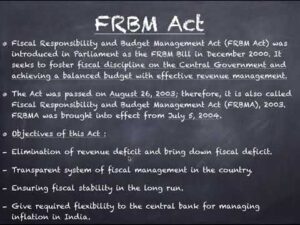 (FRBMA):-
This act aims to bring the discipline in the government’s finance, reduce fiscal deficit, and improve macroeconomic management (improve the management of funds with public)
The Objectives of the (FRBMA) ACT,2003 are as follows :
- It reduces the Fiscal deficit: It sets targets to gradually bring down the government budget deficit. This aims for the more balanced budget.
- It eliminates a Revenue Deficit: This Act also targets on the elimination of the revenue deficit, where government spending exceeds its income. This act ensures that the Government should not rely on the borrowings to meets its expenses.
- It enhances the fiscal transparency: This act Promotes the transparency among the public by disclosing their fiscal targets and achievements. This enhances the public trust.
- It ensures debt sustainability: This Act, enables the limit on the total liabilities as a percentage of GDP (Gross Domestic Product) for the government. This act secures the upcoming generations from the excessive burden of the debt.
- It promotes macroeconomic stability: By achieving the above objectives, this act fosters to create more stable and growing economy of a country.
Functions of (FRBMA) ACT, 2003 are as follows :
- Reduce Fiscal Deficit: This act lay out specific targets for reducing Fiscal and Revenue deficit over a medium-term period. The targets are reviewed and examined periodically.
- Medium-Term Fiscal Policy statement: The government is obligated to present a medium-term fiscal policy statements which outlines it’s fiscal strategy and future projections.
- Escape cause: It sometimes allows the deviations from the targets only during the exceptional cases like natural disasters or economy downfall.
- fiscal council: An independent Fiscal Council es initially formed by this act to monitor the government’s loyalty to the targets formed by FRBMA (Fiscal Responsibility and Budget management Act.)
I am enclosing an image which describes this matter in a more significant manner and the language used is too easy to understand.
See less


Goods and Services Tax (GST) is an indirect tax that came into effect on 1st July 2017 by replacing many indirect taxes in India such as the excise duty, VAT, services tax, etc. Goods and Service Tax (GST) is levied on the supply of goods and services and is a destination-based tax that is levied onRead more
Goods and Services Tax (GST) is an indirect tax that came into effect on 1st July 2017 by replacing many indirect taxes in India such as the excise duty, VAT, services tax, etc. Goods and Service Tax (GST) is levied on the supply of goods and services and is a destination-based tax that is levied on every value addition.
Salient features of the Goods and Services Tax:
Since its implementation in 2017, the GST has achieved the following milestones:
However, several challenges still need to be addressed, such as:
While the government has worked to solve many issues, considerable intervention is still required to bring GST to its full efficiency. The proposal to have a single return will simplify compliance and do away with matching requirements. Such a step will bring out the true sense of ‘One Nation, One Tax’.
See less