

Roadmap for Answer Writing Introduction Contextualize the importance of ocean temperatures in understanding global climate, marine ecosystems, and weather patterns. Briefly define ocean temperature: Ocean temperature refers to the measure of the heat content in the ocean, which varies across different regions and ...


Introduction Oceanography is the scientific study of the oceans, encompassing their physical, chemical, biological, and geological properties. Its role in understanding climate change and sea level rise is crucial, as the oceans are significant regulators of the Earth’s climate system and vital indiRead more
Introduction
Oceanography is the scientific study of the oceans, encompassing their physical, chemical, biological, and geological properties. Its role in understanding climate change and sea level rise is crucial, as the oceans are significant regulators of the Earth’s climate system and vital indicators of environmental changes.
Understanding Climate Change through Oceanography
- Carbon Sink Function: Oceans absorb approximately 30% of the carbon dioxide emitted by human activities, acting as a significant carbon sink. Oceanographers study how this process affects ocean chemistry and the implications for marine life and global warming. For instance, the increasing acidification of ocean waters, as noted in recent reports from NOAA, has detrimental effects on coral reefs and shellfish.
- Heat Distribution: The ocean plays a vital role in heat distribution around the planet. Ocean currents, such as the Gulf Stream, transport warm water from the tropics to higher latitudes, influencing weather patterns. Studies indicate that changes in these currents, exacerbated by climate change, can lead to altered weather patterns, as seen in the recent heatwaves in Europe attributed to shifts in oceanic heat distribution.
- Monitoring Temperature Changes: Oceanographers use satellite technology and buoys to monitor sea surface temperatures and heat content. Recent findings show that the Pacific Ocean has absorbed an unprecedented amount of heat, contributing to climate extremes worldwide.
Sea Level Rise and Oceanography
- Melting Ice Caps and Glaciers: Oceanography provides crucial data on the contributions of melting ice sheets and glaciers to sea level rise. Research indicates that the Greenland and Antarctic ice sheets are losing ice at alarming rates. The 2023 IPCC report highlighted that the Antarctic ice loss has increased dramatically, contributing significantly to rising sea levels.
- Thermal Expansion: As oceans warm, water expands, leading to thermal expansion as a contributor to sea level rise. Oceanographers study temperature profiles in the ocean to quantify this effect. Recent data show that thermal expansion accounted for about half of the observed sea level rise over the past century.
- Coastal Monitoring: Oceanographic studies are essential for monitoring coastal areas vulnerable to rising sea levels. For instance, ongoing research in the Bay of Bengal region indicates that rising sea levels pose significant risks to coastal communities in India and Bangladesh, highlighting the need for effective adaptation strategies.
Recent Examples of Oceanographic Research
- Global Ocean Observing System (GOOS): This initiative integrates oceanographic data worldwide, facilitating real-time monitoring of climate change effects. The 2023 Global Ocean Report emphasizes the importance of continuous data collection for predicting future climate scenarios and sea level trends.
- The Ocean Cleanup Project: This recent initiative aims to remove plastic from the oceans while studying the impact of ocean currents on waste distribution. The project provides valuable insights into how marine ecosystems are affected by climate change.
- Research on Coral Reefs: Studies conducted on the Great Barrier Reef have revealed how increased sea temperatures and acidification affect coral health. Recent coral bleaching events highlight the urgent need for oceanographic research to inform conservation efforts.
Conclusion
Oceanography is pivotal in understanding the complex dynamics of climate change and sea level rise. Through the study of ocean processes, researchers can provide critical insights into mitigating the impacts of climate change and developing adaptive strategies for vulnerable coastal communities. As ocean conditions continue to evolve, ongoing research and monitoring are essential to safeguard marine ecosystems and human populations alike.
See less

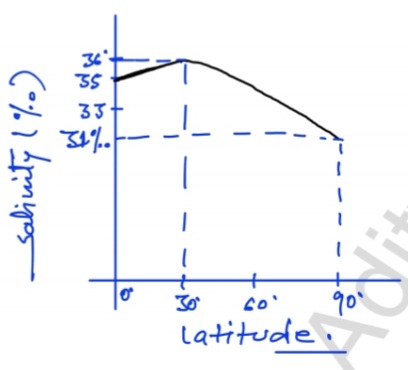


Model Answer Factors Influencing Ocean Temperature Ocean temperature is influenced by several key factors: Latitude: Temperature decreases from the equator to the poles due to decreasing solar radiation (Source: Oceanographic Studies). Unequal Distribution of Land and Water: Oceans in the Northern HRead more
Model Answer
Factors Influencing Ocean Temperature
Ocean temperature is influenced by several key factors:
Horizontal Distribution of Temperature
Surface ocean temperatures are highest near the equator, averaging around 27°C, and decrease towards the poles at about 0.5°C per latitude. The temperature is higher in the Northern Hemisphere (around 19°C) compared to the Southern Hemisphere (around 16°C) due to unequal land-water distribution (Source: Climatological Studies).
Vertical Distribution of Temperature
- First Layer (0-500m): Warm surface water, ranging from 20°C to 25°C, is present in tropical and subtropical regions.
- Second Layer (300m-1000m): The thermocline shows a rapid temperature drop.
- Third Layer (below 1000m): Cold, dense water, typically near 4°C, dominates the deep ocean (Source: Ocean Temperature Profiles).
See less