

What effects do ocean currents have on the distribution of marine resources around the world?

Model Answer Introduction Ocean currents are continuous streams of water that flow in specific directions, influencing marine ecosystems significantly. In contrast, water masses are distinct bodies of water characterized by consistent temperature, salinity, and density. Understanding their differencRead more
Model Answer
Introduction
Ocean currents are continuous streams of water that flow in specific directions, influencing marine ecosystems significantly. In contrast, water masses are distinct bodies of water characterized by consistent temperature, salinity, and density. Understanding their differences is crucial for grasping their impacts on marine life and coastal environments.
Impact of Ocean Currents on Marine Life
Nutrient Distribution
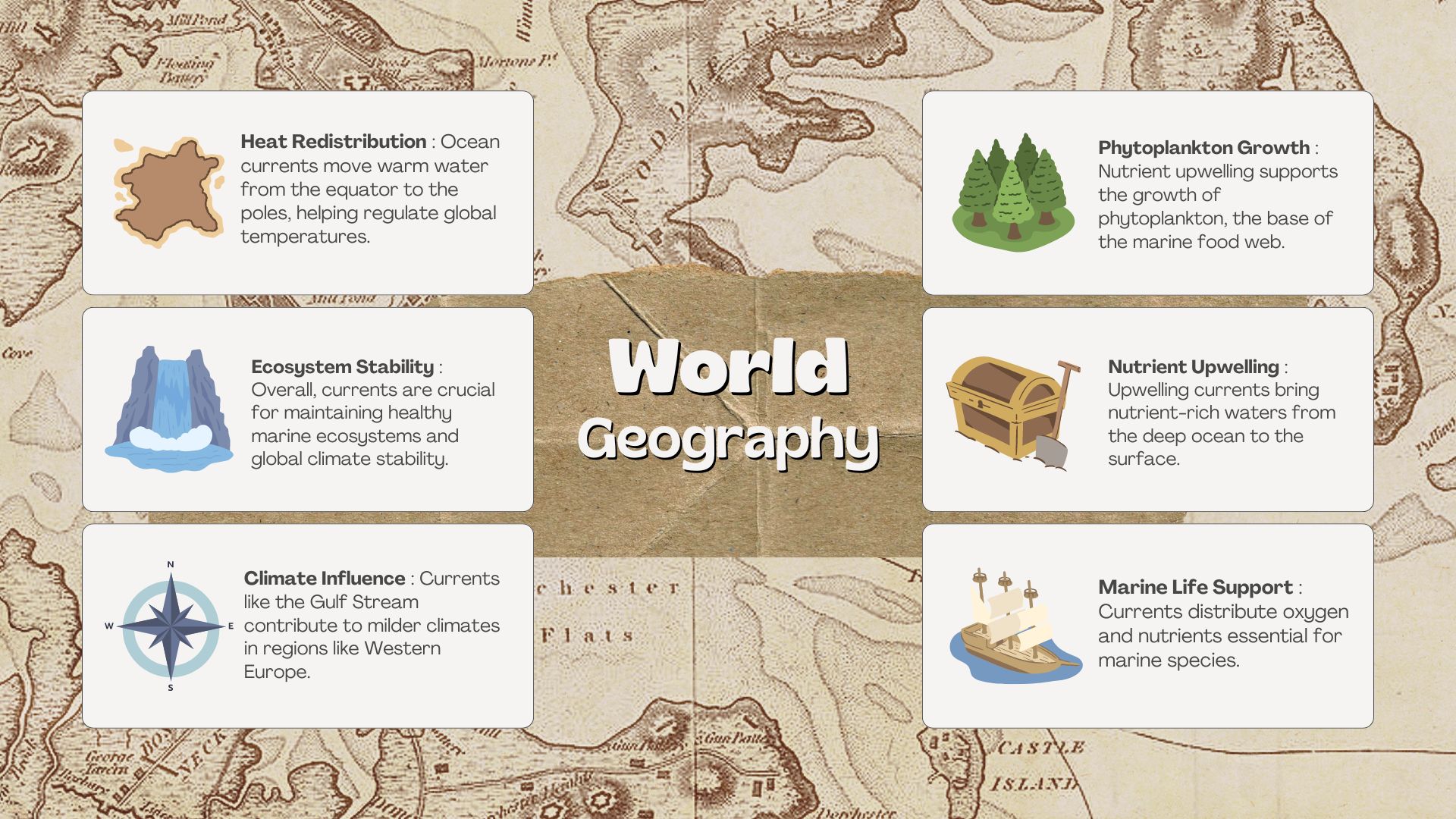
Ocean currents play a vital role in transporting nutrients across vast distances, which supports the marine food chain. For instance, the Gulf Stream carries warm water from the Gulf of Mexico to the North Atlantic, facilitating nutrient distribution that benefits phytoplankton populations.
Migration Patterns
Marine species, such as leatherback sea turtles, follow ocean currents during migrations from nesting beaches in the Caribbean to feeding grounds in the North Atlantic. These currents provide navigational pathways essential for their survival.
Biodiversity
The convergence of different ocean currents can create regions of high biodiversity. Areas where warm and cold currents mix are nutrient-rich, supporting diverse marine life.
Impact of Water Masses on Marine Life and Coastal Environment
Downwelling and Upwelling
Water mass movements, such as downwelling, can lead to oxygen depletion in deep waters, creating “dead zones” where marine life struggles to survive. Conversely, upwelling brings nutrient-rich waters to the surface, stimulating phytoplankton growth, which supports a wide range of marine species.
Coastal Erosion and Beach Nourishment
Strong ocean currents can cause coastal erosion, as seen along California’s Big Sur, where currents have worn away beaches and cliffs (Source: Coastal Studies). However, these currents can also deposit sediment, providing natural beach nourishment.
Pollution Transport
Ocean currents can transport pollutants, including oil spills and plastic debris, to coastal areas, posing threats to marine life and human health.
Conclusion
Both ocean currents and water masses significantly influence marine life and coastal environments. Currents affect nutrient distribution and migration, while water masses impact oxygen levels and biodiversity. Understanding these dynamics is essential for marine conservation efforts.
See less





An ocean current is a continuous, directed movement of seawater in the ocean, driven by various forces such as wind, temperature, salinity, and the Earth's rotation. Examples of ocean currents include the Peruvian current, Labrador current, and Falkland current. These currents play a crucial role inRead more
An ocean current is a continuous, directed movement of seawater in the ocean, driven by various forces such as wind, temperature, salinity, and the Earth’s rotation. Examples of ocean currents include the Peruvian current, Labrador current, and Falkland current. These currents play a crucial role in concentrating and dispersing various marine resources—valuable materials and assets derived from the world’s oceans and seas—leading to the differential distribution of marine resources worldwide.
Influence of Ocean Currents on the Worldwide Distribution of Marine Resources:
Ocean currents, driven by various natural forces, shape the distribution of valuable marine assets in several ways. Recognizing their profound influence is essential for preserving and responsibly managing these invaluable marine resources on a global scale, ensuring both ecological balance and sustainable utilization as we explore and harness the riches of our oceans.
See less