


Improving access to quality education for students in rural and underprivileged areas in India requires a multifaceted approach. First, enhancing infrastructure is crucial; this includes building well-equipped schools, providing reliable electricity, and ensuring internet connectivity. Mobile learniRead more
Mains Answer Writing Latest Questions

How can u explain that education outside the India is much better in skills and getting job as compare to education delivered to student in school and colleges of India ?
-
The educational structure and provision of education in India is broad based and structured towards meeting the needs of its numerous populace. It is basically composed of three levels: primary, secondary and higher education. Many different national and local authorities oversee the education systeRead more
The educational structure and provision of education in India is broad based and structured towards meeting the needs of its numerous populace. It is basically composed of three levels: primary, secondary and higher education. Many different national and local authorities oversee the education system, leading to diversity in content and policies.
When it comes to basic education, a child must enrol for five years of primary education, and on to an additional five years for secondary education. This National Council of Educational Research and Training (NCERT) is also involved in policy making processes within the country and in developing curricula for implementation. In all the three levels, higher education refers to all faculties, colleges and technical institutions with degrees in other respective areas.
Nonetheless positive developments have been witnessed, such as; high drop-out rate, gauged ration in rural areas and emphasis of education on rote memory rather than formulated ideas remains a constant concern. Recent reforms address all aspects, including quality improvement, the role of information technology and emphasizing skills. The National Education Policy (NEP) 2020 is a step towards restructuring the Indian education system in a more fluid, comprehensive manner, whereby education will span across areas rather than on one single line.
On the whole, enhancements with respect to enrollment and literacy levels and the still changing Indian education remain positive factors worth comments.
See less


How can education systems support lifelong learning in a rapidly changing world?
-
Education systems can support lifelong learning in a rapidly changing world by fostering a mindset of curiosity, adaptability, and continuous skill development. Firstly, schools and universities can emphasize not just rote learning but critical thinking, problem-solving, and creativity—skills that aRead more
Education systems can support lifelong learning in a rapidly changing world by fostering a mindset of curiosity, adaptability, and continuous skill development. Firstly, schools and universities can emphasize not just rote learning but critical thinking, problem-solving, and creativity—skills that are essential regardless of technological advances. This approach prepares individuals to embrace new challenges and opportunities throughout their lives.
Secondly, flexible learning pathways and digital platforms can be integrated into education systems. These enable learners to access knowledge anytime, anywhere, catering to diverse learning styles and schedules. By offering courses and resources online, institutions can reach a broader audience and facilitate learning beyond traditional classroom settings.
Thirdly, partnerships between educational institutions, industries, and communities can provide real-world experiences and mentorship. This practical exposure helps learners apply theoretical knowledge, stay updated with industry trends, and develop relevant skills for current and future job markets.
Lastly, promoting a culture of lifelong learning requires continuous support and encouragement from policymakers, educators, and employers. Recognizing and rewarding skills acquired throughout one’s career encourages individuals to invest in their ongoing development, ensuring they remain competitive and fulfilled in a rapidly evolving world. Thus, education systems play a crucial role in empowering individuals to thrive amidst change, fostering a dynamic and resilient society.
See less


shivamxLearner
-
The concept of Foundational Literacy and Numeracy (FLN) forms the bedrock of a child’s learning journey. FLN emphasizes the importance of making sure that children develop fundamental literacy (reading and writing) and numeracy (mathematics) skills in the early years of their education. These fundamRead more
The concept of Foundational Literacy and Numeracy (FLN) forms the bedrock of a child’s learning journey. FLN emphasizes the importance of making sure that children develop fundamental literacy (reading and writing) and numeracy (mathematics) skills in the early years of their education. These fundamental abilities are considered to be highly essential since they ensure the overall cognitive growth of a child and serve as a foundation for the advanced levels of learning in the following years.Foundational Literacy and Numeracy (FLN) is considered crucial because it sets the stage for a Child’s ability to access further education. These children can then participate effectively in the workforce, and engage in civic life efficiently when they grow up.
The draft NEP calls for achieving foundational skills -reading, writing and arithmetic – for all children in primary school, and beyond by 2025, to become a national mission. It also talks about institutionalising a robust system of assessment to help teachers evaluate the progress of each student, and identify where each student is on the learning ladder. Without foundational learning, the draft NEP adds, the country could lose over 10 crore students from the learning system and to illiteracy. India’s school education system is the largest in the world, with over 260 million children studying in close to 1.5 million schools.
The Importance of Foundational Literacy and Numeracy
-Addressing the Learning Gap
One of the primary reasons foundational literacy and numeracy are so crucial in rural India is the substantial learning gap among students. Many children enter primary school needing more basic literacy, numeracy, and reading skills. This gap widens as they progress through the education system, making it increasingly arduous to catch up with their peers.
-Empowering Students for Future Success
Robust foundational literacy and numeracy skills empower students to excel academically and navigate real-life situations confidently. In rural areas where agricultural activities are prevalent, numeracy skills are essential for land measurement, yield calculation, and financial management.
-Unlocking Opportunities for Growth
Investing in foundational learning and numeracy in rural areas is a matter of social responsibility and an economic imperative. A well-educated workforce propels innovation, entrepreneurship, and economic growth. By ensuring children in rural communities receive quality education, we unlock their potential and create opportunities for socio-economic advancement.
See less


Khushboo MorkarBegginer
-
There are several potential downsides to relying too heavily on technology in the classroom: Distraction and Reduced Focus: Easy access to the internet, social media, and various digital devices can easily distract students, leading to reduced attention and focus during lessons. The constant temptatRead more
There are several potential downsides to relying too heavily on technology in the classroom:
- Distraction and Reduced Focus:
- Easy access to the internet, social media, and various digital devices can easily distract students, leading to reduced attention and focus during lessons.
- The constant temptation to multitask or engage with non-educational content can undermine students’ ability to engage deeply with the material.
- Lack of Hands-on, Tactile Learning:
- Over-reliance on digital tools and screens can diminish opportunities for hands-on, physical learning experiences that are crucial for certain subjects and age groups.
- Manipulating physical objects, engaging in hands-on experiments, and using traditional learning materials can be important for developing certain cognitive and motor skills.
- Limited Social Interaction and Collaboration:
- Technology-driven classrooms can reduce face-to-face interaction, collaboration, and social skills development among students.
- The lack of in-person discussions, group work, and peer-to-peer learning can hinder the development of important social and communication abilities.
- Equity and Access Issues:
- Reliance on technology can create or exacerbate inequalities if some students do not have access to the necessary devices or reliable internet connectivity at home.
- This can disadvantage students from lower-income or underserved backgrounds, further widening the digital divide.
- Dependence and Loss of Traditional Skills:
- Heavy reliance on technology can lead to a loss of traditional skills, such as handwriting, critical thinking, and problem-solving without the aid of digital tools.
- This can result in a generation that is overly dependent on technology and lacks essential skills for when digital tools are unavailable.
- Privacy and Security Concerns:
- Increased use of digital platforms and storage of student data can raise privacy concerns and increase vulnerability to data breaches or misuse.
- Ensuring the proper safeguards and data management practices is crucial when incorporating technology in the classroom.
- Distraction and Reduced Focus:


Akarsh SrivastavaBegginer
How does educational policy differ across various countries, and what can be learned from different approaches?
-
Educational policies vary significantly across countries due to diverse cultural, social, economic, and political contexts. For instance, countries like Finland prioritize equitable access to high-quality education with minimal standardized testing, focusing on holistic student development and teachRead more
Educational policies vary significantly across countries due to diverse cultural, social, economic, and political contexts. For instance, countries like Finland prioritize equitable access to high-quality education with minimal standardized testing, focusing on holistic student development and teacher professionalism. In contrast, education systems in East Asian countries such as South Korea and Japan emphasize rigorous academic standards and extensive testing to drive achievement.
Different approaches to educational policy offer valuable lessons for improving outcomes globally. Finland’s emphasis on teacher autonomy and comprehensive support for students’ well-being underscores the importance of fostering a supportive learning environment. Meanwhile, East Asian models highlight the benefits of rigorous academic standards and systematic evaluation in driving educational excellence.
Cross-country comparisons also reveal the importance of tailoring educational policies to local needs while promoting innovation and inclusivity. Embracing diversity in educational strategies and integrating successful elements from different systems can inform policies that better prepare students for future challenges in a globalized world.
See less


How can we make better education system?
-
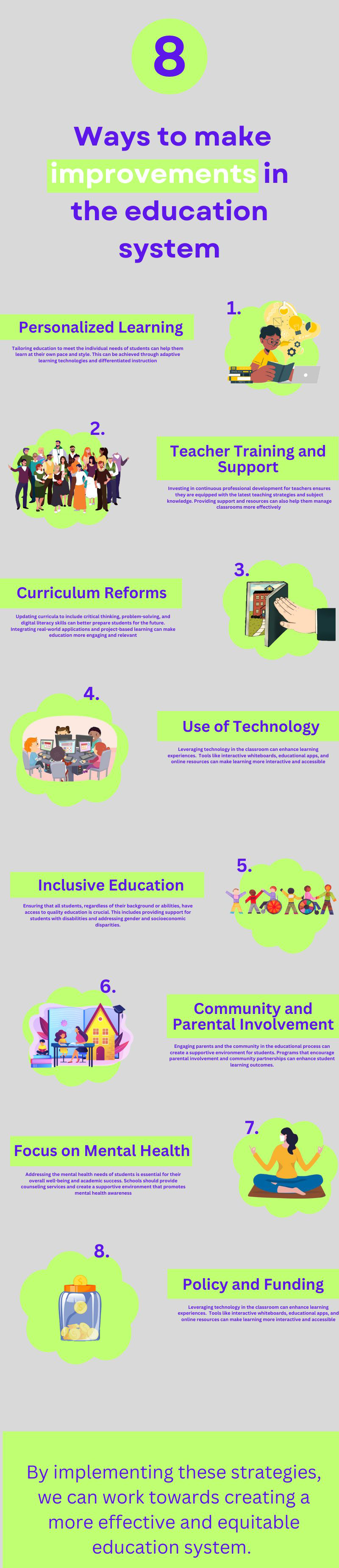
By implementing these strategies, we can work towards creating a more effective and equitable education system. Hope this infographic visualization helps understanding this stopic better! Thanks.
By implementing these strategies, we can work towards creating a more effective and equitable education system.
See less
Hope this infographic visualization helps understanding this stopic better! Thanks.


Koushani ChakrabortyBegginer
What are the necessary changes that are needed in every government schools across India?
-
Improving government schools across India requires several key changes to enhance educational quality and equity: 1. **Infrastructure Upgrades**: Many government schools suffer from inadequate facilities. Upgrading infrastructure, including classrooms, libraries, laboratories, and sanitation facilitRead more
Improving government schools across India requires several key changes to enhance educational quality and equity:
1. **Infrastructure Upgrades**: Many government schools suffer from inadequate facilities. Upgrading infrastructure, including classrooms, libraries, laboratories, and sanitation facilities, is crucial for creating a conducive learning environment.
2. **Teacher Training and Recruitment**: Investing in continuous professional development for teachers and ensuring the recruitment of qualified educators can improve teaching quality. Regular training on new pedagogical methods and subject knowledge is essential.
3. **Curriculum and Pedagogy**: Revising curricula to include contemporary and relevant subjects, and adopting modern teaching methodologies can make education more engaging and effective. Incorporating practical skills and critical thinking into the curriculum is also important.
4. **Technology Integration**: Equipping schools with technology and integrating digital tools into teaching can enhance learning experiences. Providing access to computers, tablets, and the internet can bridge the digital divide.
5. **Student Support Services**: Establishing counseling services, special education resources, and extracurricular programs can support diverse student needs and promote holistic development.
6. **Community Involvement**: Engaging parents and local communities in school management and decision-making can foster a supportive educational environment and enhance accountability.
7. **Health and Nutrition**: Implementing programs to ensure students receive adequate nutrition and healthcare is vital for their overall well-being and academic performance.
These changes aim to address systemic issues, improve educational outcomes, and ensure equitable access to quality education across government schools in India.
See less

Technology act like a catalyst in process of education.It made education accessible to remote areas, breaking geographical barriers. Online courses, webinars, and digital libraries have democratized learning, allowing anyone with internet access to acquire new skills and knowledge. It has personalizRead more
Technology act like a catalyst in process of education.It made education accessible to remote areas, breaking geographical barriers. Online courses, webinars, and digital libraries have democratized learning, allowing anyone with internet access to acquire new skills and knowledge.
It has personalized learning experiences, adapting to individual learning styles and paces. Virtual reality technologies have made learning more interactive and engaging.
Technology has also transformed skill development.Open and distance learning also played a supporting role with technology . This made Online certification courses, coding bootcamps, and MOOCs have made it easier for individuals to acquire industry-relevant skills. Digital portfolios, quizzes and online assessments have made skill validation more transparent and efficient.
In nutshell technology has not only made education and skill development more democratized but has also made it more inclusive and personalized.
See less