

Examine the ways in which the National Geospatial Policy’s institutional architecture will improve India’s geospatial infrastructure. (Answer in 250 words)

Aditya-L1 is a significant advancement over its predecessor, Aditya-1. Here’s how they differ and the scientific objectives of Aditya-L1: Differences Between Aditya-L1 and Aditya-1: Mission Scope and Payloads: Aditya-1: Originally planned to be a dedicated mission to study the solar corona, Aditya-1Read more
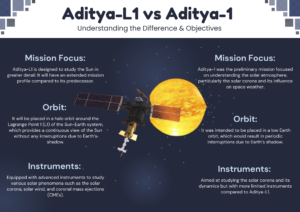
Aditya-L1 is a significant advancement over its predecessor, Aditya-1. Here’s how they differ and the scientific objectives of Aditya-L1:
Differences Between Aditya-L1 and Aditya-1:
- Mission Scope and Payloads:
- Aditya-1: Originally planned to be a dedicated mission to study the solar corona, Aditya-1 was designed with a single payload—the Visible Emission Line Coronagraph (VELC). Its primary focus was to capture images of the solar corona and study its dynamics.
- Aditya-L1: Aditya-L1 is an extended and enhanced version of the original mission. It carries multiple payloads to study various aspects of the Sun. While it still includes the VELC, it also incorporates other instruments to observe the solar atmosphere, solar wind, and the impact of solar activity on the Earth’s environment.
- Orbital Position:
- Aditya-1: Planned to be in a low-Earth orbit.
- Aditya-L1: Will be placed in a Lagrange Point 1 (L1) orbit, which is a stable point between the Earth and the Sun. This location provides a continuous view of the Sun without any interference from the Earth or Moon.
- Mission Duration and Coverage:
- Aditya-1: Designed for a limited mission duration and scope.
- Aditya-L1: Aims for a longer mission duration with comprehensive coverage of various solar phenomena due to its strategic position at L1.
Scientific Objectives of Aditya-L1:
- Study of the Solar Corona: To observe the outermost layer of the Sun’s atmosphere and understand its heating mechanisms, solar wind acceleration, and coronal mass ejections.
- Solar Activity and Space Weather: To investigate solar activities such as solar flares and their impact on space weather, including geomagnetic storms and their effects on Earth’s magnetosphere.
- Dynamics of the Solar Atmosphere: To analyze the solar atmosphere’s dynamics and the interactions between different layers, including the photosphere, chromosphere, and corona.
- Solar Wind Studies: To measure the properties of the solar wind and its influence on the Earth’s space environment.
- Connection Between Solar Activity and Geomagnetic Effects: To explore the link between solar phenomena and their effects on the Earth’s magnetic field and ionosphere.
Overall, Aditya-L1 aims to provide a holistic understanding of solar activities and their influence on space weather, which is crucial for predicting space weather events and their potential impact on technological systems and daily life on Earth.
See less


The Ministry of Science and Technology has notified a citizen-centric National Geospatial Policy (NGP) 2022 that seeks to strengthen the geospatial sector to support national development, economic prosperity, and a thriving information economy. It spells out the vision, and goals for the geospatialRead more
The Ministry of Science and Technology has notified a citizen-centric National Geospatial Policy (NGP) 2022 that seeks to strengthen the geospatial sector to support national development, economic prosperity, and a thriving information economy. It spells out the vision, and goals for the geospatial sector and outlines the strategies for achieving them. It aims to make geospatial technology and data as agents of transformation for achieving the SDGs. The policy proposes the following institutional framework to achieve the aforementioned objectives:
This policy would strengthen the geospatial infrastructure in the following manner:
Geospatial data is now widely accepted as a critical national infrastructure and information resource with proven societal, economic and environmental value. This Policy is the right step forward in the direction of achieving these goals.
See less