
IT & Computers
Share
Lost your password? Please enter your email address. You will receive a link and will create a new password via email.
Please briefly explain why you feel this question should be reported.
Please briefly explain why you feel this answer should be reported.
Please briefly explain why you feel this user should be reported.
What is the Boyer-Moore algorithm, and how does it optimize pattern matching?
The Boyer-Moore algorithm is an efficient string-searching algorithm for finding a substring (pattern) within a main string (text). Developed by Robert S. Boyer and J Strother Moore in 1977, it optimizes pattern matching by utilizing two key heuristics: the Bad Character Rule and the Good Suffix RulRead more
The Boyer-Moore algorithm is an efficient string-searching algorithm for finding a substring (pattern) within a main string (text). Developed by Robert S. Boyer and J Strother Moore in 1977, it optimizes pattern matching by utilizing two key heuristics: the Bad Character Rule and the Good Suffix Rule.
**Bad Character Rule**: When a mismatch occurs, the algorithm shifts the pattern to align the bad character in the text with its last occurrence in the pattern. If the bad character is not in the pattern, the pattern is shifted past the bad character.
**Good Suffix Rule**: Upon a mismatch, this rule shifts the pattern to align the longest suffix of the matched portion with another occurrence of this suffix within the pattern. If no such suffix exists, the pattern is shifted entirely past the mismatched character.
The algorithm starts comparing from the end of the pattern, allowing it to skip large sections of text, especially when mismatches are frequent. Preprocessing the pattern to create bad character and good suffix tables helps determine optimal shifts during the search, reducing the number of comparisons.
For example, searching for “NEEDLE” in “FINDINAHAYSTACKNEEDLEINA” involves comparing from the end of “NEEDLE”, using the heuristics to shift the pattern efficiently, leading to faster pattern matching compared to checking each character sequentially.
See lessExplain the concept of amortized analysis and provide an example of its application?
Amortized analysis is a technique in computer science for evaluating the average time complexity of an algorithm over a sequence of operations, rather than per operation. This method provides a realistic measure of performance by spreading the cost of expensive operations over many cheaper ones, ensRead more
Amortized analysis is a technique in computer science for evaluating the average time complexity of an algorithm over a sequence of operations, rather than per operation. This method provides a realistic measure of performance by spreading the cost of expensive operations over many cheaper ones, ensuring smoother overall performance.
A common example is dynamic array resizing. When an array becomes full, it doubles in size, requiring all elements to be copied to the new array, which is costly. However, most insertions are quick and simple.
If we insert \( n \) elements, resizing happens infrequently, making most insertions \( O(1) \). When resizing occurs, its complexity is \( O(n) \). By analyzing the total cost over all insertions, the average time per insertion is \( O(1) \) because the expensive operations are rare.
Thus, amortized analysis shows that while some operations are costly, their infrequency balances out, providing a clearer view of the algorithm’s overall efficiency.
See lessHow do you approach solving a new problem using AI
Approaching a new problem using AI involves several key steps: Understand the Problem: Clearly define the problem you're trying to solve. Identify the goals, constraints, and requirements. This helps in selecting the right AI techniques and tools. Data Collection: Gather relevant data, as AI modelsRead more
Approaching a new problem using AI involves several key steps:
- Understand the Problem: Clearly define the problem you’re trying to solve. Identify the goals, constraints, and requirements. This helps in selecting the right AI techniques and tools.
- Data Collection: Gather relevant data, as AI models rely heavily on data. Ensure the data is accurate, comprehensive, and representative of the problem space. Data can come from various sources like databases, APIs, or manual collection.
- Data Preprocessing: Clean and preprocess the data to remove noise and handle missing values. This may involve normalization, scaling, encoding categorical variables, and splitting the data into training and testing sets.
- Model Selection: Choose an appropriate AI model based on the problem type. For classification, regression, clustering, or recommendation problems, different models like decision trees, neural networks, or support vector machines might be suitable.
- Training: Train the model using the training data. This involves feeding the data into the model and allowing it to learn patterns and relationships.
- Evaluation: Evaluate the model’s performance using metrics like accuracy, precision, recall, or F1 score. This step ensures the model generalizes well to new, unseen data.
- Optimization and Tuning: Fine-tune the model by adjusting hyperparameters and improving its performance through techniques like cross-validation and grid search.
- Deployment: Deploy the model into a production environment where it can be used to make predictions or decisions.
- Monitoring and Maintenance: Continuously monitor the model’s performance and update it as needed to ensure it remains effective over time.
See lessWhat is the Boyer-Moore algorithm, and how does it optimize pattern matching?
The Boyer-Moore algorithm is a fairly fast string searching algorithm for pattern matching, designed by Robert S. Boyer and J Strother Moore in 1977. This algorithm creates useful economies in searching by skipping sections of the text that cannot contain the pattern. There are two heuristic approacRead more
The Boyer-Moore algorithm is a fairly fast string searching algorithm for pattern matching, designed by Robert S. Boyer and J Strother Moore in 1977. This algorithm creates useful economies in searching by skipping sections of the text that cannot contain the pattern.
There are two heuristic approaches that can be used with the algorithm:
1. Bad Character Heuristic: In case of a mismatch, the pattern is shifted such that the mismatched character in the text aligns with the rightmost occurrence of that character in the pattern. If the character does not occur in the pattern, the pattern is shifted past the mismatched character.
2. Good Suffix Heuristic: When a mismatch occurs, the pattern is shifted such that either the longest matched suffix aligns with its previous occurrence in the pattern or the matched suffix is bypassed.
These heuristics enable the Boyer-Moore algorithm to skip large parts of the text, thereby reducing the number of comparisons significantly. This makes this algorithm very effective on large texts and with longer patterns, outperforming naive string-searching algorithms through such strategic skipping mechanisms.
See lessWhat is Digital Marketing?
Digital marketing is the practice of promoting and selling products or services using online platforms and technologies. It encompasses a wide range of strategies and tactics aimed at reaching and engaging a target audience through various digital channels such as search engines, social media, emailRead more
Digital marketing is the practice of promoting and selling products or services using online platforms and technologies. It encompasses a wide range of strategies and tactics aimed at reaching and engaging a target audience through various digital channels such as search engines, social media, email, and websites. By leveraging tools like search engine optimization (SEO), pay-per-click advertising (PPC), content marketing, and social media campaigns, digital marketing seeks to drive traffic, increase brand awareness, and generate leads or sales. This field also involves analyzing data to measure the effectiveness of campaigns, understand consumer behavior, and optimize marketing efforts for better results. Ultimately, digital marketing helps businesses connect with their audience in a more personalized and interactive way, making it an essential component of modern business strategies.
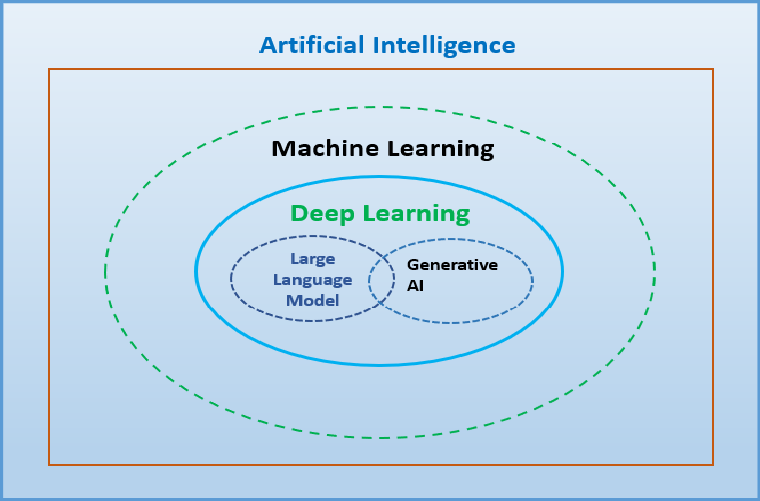
See lessWhat is difference between AI,ML and Deep Learning.How are they related to each other.
Artificial Intelligence (AI) Definition: AI is the broadest concept that involves creating machines or systems that can perform tasks that typically require human intelligence. These tasks include reasoning, learning, problem-solving, perception, and understanding natural language. Examples: VirtualRead more
Artificial Intelligence (AI)
Definition: AI is the broadest concept that involves creating machines or systems that can perform tasks that typically require human intelligence. These tasks include reasoning, learning, problem-solving, perception, and understanding natural language.
Examples:
Machine Learning (ML)
Definition: ML is a subset of AI that involves the development of algorithms that allow computers to learn from and make predictions or decisions based on data. Instead of being explicitly programmed to perform a task, ML models improve their performance through experience (data).
Examples:
Deep Learning (DL)
Definition: DL is a subset of ML that involves neural networks with many layers (deep neural networks). It aims to model complex patterns in data using multiple layers of abstraction.
Examples:
See lessHow can AI impact the society
AI is having a major impact on society, and it's changing the way we live and work in many ways. Here's a look at some of the positive and negative impacts of AI: Positive Impacts: Efficiency and Productivity: AI can automate repetitive tasks, freeing up humans for more creative and strategic work.Read more
AI is having a major impact on society, and it’s changing the way we live and work in many ways. Here’s a look at some of the positive and negative impacts of AI:
Positive Impacts:
Efficiency and Productivity: AI can automate repetitive tasks, freeing up humans for more creative and strategic work. This can lead to increased efficiency and productivity across many industries.
Improved Decision Making: AI can analyze vast amounts of data to identify patterns and trends that humans might miss. This can help businesses and organizations make better decisions.
Advancements in Healthcare: AI is being used to develop new diagnostics, treatments, and personalized medicine. It can also assist in drug discovery and medical research.
Enhanced Education: AI-powered tutoring systems can personalize learning experiences for individual students. This can improve educational outcomes and make education more accessible.
Negative Impacts:
Job Displacement: As AI automates more tasks, some jobs may be lost. This could lead to unemployment and income inequality.
Privacy Concerns: AI systems that collect and analyze personal data raise privacy concerns. It’s important to ensure that this data is collected and used ethically.
Bias and Discrimination: AI systems can perpetuate existing biases if they are trained on biased data. This can lead to discrimination against certain groups of people.
Algorithmic Bias: AI algorithms can be biased, which can lead to unfair or discriminatory outcomes. It’s important to develop and use AI systems that are fair and unbiased.
See lessHow do create a well structured prompt using tools like ChatGPT.
Creating a well-structured prompt for ChatGPT involves clarity, context, and specificity. Here are key steps to follow: 1. Start with a Clear Question or Task: Define what you need from ChatGPT. Be concise and direct. - Example: "Can you summarize the key points of the article on climate change?" 2.Read more
Creating a well-structured prompt for ChatGPT involves clarity, context, and specificity. Here are key steps to follow:
1. Start with a Clear Question or Task: Define what you need from ChatGPT. Be concise and direct.
– Example: “Can you summarize the key points of the article on climate change?”
2. Provide Context: Give necessary background information to help ChatGPT understand the topic better.
– Example: “The article is about recent scientific findings on the impact of greenhouse gases.”
3. Be Specific: Detail any particular requirements or aspects you want to focus on.
– Example: “Please focus on the effects on polar ice caps and sea levels.”
4. Format for Clarity: Use bullet points or numbered lists if multiple points need to be addressed.
– Example:
1. “Summarize the article.”
2. “Highlight key statistics.”
5. Limit the Scope: Avoid overly broad prompts to ensure precise and relevant responses.
– Example: “Summarize the main findings of the last two paragraphs.”
6. Include Examples if Needed: Providing examples can guide the model on the format or detail level.
– Example: “For instance, mention specific data points like ‘CO2 levels increased by X%.'”
Following these steps ensures your prompts are structured to yield clear, useful, and targeted responses from ChatGPT.
See lessSEO
Social signals, such as likes, shares, comments, and overall engagement on social media platforms, influence SEO indirectly rather than being a direct ranking factor. Here’s how they contribute: Increased Visibility and Traffic: When content is shared widely on social media, it reaches a broader audRead more
Social signals, such as likes, shares, comments, and overall engagement on social media platforms, influence SEO indirectly rather than being a direct ranking factor. Here’s how they contribute:
In summary, while social signals are not a direct ranking factor, their impact on traffic, backlinks, brand credibility, and content indexing can significantly influence SEO performance.
See lessHow do you choose between different cloud service providers, and what factors should be considered?
Choosing between different cloud service providers involves evaluating several key factors to ensure the best fit for your needs: 1. Cost: Compare pricing models, including pay-as-you-go, reserved instances, and free tiers. Consider the total cost of ownership, including hidden fees and long-term diRead more
Choosing between different cloud service providers involves evaluating several key factors to ensure the best fit for your needs:
1. Cost: Compare pricing models, including pay-as-you-go, reserved instances, and free tiers. Consider the total cost of ownership, including hidden fees and long-term discounts.
2. Performance: Assess the performance metrics, such as latency, speed, and reliability. Look for providers with a strong track record and data centers in locations relevant to your user base.
3. Scalability: Ensure the provider can handle your growth needs, offering seamless scaling options for both compute and storage resources.
4. Security: Evaluate the provider’s security measures, including data encryption, compliance with industry standards, and security certifications (e.g., ISO 27001, SOC 2).
5. Support and Service Level Agreements (SLAs): Look into the quality of customer support, availability of technical assistance, and the terms of SLAs regarding uptime and issue resolution.
6. Features and Services: Compare the range of services offered, such as machine learning, big data analytics, IoT support, and developer tools. Consider how well these align with your project requirements.
7. Integration and Compatibility: Check for compatibility with your existing systems and ease of integration with third-party services and applications.
8. Reputation and Reviews: Research customer reviews and industry reputation to gauge the provider’s reliability and user satisfaction.
By weighing these factors, you can make an informed decision that aligns with your business goals and technical requirements.
See less