
Mains Answer Writing Latest Questions


Evaluate the effectiveness of India’s current cyber security framework in safeguarding critical infrastructure and personal data. In light of increasing cyber threats, what reforms are needed to strengthen India’s national security in cyberspace? (250 words)

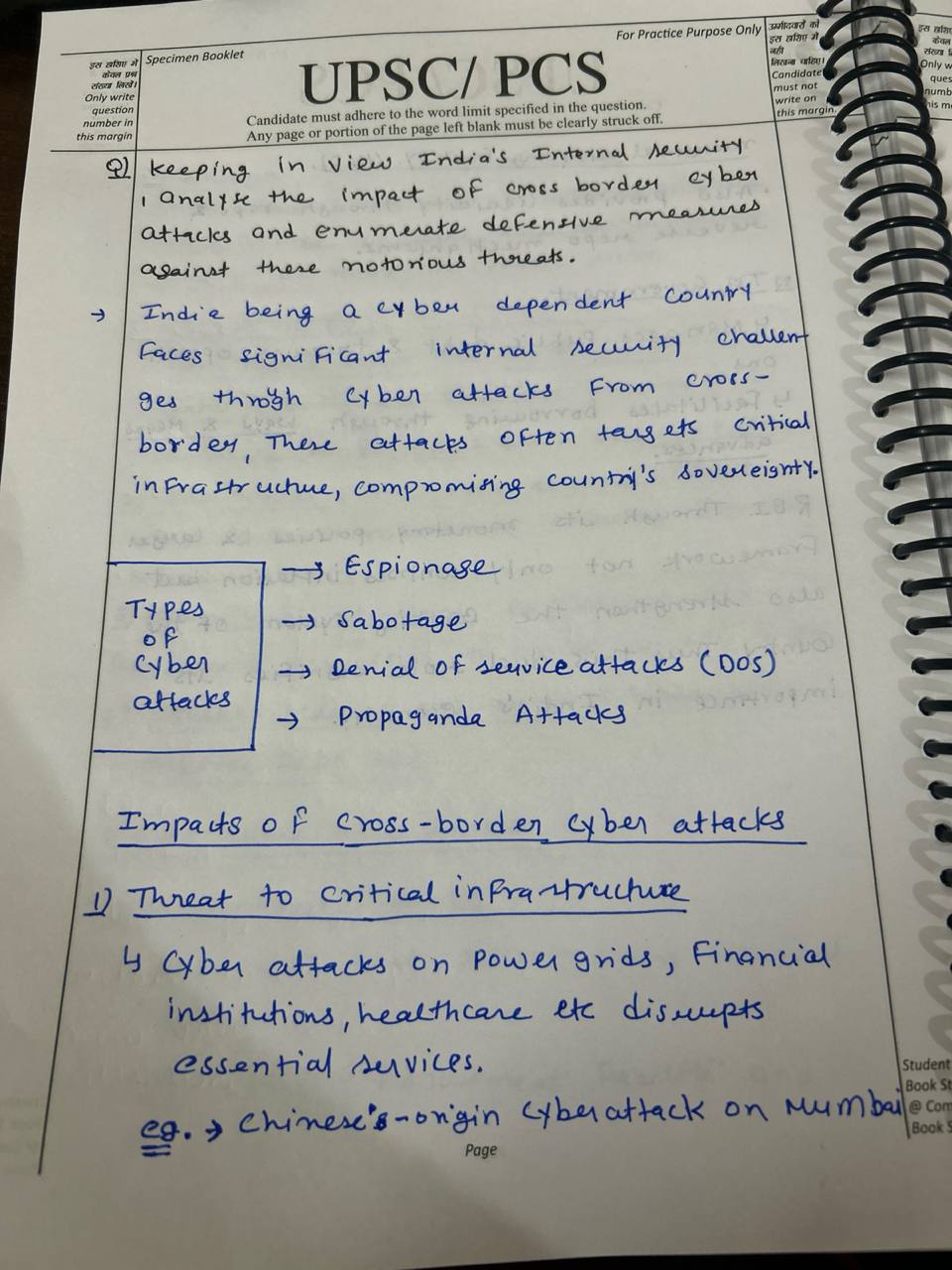
Keeping in view India’s internal security , analyse the impact of cross – border cyber attacks and enumerate defensive measures against these notorious threats .




-
Cyber-Security experts mostly use Linux OS (operating system) over Windows or Mac as: Linux has Enhanced Security and Privacy Linux is a Free to use Open OS Linux also comes with a lot of preinstalled Ethical Hacking tools that may assist the user Linux is known for its excellent performance, particRead more
Cyber-Security experts mostly use Linux OS (operating system) over Windows or Mac as:
- Linux has Enhanced Security and Privacy
- Linux is a Free to use Open OS
- Linux also comes with a lot of preinstalled Ethical Hacking tools that may assist the user
- Linux is known for its excellent performance, particularly on older hardware.
- Linux offers unparalleled customization and flexibility.


-
Defense mechanisms against APTs are becoming very complex as most modern advancements involve proactive and predictive types of defense mechanisms. Most forms of APTs work as multistage attacks, covert reconnaissance, as well as data exfiltration attacks, mainly oriented to evade traditional detectiRead more
Defense mechanisms against APTs are becoming very complex as most modern advancements involve proactive and predictive types of defense mechanisms. Most forms of APTs work as multistage attacks, covert reconnaissance, as well as data exfiltration attacks, mainly oriented to evade traditional detection tools. This is the reason newer defense approaches are designed based on the use of machine learning, AI, and behavioral analytics for real-time threat detection. The above are some of the vital developments and findings about machine learning.
1. Machine Learning and AI-based Threat Detection – Behavioral Analysis and Anomaly Detection: In contrast to the Signature-based, an ML model will identify anomalous pattern or behavior as to how normal networking and user activity is perceived. Any anomaly be that a strange login location, non-conventional time, data access time, among others, will be identified and it could well mean an APT.
These approaches work very well because at such minimal deviations might be noticed and this can actually be picked both with supervision and unsupervised as these use methodologies including cluster or anomaly detection methods.
Predictive Analytics and Threat Intelligence: Models trained against large datasets of observed previously APT campaign datasets shall identify precursors or Indicators of Compromise, IoCs, well ahead of the full-fledged attack. This capability helps to proactively lock the vulnerable assets for security teams.
– NLP in Phishing Detection: Various APTs have their entry using spear-phishing attacks. The models for NLP-based identification depend upon the language pattern analysis of the email message or text in messenger that can determine the potential malware content and screen the suspicious emails in real-time.2. TIP integration
TIPs will aggregate data from OSINT, dark web sources, and known IoCs. Bring AI models into EDR systems to make detections even more effective by correlating the threat signals with real-world attack data to make them more accurate and reduce the response time.3. Endpoint Detection and Response with Artificial Intelligence
Modern EDR uses machine learning to observe endpoints in real time. Meaning, it’s identifying all the activities of elevation privileges, lateral movement in the network, etc. Applying an AI-powered EDR will make the response automated-this system might isolate it to other systems, and it might prevent malware from moving forward by blocking a particular malicious process.4. User and Entity Behavior Analytics (UEBA)
See less
They use machine learning algorithms for the analysis of communications and interactions of users and devices in a network and, simultaneously, detect behavior when it is anomalous enough that could signal, further, credential theft or insider threats. As UEBA systems can catch very stealthy malicious activity that may remain unnoticed by other traditional security tools, they improve as they get more data which they collect in real time.


Roadmap for Answer Writing 1. Introduction Define “Critical Infrastructure” (CI) and its importance in a nation’s security and economy. Highlight India’s vulnerability to cyber threats despite its significant efforts. 2. Challenges to Securing Critical Infrastructure Discuss the current vulnerabilities and limitations India faces in securing ...
-

Model Answer Strengthening the Security of India's Critical Infrastructure: Despite significant efforts by India to secure its Critical Infrastructure (CI) from cyber threats, persistent vulnerabilities remain. The government has enacted policies like the National Cyber Security Policy and establishRead more
Model Answer
Strengthening the Security of India’s Critical Infrastructure:
Despite significant efforts by India to secure its Critical Infrastructure (CI) from cyber threats, persistent vulnerabilities remain. The government has enacted policies like the National Cyber Security Policy and established entities like CERT-In and the National Critical Information Infrastructure Protection Centre. However, India’s CI still faces major cyber challenges, as evidenced by a sharp rise in cyber-attacks in 2023, including 429,847 incidents targeting financial services and breaches of 70 government websites.
Challenges in Securing Critical Infrastructure:
- Skilled Workforce Shortage: India’s cyber security industry suffers from a 30% demand-supply gap of skilled professionals, which hampers the effective management of CI securitytdated Systems:** Many CI systems still rely on outdated infrastructure, making them vulnerable to cyberattacks. For example, ransomware attacks on AIIMS Delhi and SpiceJet in 2022 highlighted these weaknesses .
- Ereat Landscape: Cybercriminals are increasingly using advanced technologies like AI and zero-day exploits, making it difficult for defenders to keep up with new tactics .
- Inadequateurity Infrastructure: According to the CISCO Cybersecurity Readiness Index, only 24% of Indian firms possess the resources to address cybersecurity effectively .
Measures to Strengthecurity:
- Advanced Threat Detection and Response: Adopting AI-driven solutions can enhance real-time threat detection. For instance, Indian financial institutions are already using AI to prevent fraud .
- International Cyber Security: Implementing global frameworks like the NIST Cyber Security Framework can help strengthen CI protection .
- **Mandatory Cyber Crisis Management Plablishing a standardized crisis management plan across both public and private sectors will ensure a coordinated and efficient response to cyber incidents .
- Strengthening Supply Chain Integrity: Promote of indigenous cyber security solutions can reduce dependence on international products and fortify India’s CI against potential threats .
Securing India’s Critical Infrastructure requires continuount in cyber security, collaboration among stakeholders, and proactive risk management to ensure resilience against future cyber threats.
See less

Roadmap for Answer Writing 1. Introduction Briefly introduce the evolving nature of cybersecurity challenges in India. Mention the need for continuous innovation and adaptability in the face of rising cyber threats. Introduce CERT-In as the key body responsible for managing and safeguarding India’s cyberspace. 2. ...
-
Model Answer Introduction The cybersecurity landscape in India is facing increasing challenges, with a sharp rise in incidents and complex attacks. As the threats evolve, the Indian Computer Emergency Response Team (CERT-In) plays a crucial role in safeguarding the nation's cyberspace through proactRead more
Model Answer
Introduction
The cybersecurity landscape in India is facing increasing challenges, with a sharp rise in incidents and complex attacks. As the threats evolve, the Indian Computer Emergency Response Team (CERT-In) plays a crucial role in safeguarding the nation’s cyberspace through proactive and reactive measures.
Proactive Functions of CERT-In
1. Security Guidelines and Advisories
CERT-In issues updated security protocols to mitigate emerging threats. For instance, in 2023, it released “Guidelines on Information Security Practices” aimed at government entities, providing essential measures for cybersecurity defense.2. Vulnerability and Risk Analysis
CERT-In actively identifies vulnerabilities and assesses potential risks to prepare for cyber-attacks. A notable example is the identification of the Akira ransomware in 2023, which it flagged as a growing threat.3. Training and Capacity Building
To strengthen cyber defense capabilities, CERT-In conducts training programs. In 2023, CERT-In partnered with Mastercard India to provide specialized cybersecurity training, particularly for the financial sector.4. Central Database
CERT-In serves as a national repository and referral agency, consolidating data on cyber intrusions to better understand trends and facilitate swift responses.Reactive Functions of CERT-In
1. Assistance and Recovery
CERT-In plays a vital role in responding to cybersecurity incidents. In 2022, it handled over 1.39 million incidents, providing necessary interventions to prevent further damage.2. Incident Response
CERT-In offers rapid, 24/7 support to manage and mitigate cyber threats, ensuring a swift and coordinated response to incidents.3. Information Sharing
CERT-In collaborates with other CERTs and organizations, sharing crucial information about emerging cyber threats, enhancing the collective defense network.4. Artifact Analysis and Incident Tracing
It also analyzes malicious software and traces the origins of cyber threats to mitigate future attacks.Conclusion
With India’s growing cybersecurity challenges, CERT-In’s role remains critical in ensuring the protection of cyberspace. However, continued investment in advanced technologies, global cooperation, and public-private partnerships are essential to bolster its effectiveness.
See less
Roadmap for Answer Writing 1. Introduction Introduce the Digital Personal Data Protection Act, 2023. Briefly explain its significance in the context of data privacy and digital interactions in India. 2. Context of the Digital Personal Data Protection Act, 2023 Growing Digital Economy and Privacy Concerns: ...
-
Digital Personal Data Protection Act, 2023 – Context and Key Features The Digital Personal Data Protection Act, 2023 is India's first comprehensive law aimed at protecting people's personal data in the digital sphere. The digital economy is thriving, therefore increasing amounts of personal data areRead more
Digital Personal Data Protection Act, 2023 – Context and Key Features The Digital Personal Data Protection Act, 2023 is India’s first comprehensive law aimed at protecting people’s personal data in the digital sphere. The digital economy is thriving, therefore increasing amounts of personal data are shared digitally, whether in an app, website or through other digital mechanisms. However, until now, there was no legal structure giving accountability to organisations in relation to the use of that data. The act was lobbied for and delivered after the 2017 ruling in which the Supreme Court made privacy a fundamental right. Increasing cases of ‘data breach,’ the misuse of people’s personal data, and international contingencies, like the highly publicised GDPR, highlighted the need for India to have its own, independent, law to protect personal data. Some of the important features of the Act are: It is applicable to all digital personal data, even where processed outside India; Consent is foregrounded – organisations must obtain permission from individuals before processing their data, with some exceptions; Individuals have rights to access, rectify, and erase their data; children’s data has an additional level of protection; Data Protection Board to oversee complaints and enforcement; and. Severe fines up to ₹250 crore (approximately $30 million) for serious offence. The law is a strong start but it will be interesting to see the tangible impact with the public’s ongoing engagement.
See less

The cyber security framework plays a major role in tackling cyber threats via the National Cyber Security Policy (2013) which has made progress against digital threats since it's inception . Evaluation of cyber security framework: Strengths : 1)Legal and regulatory framework: The Information TechnolRead more
The cyber security framework plays a major role in tackling cyber threats via the National Cyber Security Policy (2013) which has made progress against digital threats since it’s inception .
Evaluation of cyber security framework:
Strengths :
1)Legal and regulatory framework: The Information Technology act (2000) and National Cyber Security Policy (2013) aim to detect cyber threats towards data protection and online transactions. The legal framework criminalizes cyber offences and develop country’s protection against threats.
2) Setting up institutions such as :
3) National Cyber Security Policy:Marks strategic objectives effective cyber ecosystem via promotion of research and development .
4) Focus on capacity building.
5) Provide indigenous solution: NCRF promotes participation of companies like TCS ,Wipro, Cyber ark etc for cyber defence.
6) Public-private partnership
Reforms to further strengthen defences:
1) Awareness campaigns: best possible way of defending threats is informed masses.
2) Continuous review and adaptation: dynamic scenario which requires regular evaluation and modification.
3) Increased budget allocation: both by government and private parties monitored by top management ( 10% of IT budget recommended).
4) Training programmes as recently announced by HM Amit Shah of training 5000 commandos .
5) Acts such as Digital India which would encompass A.I , cybersecurity and data privacy.
See less