
Home/Indian Economy/Page 69
Indian Economy
Share
Lost your password? Please enter your email address. You will receive a link and will create a new password via email.
Please briefly explain why you feel this question should be reported.
Please briefly explain why you feel this answer should be reported.
Please briefly explain why you feel this user should be reported.
What are the best practices for sustainable agriculture in arid regions?
Arid regions are those which characterized with little precipitation and high evaporation resulting to sparse vegetation. For sustainable agriculture in arid regions following innovative techniques to be adopted: 1. Crop selection: Select those drought tolerant crops. This means focus on those cropsRead more
Arid regions are those which characterized with little precipitation and high evaporation resulting to sparse vegetation. For sustainable agriculture in arid regions following innovative techniques to be adopted:
1. Crop selection: Select those drought tolerant crops. This means focus on those crops which suitable with minimal water.
2. Encourage agroforestry: Planting trees and shrubs in agricultural landscapes can prevent water loss.
3. Adopt soil management practices: Farmers should adopt soil management practices such as watering during cooler times of the day, measure soil moisture level with moisture sensor and so on
4. Focus on soil conservation: Soil conservation practice like conservation tillage can help to reduce soil erosion and also improve water retention.
By adopting such innovative and productive practices farmer able to ensure sustainable agriculture in arid regions.
See lessCan AI will ever be able to replace human brain?
Artificial Intelligence (AI) has made remarkable strides in recent years, demonstrating capabilities that were once considered exclusive to humans. However, the question of whether AI can completely replace the human brain is complex. The human brain is not only a processing unit but also a center oRead more
Artificial Intelligence (AI) has made remarkable strides in recent years, demonstrating capabilities that were once considered exclusive to humans. However, the question of whether AI can completely replace the human brain is complex. The human brain is not only a processing unit but also a center of emotions, consciousness, and ethical reasoning, which are challenging to replicate fully in AI.AI excels in tasks involving data analysis, pattern recognition, and performing repetitive tasks with high precision. It can process vast amounts of information faster than humans and can assist in decision-making by providing data-driven insights. Yet, AI lacks the ability to understand context, exhibit genuine creativity, and experience emotions. Human intuition, empathy, and moral judgment are integral aspects of decision-making that AI cannot mimic entirely.Moreover, the human brain’s ability to adapt, learn from minimal data, and understand nuanced situations is still far superior to AI. While AI can augment human capabilities and perform specific functions exceptionally well, replacing the human brain entirely would require overcoming significant technical and philosophical challenges.In summary, AI can complement and enhance human abilities but is unlikely to replace the human brain entirely due to its limitations in replicating human consciousness, emotional intelligence, and ethical reasoning.
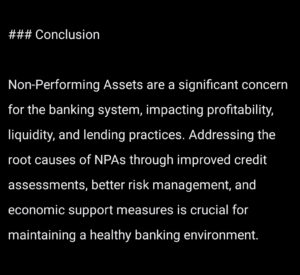
See lessNon-Performing Assets (NPA) : Meaning, Cause & Impact on Banking System
See lessCritically examine the role of groundwater depletion in exacerbating the water crisis in Delhi and Bangalore. What measures can be implemented to manage groundwater resources more sustainably?
India being the largest consumer of groundwater accounting a major chunk i.e around 25% of the total world's groundwater withdrawal which indicates a great dependency on it, and so its depletion will lead to various problems, as megacities like Bangalore and delhi are facing major shortage of waterRead more
- Due to the deforestation in the megacities,the groundwater is not getting recharged as its depleting
- Wetlands encroachments
- No strict conservation policies of water recharging
- Climate change is also exacerbating this crisis as high temperature are responsible for more evaporation
- Way forward
- A stringent policy should be there for the overall recharging of the aquifers through promising methods like rainwater harvesting and various traditional methods
- Community awareness campaign can play a major role in generating awareness
- Wetlands conservation programme should be there
- Sustainable use of groundwater resources should be encouraged
- Being the largest consumer and catering the largest population of the world we should think of this challenging problem and implement the strategic management of not only the groundwater but all sources of water.
See lessAnalyze the potential impact of the Agnipath scheme on India's military readiness and modernization. How might the short-term nature of the Agniveer tenure affect the armed forces' operational capabilities?
The Agnipath scheme, which introduces a short-term tenure for soldiers known as Agniveers, aims to modernize and streamline the Indian military. However, this approach might have mixed impacts on military readiness and modernization. On one hand, the scheme could enhance operational efficiency by brRead more
The Agnipath scheme, which introduces a short-term tenure for soldiers known as Agniveers, aims to modernize and streamline the Indian military. However, this approach might have mixed impacts on military readiness and modernization.
On one hand, the scheme could enhance operational efficiency by bringing in younger, tech-savvy recruits who are more adaptable to modern warfare requirements. It also promises to reduce the long-term financial burden on the defense budget by cutting down on pension liabilities. On the other hand, the short tenure may compromise the development of experienced and seasoned personnel essential for high-stakes operations and leadership roles.
The constant influx of new recruits could lead to a lack of continuity and depth in military expertise, potentially affecting strategic planning and execution. Furthermore, the need for frequent training and reorientation of new recruits might strain resources and affect operational readiness in the short term. Thus, while the Agnipath scheme could drive modernization, its impact on the effectiveness and stability of the armed forces might pose challenges that need careful management.
See lessHuman Resource is as important as the Cash resource, which is an asset to the business. Do you think that the businesses take the human asset lightly and under pays ?
In many businesses, there is a tendency to undervalue human resources compared to cash assets. While it is widely acknowledged that employees are vital to the success and growth of any organization, there is often a disconnect between this recognition and the actual treatment and compensation of empRead more
In many businesses, there is a tendency to undervalue human resources compared to cash assets. While it is widely acknowledged that employees are vital to the success and growth of any organization, there is often a disconnect between this recognition and the actual treatment and compensation of employees. Several factors contribute to this discrepancy.
Firstly, the focus on short-term financial performance can lead businesses to prioritize cost-cutting measures, including minimizing payroll expenses. This often results in underpaying employees, as companies seek to maximize profits and shareholder value. Additionally, there is a prevalent notion that labor is easily replaceable, particularly in industries with high turnover rates or a large supply of available workers. This mindset can lead to undervaluing the unique skills, experience, and contributions that individual employees bring to the organization.
Moreover, the lack of effective human resource management practices can exacerbate this issue. Inadequate performance appraisal systems, limited career development opportunities, and insufficient employee engagement initiatives can contribute to a sense of undervaluation among employees. This not only affects their morale and productivity but can also lead to higher turnover rates, further impacting the organization’s overall performance.
To address this, businesses need to recognize that investing in their human resources is as crucial as managing their financial assets. Fair compensation, opportunities for professional growth, and a supportive work environment are essential for attracting and retaining top talent, ultimately driving sustainable business success.
See lessAI and Employment
We are likely to see the AI reshaping the job market in deep ways over the next decade, perhaps. According to a number of experts, very routine and predictable tasks across many sectors might be at risk of getting automated within the next few decades. This shift is not just about the loss of jobs bRead more
We are likely to see the AI reshaping the job market in deep ways over the next decade, perhaps. According to a number of experts, very routine and predictable tasks across many sectors might be at risk of getting automated within the next few decades. This shift is not just about the loss of jobs but also one of job transformation. Many of these roles, especially in areas such as healthcare, finance, and law, may change, using AI as a very strong tool that will enhance rather than replace human decision-making.
At the same time, new work will surely be creating right along with the development of AI technologies. The jobs for AI developers, ethicists, and maintenance specialists will be in high demand and will yield opportunities to people that are impossible to predict at this time. This technological revolution will also put a premium on uniquely human skills like creativity, emotional intelligence, and complex problem-solving—abilities that AI still struggles to replicate.
We can’t deny the real challenges this transition will bring, though. Many workers, especially in the most potentially automatizable industries, will probably find themselves with worthless skills. This is when proactive strategies matter.
This could be apparently realized through the foste-ring of a culture of lifelong learning. We need to get away from the notion that education stops once a degree is issued. Upskilling and reskilling should be continuously encouraged with frequent intervals in between, promoted through government schemes and company programs. This could include online courses and workshops that impart hands-on experience in helping workers adjust to the dynamic requirements of the labor market.
We also need to refashion our social support systems. Some countries might try to experiment with basic income guarantees to step in and support workers, to provide a minimum level of protection against job displacement by machines, while others may design comprehensive job transition services, with counseling, retraining, and placement assistance for workers.
Thirdly, education systems will also have an overhaul. Artificiency in AI can be introduced within school settings to make sure that the next generation is better set up for an AI-driven workplace. More than the technical skills themselves, we need to focus on building critical thinking, creativity, and emotional intelligence, which surely will not be taken away from humans by machines.
The responsibility also falls on policymakers. We must have regulations that provide for the responsible development of AI, considering impacts on employment. This may mean regulation in the direction of industry incentives to human-centered space or perhaps even a decrease in the number of hours a person works in a week to spread available work among more people.
This transition, essentially driven by AI, must be negotiated with collective efforts from governments, businesses, educational institutions, and individuals. It is all about being proactive, adaptable, and focused on how to capture the potential of AI, while at the same time getting the harms under control. Instead, an end state should be developed in which AI yields augmented human capabilities, not simply replaced new machine counterparts.
See lessThe Future of Protein: Biotechnological Advances in Alternative Foods
Biotechnology's Role in Alternative Proteins Biotechnology is a cornerstone in developing alternative protein sources. In plant-based proteins, genetic engineering enhances crop yield, nutritional content, and resistance to pests and diseases. Precision fermentation, a biotechnological process, prodRead more
Biotechnology’s Role in Alternative Proteins
Biotechnology is a cornerstone in developing alternative protein sources.
In plant-based proteins, genetic engineering enhances crop yield, nutritional content, and resistance to pests and diseases. Precision fermentation, a biotechnological process, produces proteins like mycoprotein, a meat substitute, using microorganisms.
For lab-grown meat, biotechnology is indispensable. Scientists utilize stem cells from animal tissue to cultivate muscle fibers in bioreactors. Genetic engineering can optimize these cells for faster growth and desired characteristics. Additionally, bioreactors, a product of biotechnology, provide the controlled environment necessary for meat cultivation.
These biotechnological advancements offer potential solutions to global food challenges like resource scarcity, environmental impact, and food security.
See lessExam
USE OF APTITUDE TEST IN COMPETITIVE EXAMS Aptitude test designate one's Intelligence quotient . It's the Practical knowledge that makes a person unique in the cat race where a vigilant officer is chosen in a populous country like us. The competition is immense as mentioned earlier.Aspirants take yeaRead more
USE OF APTITUDE TEST IN COMPETITIVE EXAMS
Aptitude test designate one’s Intelligence quotient . It’s the Practical knowledge that makes a person unique in the cat race where a vigilant officer is chosen in a populous country like us. The competition is immense as mentioned earlier.Aspirants take years of preparation spending all their efforts, money, skills . People who have crammed the portions for years can ace the exam but the on-spot question outshines their diplomacy and spontaneity. Aptitude tests enact their complete character development and Persevarnce of solution seeking . Idealistic mindset differs one’s personality is a wise man’s words . It dignifies a individual’s knowledge and wisdom before their caste, religion and race. It eventually paves their vitality in the socio-economic environment as a citizen serving our motherland.
See lessDiscuss the impact of the Olympic Games on global diplomacy and international relations. Illustrate your answer with examples from recent Olympic events.
The Olympic Games wield significant influence on global diplomacy and international relations, acting as a platform for both cooperation and contention. Global Stage for Diplomacy The Olympics offer nations a chance to showcase their culture and achievements, fostering goodwill. For instance, the 20Read more
The Olympic Games wield significant influence on global diplomacy and international relations, acting as a platform for both cooperation and contention.
Global Stage for Diplomacy
The Olympics offer nations a chance to showcase their culture and achievements, fostering goodwill. For instance, the 2008 Beijing Olympics were seen as a symbol of China’s rising global status. The games allowed China to project its economic and political influence on the world stage.
Opportunity for Cooperation
The Olympics can bridge divides. In 2018, the PyeongChang Winter Olympics featured a historic moment of reconciliation when North and South Korea formed a unified women’s ice hockey team and marched together under a single flag during the opening ceremony. This gesture of unity was a significant diplomatic thaw amidst ongoing tensions.
Conflict and Controversy
Conversely, the Games can highlight geopolitical conflicts. The 2022 Beijing Winter Olympics faced criticism over human rights issues, with several nations, including the United States, conducting diplomatic boycotts. This illustrated how the Olympics can become entangled in global political disputes.
In essence, while the Olympics have the potential to foster international camaraderie, they also reflect and amplify existing global tensions.
See less