

Highlight the urgent issues of the day while tracing the evolution of land reforms in India.
Mains Answer Writing Latest Questions

Advait DeshmukhBegginer
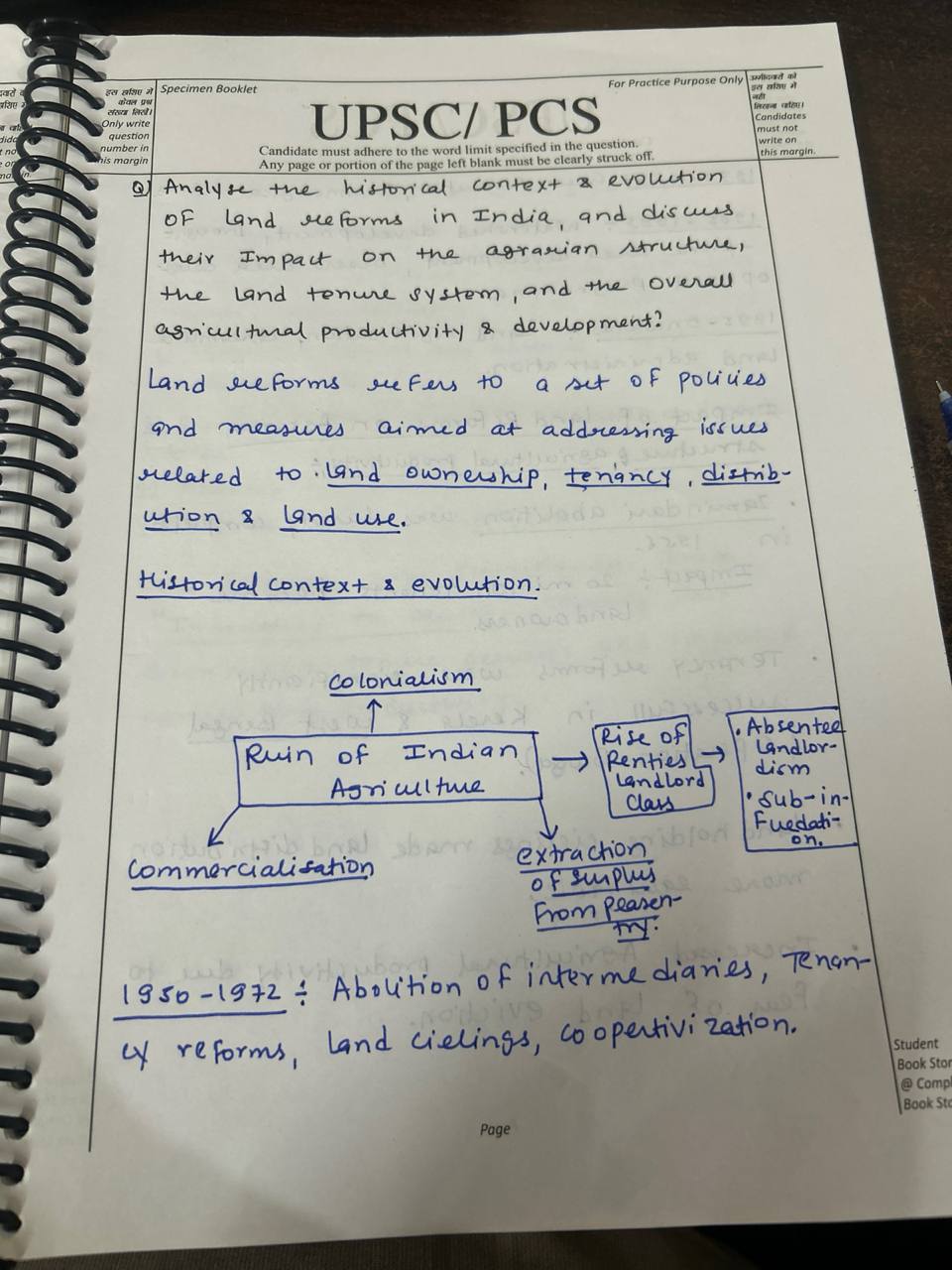
Examine the historical background and the development of land reforms in India. Talk about how these changes have affected the country’s agrarian structure, land tenure system, and general agricultural development and production.



TeamSupreme
Roadmap for Answer Writing 1. Introduction Definition of Land Reforms: Briefly define what land reforms are and their significance in India’s agrarian context. Contextual Importance: Mention that land reforms were implemented post-independence to address socio-economic disparities. 2. Objectives of Land Reforms in India Abolition of ...
-

Model Answer Introduction Land reforms have been crucial in India's agrarian history, aimed at promoting social justice and economic development. Implemented post-independence, these reforms sought to rectify socio-economic disparities caused by historical land ownership patterns. Objectives of LandRead more
Model Answer
Introduction
Land reforms have been crucial in India’s agrarian history, aimed at promoting social justice and economic development. Implemented post-independence, these reforms sought to rectify socio-economic disparities caused by historical land ownership patterns.
Objectives of Land Reforms in India
- Abolition of Intermediaries:
- Eliminate zamindars and other intermediaries who exploited peasants. This aimed to connect the state directly with the tillers.
- Tenancy Regulation:
- Provide security to tenants against eviction and ensure fair rent practices, protecting the rights of those who cultivate the land.
- Redistribution of Land:
- Achieve a more equitable distribution of land and eliminate large landholdings, thereby benefiting the landless and small farmers.
- Land Consolidation:
- Amalgamate fragmented farms into compact units for efficient farming, enhancing agricultural productivity.
- Agrarian Administration:
- Introduce effective management and administrative measures for agricultural land to streamline operations.
Measures of Land Reforms
- Abolition of Zamindari System:
- Various state acts were passed to abolish zamindars, vesting land titles directly with the state, benefiting millions of peasants.
- Fixation of Land Ceilings:
- Laws were enacted to set maximum landholding limits. Surplus lands were taken by the state and redistributed among the landless.
- Tenancy Laws:
- Implemented to provide security of tenure, fair rent fixation, and ownership rights to tenants in various states.
- Consolidation of Holdings:
- Efforts were made to reduce land fragmentation and create unified holdings for better management.
- Cooperative Farming:
- Encouraged smallholders to pool resources for cooperative farming, enhancing productivity.
Land Ceiling as an Effective Economic Reform
- Reduction in Inequalities: Redistributing surplus land helps reduce economic disparities and provides livelihoods to vulnerable populations.
- Enhanced Productivity: Smaller farms typically achieve higher productivity per unit of land. For instance, in states like West Bengal and Kerala, comprehensive land reforms led to improved agricultural productivity.
- Economic Empowerment: Land ownership serves as collateral, enabling farmers to access credit and invest in better technologies.
- Diversified Agriculture: Secure land rights encourage farmers to invest in long-term crops and diversify their practices.
In conclusion, land reforms, particularly the land ceiling policy, have transformed India’s agrarian landscape, addressing historical injustices while promoting a more inclusive agricultural economy.
See less - Abolition of Intermediaries:
TeamSupreme
Roadmap for Answer Writing 1. Introduction Define Land Reforms: Explain what land reforms entail in the Indian context, focusing on ownership, leasing, and property rights. Historical Context: Briefly mention the government’s commitment to land reforms post-independence and notable movements like Bhoodan and Gramdan. 2. ...
-
Model Answer Introduction Land reform encompasses efforts to modify the ownership, operation, leasing, and property rights associated with land in India. The Indian government has historically been committed to land reforms to ensure distributive justice, reflecting promises made during the freedomRead more
Model Answer
Introduction
Land reform encompasses efforts to modify the ownership, operation, leasing, and property rights associated with land in India. The Indian government has historically been committed to land reforms to ensure distributive justice, reflecting promises made during the freedom struggle. Notable movements like Bhoodan and Gramdan, along with legislative measures to abolish landlordism and protect tenant rights, have shaped land reform efforts.
Role of Land Reforms in Agricultural Development
- Improved Land Productivity: Land reforms enhance productivity by redistributing land to small and marginal farmers, enabling them to access credit, technology, and efficient farming practices. Studies show that productivity can increase significantly when land is more equitably distributed (Source: Planning Commission of India).
- Reduced Poverty: By granting land access to landless laborers, land reforms can elevate their income and improve living standards. According to the National Sample Survey, land ownership correlates with better economic outcomes for families (Source: NSSO Reports).
- Promoting Economic Growth: Increased agricultural production from effective land reforms creates more employment opportunities, thereby fostering broader economic growth. This has been evident in regions with successful land redistribution initiatives.
Factors Responsible for the Success of Land Reforms in India
- Political Will: The commitment of the government to implement land reforms was crucial, particularly through constitutional amendments like the insertion of the 9th Schedule, which facilitated the abolition of the right to property.
- Effective Implementation: Successful execution of ceiling laws that limited land ownership was vital. The political resolve to enforce these laws significantly influenced outcomes (Source: Ministry of Agriculture).
- Support from Civil Society: NGOs and cooperatives played a pivotal role in raising awareness about land rights and helping farmers navigate the reforms, thereby enhancing the effectiveness of the initiatives.
- Green Revolution: The introduction of high-yield variety (HYV) seeds and subsidies for fertilizers during the Green Revolution bolstered agricultural productivity, complementing land reform efforts (Source: Indian Council of Agricultural Research).
- Strong Monitoring and Evaluation: Implementing robust monitoring mechanisms ensured that land reforms were executed efficiently and transparently.
Conclusion
Land reforms are essential for enhancing agricultural development in India by increasing productivity, reducing poverty, and promoting economic growth. While the initial efforts reflected good intentions, the implementation has often been mixed. With current land availability at 0.12 hectares per capita, India must now focus on second-generation land reforms that emphasize digitization and financial inclusion to further advance agricultural productivity.
See less
TeamSupreme
Roadmap for Answer Writing Introduction Define the LARR Act Briefly explain the Right to Fair Compensation and Transparency in Land Acquisition, Rehabilitation and Resettlement Act (LARR) 2013 and its implementation date (1st January 2014). Thesis Statement Introduce the purpose of the Act: to address historical ...
-
Model Answer Introduction The Right to Fair Compensation and Transparency in Land Acquisition, Rehabilitation and Resettlement Act (LARR) 2013 replaced the outdated Land Acquisition Act of 1894. This new legislation aims to address historical injustices related to land acquisition, focusing on fairRead more
Model Answer
Introduction
The Right to Fair Compensation and Transparency in Land Acquisition, Rehabilitation and Resettlement Act (LARR) 2013 replaced the outdated Land Acquisition Act of 1894. This new legislation aims to address historical injustices related to land acquisition, focusing on fair compensation, rehabilitation, and resettlement for affected individuals.
Key Issues Addressed by the Act
- Rehabilitation and Resettlement
- The LARR Act mandates provisions for the rehabilitation and resettlement of individuals displaced by land acquisition, a significant improvement over the previous law.
- Consent Requirements
- The Act requires the consent of 80% of landowners for private projects and 70% for Public-Private Partnership (PPP) projects, ensuring greater community involvement.
- Increased Compensation
- Compensation is set at 4 times the market rate for rural land and 2 times for urban land, providing more equitable compensation for affected individuals.
- Social Impact Assessment (SIA)
- The introduction of SIA evaluates the potential impacts of land acquisition on various social groups, promoting informed decision-making.
- Restrictions on Agricultural Land Acquisition
- The Act restricts the acquisition of irrigated multi-cropped land, addressing concerns about the loss of agricultural land.
- Special Safeguards for Tribal Communities
- The Act includes provisions to protect the rights of tribal communities, aiming to prevent displacement without proper compensation.
Implications for Industrialization and Agriculture
- Delays in Project Implementation
- The requirement for SIA and community consent can lead to delays in industrial projects, potentially hindering economic growth.
- Economic Viability
- Higher compensation rates may affect the financial viability of industrial and infrastructure projects, making them less attractive to investors.
- Positive Impact on Agriculture
- Restrictions on the acquisition of agricultural land and the requirement for equivalent land cultivation elsewhere can help preserve agricultural viability.
- Adverse Effects on Infrastructure Development
- Delays in acquiring land for essential infrastructure projects may negatively impact agricultural growth and rural development.
- Exemptions for Major Activities
- Certain industrial activities, like mining, are exempt from the LARR Act, leading to an uneven impact across sectors.
Conclusion
The LARR Act of 2013 aims to uphold citizens’ fundamental right to livelihood by ensuring fair compensation and rehabilitation in land acquisition processes. While it addresses critical issues related to displacement and compensation, it also presents challenges for industrialization and agricultural growth that need careful consideration.
See less - Rehabilitation and Resettlement

Eshan FernandesBegginer
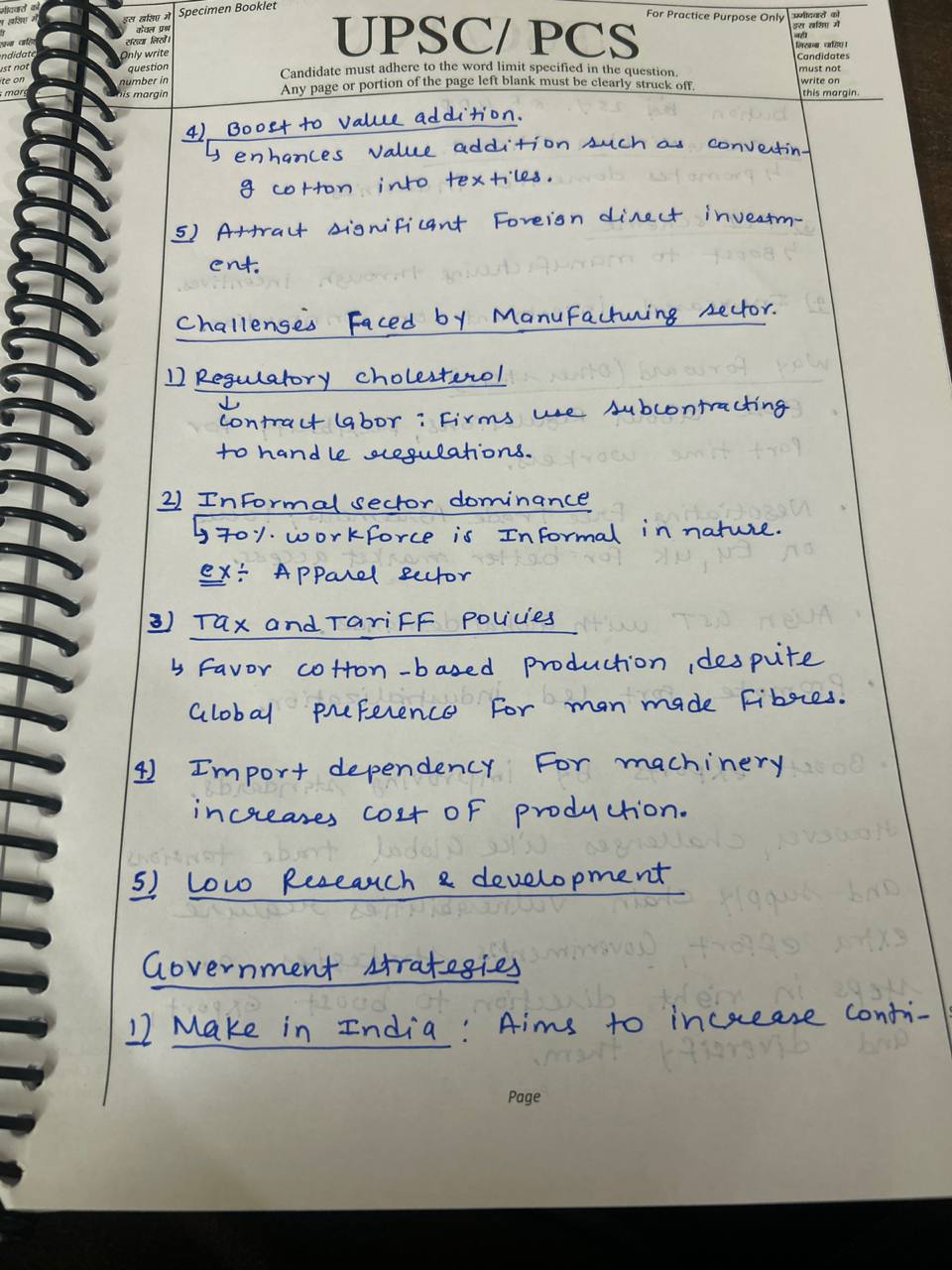
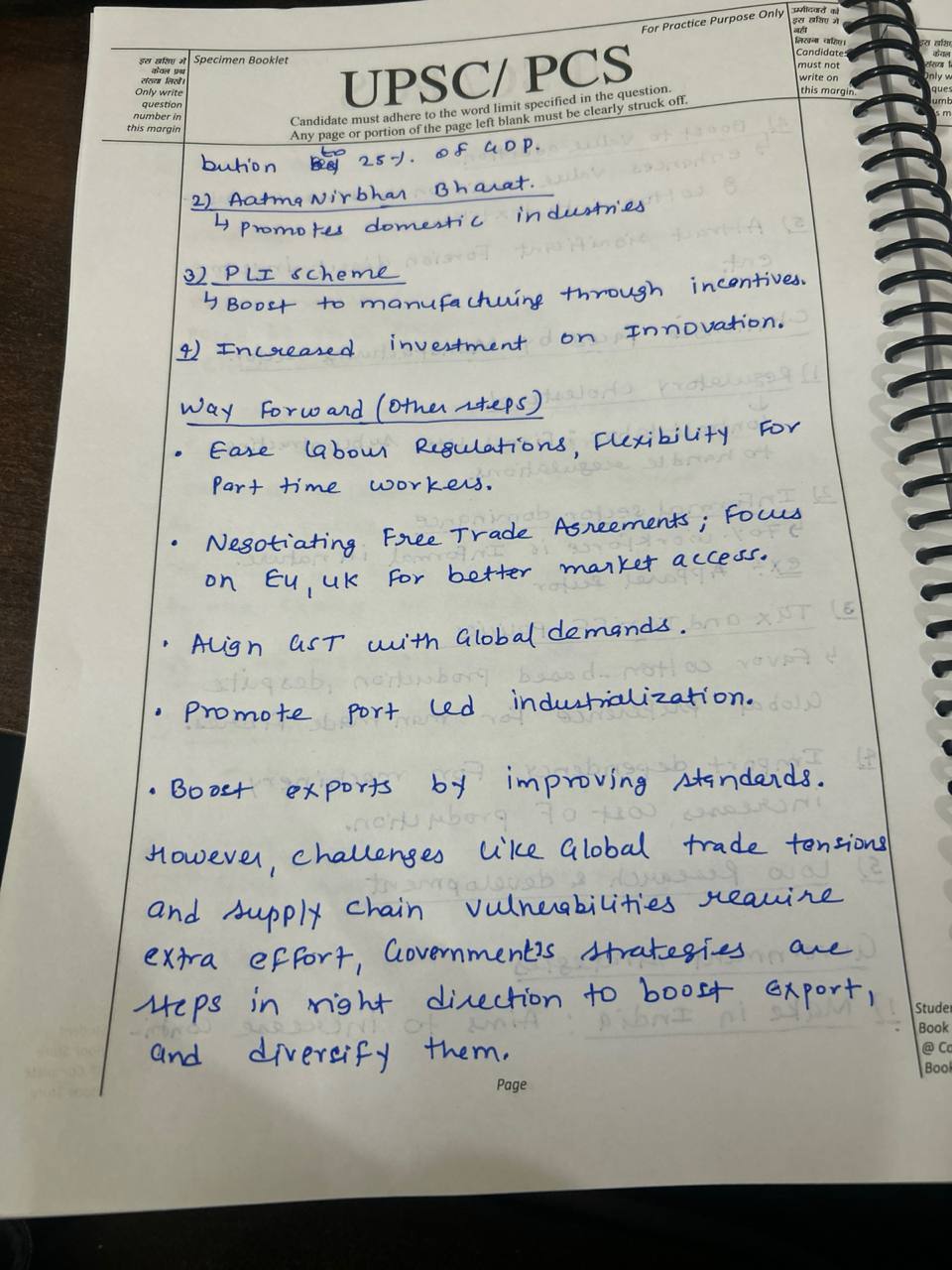
Analyze how the manufacturing sector contributes to India’s export performance and the government’s efforts to diversify export markets, increase the sector’s export competitiveness, and deal with supply chain disruptions and conflicts in the global trade arena.

TeamSupreme
Roadmap for Answer Writing Introduction: Briefly define the manufacturing sector’s contribution to GDP and the significance of MSMEs. State the purpose of the answer: to assess how current policies support growth in this sector. Importance of Increasing Manufacturing Sector Share: Rural Development: Explain how manufacturing ...
-
Model Answer Introduction The manufacturing sector is vital for India’s economic landscape, contributing approximately 17% to the GDP in 2022. Micro, Small, and Medium Enterprises (MSMEs) account for about 40% of manufacturing output, playing a significant role in job creation, exports, and overallRead more
Model Answer
Introduction
The manufacturing sector is vital for India’s economic landscape, contributing approximately 17% to the GDP in 2022. Micro, Small, and Medium Enterprises (MSMEs) account for about 40% of manufacturing output, playing a significant role in job creation, exports, and overall economic growth. Recognizing this importance, the Indian government has implemented various policies aimed at bolstering this sector.
Importance of Increasing Manufacturing Sector Share
- Rural Development: Manufacturing is essential for rural upliftment. Initiatives such as Agro-based industries and Rural Self Employment Training Institutes (RSETIs) empower rural entrepreneurs, thereby enhancing economic conditions in these areas.
- Economic Resilience: A diverse manufacturing sector can provide stability during economic downturns. For example, small enterprises adapted during the COVID-19 pandemic to produce essential goods like masks and sanitizers, showcasing resilience.
- Employment Generation: According to the Ministry of MSMEs, this sector has created around 11 crore jobs in India. Small manufacturing units, tailoring shops, and handicrafts provide extensive employment opportunities.
- Innovation: MSMEs often serve as incubators for innovation. Companies like Flipkart and Zoho started as small enterprises and have revolutionized the e-commerce and software sectors.
- Exports: MSMEs contribute approximately 48% to India’s total exports, showcasing products like jewelry and spices, which are in high global demand.
Government Policies Supporting the Manufacturing Sector
- Make in India (2014): This initiative promotes India as a global manufacturing hub, exemplified by Samsung’s establishment of its largest mobile factory in Noida.
- MSME Samadhaan: A platform for MSMEs to address delayed payments, enhancing financial stability and operational continuity.
- Udyam Registration: Simplifies the registration process, encouraging new ventures to formalize and access government benefits.
- GST Implementation: Streamlined tax structures reduce the tax burden on MSMEs, promoting compliance and encouraging formalization.
- Startup India: This initiative fosters entrepreneurial growth by providing fiscal incentives and support, leading to notable success stories like Zomato.
- Cluster Development Program: Enhances competitiveness through the development of industry clusters, such as in Kanpur’s leather sector.
- Government e-Marketplace (GeM): Facilitates market access for MSMEs by connecting them with government buyers, thus expanding their reach.
- Digital MSME Scheme: Promotes digital literacy and technology adoption, helping businesses streamline operations and improve efficiency.
Conclusion
The current policies reflect a robust framework aimed at enhancing the manufacturing sector’s contribution to India’s GDP. By creating a supportive environment through effective implementation of these initiatives, the government can significantly accelerate the growth of MSMEs and manufacturing, ultimately driving economic development.
See less
TeamSupreme
Roadmap for Answer Writing 1. Introduction Define the context: Industrial growth in relation to GDP growth in India post-reforms. State the significance of the industrial sector in the economy. 2. Reasons for Lagging Industrial Growth A. Inadequate Infrastructure Discuss the challenges posed by insufficient physical infrastructure. Fact: ...
-
Model Answer Introduction The industrial growth rate in India has lagged behind the overall growth of Gross Domestic Product (GDP) in the post-reform period. While the industrial sector contributes significantly to the economy, accounting for 27.6% of GDP, its growth has remained stagnant at aroundRead more
Model Answer
Introduction
The industrial growth rate in India has lagged behind the overall growth of Gross Domestic Product (GDP) in the post-reform period. While the industrial sector contributes significantly to the economy, accounting for 27.6% of GDP, its growth has remained stagnant at around 2-3%, compared to GDP growth rates exceeding 6-7%.
Reasons for Lagging Industrial Growth
- Inadequate Infrastructure:
The industrial sector suffers from a significant deficit in physical infrastructure, necessitating an investment of $1 trillion to improve capacities and efficiency. - High Logistics Costs:
Poor quality of industrial infrastructure has led to high logistics costs, making Indian goods less competitive globally. India spends 2-3 times more on logistics than its competitors. - Restrictive Labour Laws:
Complex and rigid labour laws create challenges for employers, often leading to legal complications that hinder industrial growth. - Complicated Business Environment:
A multi-layered tax system with high compliance costs adversely affects the competitiveness of manufacturing. India ranks poorly in regulatory aspects according to the Ease of Doing Business (EoDB) 2020 report. - Low Investment in Technology:
The reliance on inefficient and outdated technologies results in low productivity and higher costs, further disadvantaging Indian products in international markets.
Recent Changes in Industrial Policy
The Department of Industrial Policy and Promotion (DIPP) has introduced several initiatives aimed at revitalizing industrial growth:
- Policy Goals: The National Manufacturing Policy aims to increase the manufacturing sector’s contribution to GDP to 25% by 2025, while the foreign trade policy aims to double exports.
- Investment in Technology: The policy seeks to attract $100 billion in Foreign Direct Investment (FDI) annually, up from $60 billion in 2016-17, to enhance technological access.
- Targeting Key Sectors: Focus on sectors like automobiles, electronics, and renewable energy to create commercially viable industries.
- Tax Benefits: New manufacturing units benefit from a reduced corporate tax rate of 15%.
- Labour Market Flexibility: Enhancements in labour market policies aim to increase job creation in the formal sector.
While these initiatives are long-term measures, they are expected to positively impact industrial growth in the future.
Conclusion
The industrial growth rate in India has lagged due to various structural challenges. However, recent policy changes by the DIPP aim to address these issues and stimulate growth in the industrial sector.
See less - Inadequate Infrastructure:

Rohit ValiyanLearner
Examine the effects that the increasing focus on sustainability and environmental responsibility is having on India’s service industry, with a particular focus on green finance, renewable energy services, and sustainable tourism. You should also assess the steps taken by the ...
-
Implications of the Growing Emphasis on Sustainability and Environmental Responsibility on the Service Sector in India 1. Green Finance: Definition and Importance: Sustainable Investment: Green finance refers to investments made with the objective of achieving environmental benefits while generatingRead more
Implications of the Growing Emphasis on Sustainability and Environmental Responsibility on the Service Sector in India
1. Green Finance:
- Definition and Importance:
- Sustainable Investment: Green finance refers to investments made with the objective of achieving environmental benefits while generating financial returns. It includes funding for projects related to renewable energy, energy efficiency, and sustainable infrastructure.
- Implications for the Service Sector:
- Increased Investment Opportunities: The focus on green finance has created opportunities for financial institutions to offer green bonds and climate-related financial products. For example, the issuance of India’s first green bond by the Yes Bank in 2015 marked a significant step in the green finance sector.
- Risk Management and Compliance: Financial institutions are increasingly integrating environmental, social, and governance (ESG) criteria into their risk assessment processes. This shift is driven by the need to manage climate-related financial risks and comply with evolving regulations.
2. Renewable Energy Services:
- Growth and Development:
- Expansion of Renewable Energy: The emphasis on sustainability has accelerated the growth of the renewable energy sector, including solar, wind, and hydroelectric power. India has set ambitious targets under the National Solar Mission and the National Wind-Solar Hybrid Policy. For instance, India is now the world’s third-largest solar market, with installed solar capacity surpassing 60 GW by 2024.
- Implications for the Service Sector:
- Job Creation and Skill Development: The expansion of renewable energy projects has created numerous job opportunities in installation, maintenance, and management. Training programs and skill development initiatives are being implemented to meet the sector’s growing demand for skilled professionals.
- Innovation and Technological Advancements: The renewable energy sector has driven technological innovations, including advancements in solar panel efficiency and energy storage solutions. For example, the development of large-scale solar parks like the Kutch Solar Park showcases India’s commitment to advancing renewable energy technologies.
3. Sustainable Tourism:
- Focus on Eco-Friendly Practices:
- Promotion of Responsible Tourism: Sustainable tourism emphasizes minimizing environmental impact and promoting cultural and ecological preservation. The Indian government and various stakeholders are promoting eco-friendly tourism practices, such as responsible waste management and conservation efforts.
- Implications for the Service Sector:
- Growth of Eco-Tourism: The rise in eco-tourism reflects the growing awareness and demand for sustainable travel experiences. Initiatives such as the “Responsible Tourism Mission” focus on promoting sustainable tourism practices across popular destinations like Kerala and Himachal Pradesh.
- Infrastructure Development: Investments in sustainable infrastructure, such as eco-friendly hotels and green transportation options, are increasing. For instance, the development of green-certified hotels and resorts in eco-sensitive areas like the Western Ghats and Himalayan regions highlights the sector’s commitment to sustainability.
Government Initiatives to Promote Sustainability in Service Sub-Sectors
1. Green Finance Initiatives:
- Regulatory Frameworks:
- Guidelines and Standards: The Reserve Bank of India (RBI) has introduced guidelines for green bonds and sustainable finance. The Securities and Exchange Board of India (SEBI) has issued guidelines for green bond issuance to ensure transparency and standardization.
- Support for Green Projects:
- Funding and Incentives: The government offers incentives and subsidies for green projects through schemes like the National Clean Energy Fund (NCEF). These initiatives aim to support investments in renewable energy and energy efficiency projects.
2. Renewable Energy Policies:
- Target Setting and Incentives:
- Ambitious Targets: The government has set targets to achieve 500 GW of non-fossil fuel-based capacity by 2030. Initiatives like the Solar Park Scheme and the Wind Energy Mission support the development and deployment of renewable energy technologies.
- Support for Innovation:
- Research and Development: The government funds research and development in renewable energy technologies through organizations like the Department of Science and Technology (DST) and the Ministry of New and Renewable Energy (MNRE). Recent investments in battery storage technology and solar thermal energy reflect this commitment.
3. Sustainable Tourism Policies:
- Promotion of Eco-Tourism:
- Responsible Tourism Mission: Launched in 2021, the Responsible Tourism Mission aims to promote sustainable practices in tourism and involve local communities in decision-making processes. This mission supports projects that enhance environmental conservation and cultural preservation.
- Certification and Standards:
- Eco-Certification Programs: The government has introduced certification programs for eco-friendly hotels and tour operators. For example, the Green Key and EarthCheck certifications promote sustainable practices among tourism providers.
Recent Examples and Outcomes:
- Green Bonds Issuance: In 2023, the Indian government issued its first sovereign green bond, raising ₹16,000 crore to fund sustainable projects. This issuance reflects the growing focus on green finance and its impact on funding environmental initiatives.
- Growth in Renewable Energy: The development of the Bhadla Solar Park in Rajasthan, with a capacity of over 2 GW, highlights India’s progress in expanding solar energy infrastructure and its contribution to renewable energy goals.
- Sustainable Tourism Success: Kerala’s implementation of the Responsible Tourism Mission has led to increased eco-friendly practices among tourism operators, contributing to environmental conservation and community benefits.
Conclusion
The growing emphasis on sustainability and environmental responsibility has significant implications for India’s service sector, particularly in green finance, renewable energy services, and sustainable tourism. The government’s initiatives to support these emerging sub-sectors include regulatory frameworks, funding schemes, and promotional policies aimed at fostering growth and ensuring environmental sustainability. These efforts contribute to the sector’s development, job creation, and alignment with global sustainability goals, ultimately benefiting the economy and society.
See less - Definition and Importance:

TeamSupreme
Roadmap for Answer Writing Introduction Context Setting Introduce the typical economic progression of countries: agriculture → industry → services. Mention India’s unique shift directly from agriculture to services, referred to as “premature deindustrialization.” Thesis Statement State the focus of the response: to explore reasons for the ...
-
Model Answer Introduction Typically, countries transition from agriculture to industry before moving to services. However, India has experienced a direct shift from agriculture to services, a phenomenon referred to as "premature deindustrialization." This shift raises questions about the reasons behRead more
Model Answer
Introduction
Typically, countries transition from agriculture to industry before moving to services. However, India has experienced a direct shift from agriculture to services, a phenomenon referred to as “premature deindustrialization.” This shift raises questions about the reasons behind the robust growth of the services sector and whether India can achieve developed status without a strong industrial base.
Reasons for Growth of Services vs. Industry
- Liberalization of the Economy
- Fact: The economic liberalization in 1991 opened doors for foreign investment, particularly benefiting the IT and business process outsourcing (BPO) sectors.
- The removal of restrictions allowed the services sector to flourish, attracting significant investment and talent.
- Skilled Labour Force
- India boasts a large, educated workforce that is well-suited for the service industry and works for comparatively lower wages than in developed nations.
- This skilled labour pool has been instrumental in the rapid growth of IT and BPO sectors.
- Low Capital Requirement
- The service sector generally requires lower capital investment compared to industrial sectors, making it easier for entrepreneurs to start businesses.
- This accessibility has led to a proliferation of service-based enterprises.
- Government Policies
- Government initiatives, including tax breaks and infrastructure investments, have further supported the growth of the service sector.
- High Cost and Low Productivity in Industry
- The industrial sector faces challenges such as high costs of doing business, inadequate infrastructure, and low labour productivity, which have hindered its growth.
- Fact: India has a lower labour productivity compared to other developing nations, affecting competitiveness.
Can India Become a Developed Country Without a Strong Industrial Base?
While India can achieve some level of development through its booming service sector, a robust industrial base is crucial for balanced and inclusive growth. A strong industrial sector can:
- Create millions of jobs for the youth transitioning from agriculture, especially those lacking skills for service roles.
- Diversify the economy, reducing vulnerability to external shocks.
- Increase overall productivity and GDP growth.
Conclusion
In conclusion, while India has experienced significant growth in the services sector, relying solely on this path could lead to unequal development. Establishing a strong industrial base is essential for fostering a balanced and inclusive economy, enabling India to emerge as a developed nation.
See less - Liberalization of the Economy
Policies related to land management and reforms in India progressed through four broad phases. The first phase (1950-72) sought the abolition of the intermediaries, tenancy reform, and the redistribution of land. The second phase shifted attention to bringing uncultivated land under cultivation. TheRead more
Policies related to land management and reforms in India progressed through four broad phases. The first phase (1950-72) sought the abolition of the intermediaries, tenancy reform, and the redistribution of land. The second phase shifted attention to bringing uncultivated land under cultivation. The third phase (1985-95) increased attention towards water and soil conservation, while the fourth and current phase of policy (1995 onwards) centres on the necessity to continue with land legislation and efforts to improve land revenue administration and clarity in land records.
In this context, following steps have so far been taken by the government:
The imperative for land reforms derives from the Constitutional mandate to ensure redistributive justice. However, land reforms still remains an unfinished agenda and marred with inadequate achievements. There remain issues like:
In this context, initiatives like revisiting land ceiling limits; recognition of customary rights over forests; women’s rights; tenancy and sub tenancy reforms; empowering local bodies in land management systems etc. become important.
See less