
Home/Ethics in Public Administration/Accountability & Ethical Governance/Page 4
Accountability & Ethical Governance
Share
Lost your password? Please enter your email address. You will receive a link and will create a new password via email.
Please briefly explain why you feel this question should be reported.
Please briefly explain why you feel this answer should be reported.
Please briefly explain why you feel this user should be reported.
What are the two key elements of Good Governance indicated by World Bank?
Key Elements of Good Governance According to the World Bank The World Bank identifies two fundamental elements of Good Governance that are essential for effective and equitable management of public resources and institutions. These elements are Accountability and Transparency. Both elements are critRead more
Key Elements of Good Governance According to the World Bank
The World Bank identifies two fundamental elements of Good Governance that are essential for effective and equitable management of public resources and institutions. These elements are Accountability and Transparency. Both elements are critical in ensuring that governance processes are conducted fairly and that public trust is maintained.
1. Accountability
Accountability refers to the obligation of government officials, organizations, and institutions to be answerable for their actions and decisions. It involves ensuring that all actions are conducted in a manner that can be scrutinized by stakeholders, including the public, regulatory bodies, and oversight institutions.
2. Transparency
Transparency involves the openness of government actions and decisions to scrutiny and public access. It ensures that information is readily available and accessible to the public, allowing them to understand and assess the functioning of government institutions.
Conclusion
The World Bank emphasizes Accountability and Transparency as the two key elements of Good Governance. Accountability ensures that government actions are answerable and subject to scrutiny, while transparency guarantees that information about government actions is accessible to the public. Recent examples, such as the functioning of the Public Accounts Committee and the implementation of the Right to Information Act, demonstrate the importance of these elements in promoting effective governance and maintaining public trust. These principles are fundamental in fostering an environment where governance is conducted with integrity, fairness, and responsiveness to public needs.
See lessDescribe the relevance of the following in the context of civil services: a.Ethical governance b. Probity in public life.(125 Words) [UPPSC 2021]
Relevance in Civil Services a. Ethical Governance Relevance: Ethical governance ensures transparency, accountability, and integrity in public administration. It fosters trust between the government and citizens, reducing corruption and promoting effective service delivery. For example, the e-GovernaRead more
Relevance in Civil Services
a. Ethical Governance
Relevance: Ethical governance ensures transparency, accountability, and integrity in public administration. It fosters trust between the government and citizens, reducing corruption and promoting effective service delivery. For example, the e-Governance initiatives and RTI Act have significantly enhanced transparency in India, enabling citizens to access information and hold officials accountable. These measures have been crucial in exposing and addressing issues like the Madhya Pradesh ‘Vyapam’ Scam, where ethical governance led to administrative and legal reforms.
b. Probity in Public Life
Relevance: Probity in public life refers to maintaining high ethical standards and integrity in all public dealings. It is essential for building public trust and ensuring that officials act in the best interests of the public. The Supreme Court’s judgment in the ‘2G Spectrum Case’ underscored the importance of probity, leading to reforms in telecom policy and administrative practices. High-profile cases like these illustrate how probity helps uphold the rule of law and enhances the credibility of public institutions.
Conclusion
Both ethical governance and probity in public life are critical for maintaining integrity, enhancing public trust, and ensuring effective governance in civil services.
See lessWhat does 'accountability' mean in the context of public service? What measures can be adopted to ensure individual and collective accountability of public servants? (150 words)[UPSC 2014]
Accountability in Public Service In the context of public service, 'accountability' means that public servants are responsible for their actions and decisions, ensuring they act transparently, ethically, and in the public’s interest. It involves being answerable to the public, lawmakers, and regulatRead more
Accountability in Public Service
In the context of public service, ‘accountability’ means that public servants are responsible for their actions and decisions, ensuring they act transparently, ethically, and in the public’s interest. It involves being answerable to the public, lawmakers, and regulatory bodies for the use of resources and the outcomes of their actions.
Measures to Ensure Accountability
By implementing these measures, accountability can be strengthened, promoting effective and responsible public service.
See lessDifferentiate between democratic attitude and bureaucratic attitude of public servants. (125 Words) [UPPSC 2019]
Differentiating Between Democratic Attitude and Bureaucratic Attitude of Public Servants Democratic Attitude: Public Engagement: Public servants with a democratic attitude prioritize engaging with citizens, valuing public opinion, and ensuring transparency. For example, the Participatory Budgeting iRead more
Differentiating Between Democratic Attitude and Bureaucratic Attitude of Public Servants
Democratic Attitude:
Bureaucratic Attitude:
Recent Example: The Digital India initiative showcases a blend of democratic and bureaucratic attitudes by using technology to improve transparency and citizen engagement, yet it also involves procedural elements typical of bureaucratic systems.
Conclusion: While democratic attitudes emphasize public engagement, flexibility, and accountability, bureaucratic attitudes focus on formality, procedural adherence, and hierarchical decision-making. Both approaches have their roles in effective public administration.
See less"The Right to Information Act is not only about citizen's empowerment but it essentially redefines the concept of accountability." Discuss. (200 Words) [UPPSC 2022]
The Right to Information Act and Its Impact on Accountability **1. Citizen Empowerment: The Right to Information (RTI) Act empowers citizens by granting them the right to access information held by public authorities. This transparency allows individuals to understand and scrutinize government actioRead more
The Right to Information Act and Its Impact on Accountability
**1. Citizen Empowerment:
**2. Redefinition of Accountability:
**3. Increased Transparency:
**4. Checks and Balances:
**5. Public Participation:
In summary, the RTI Act not only empowers citizens but also redefines accountability by ensuring that public officials are transparent, answerable, and held responsible for their actions.
See less"In doing a good thing, everything is permitted which is not prohibited expressly or by clear implication." Examine the statement with suitable examples in the context of a public servant discharging his/her duties. (150 words) [UPSC 2018]
Examining the Statement in the Context of Public Service Statement Explanation The statement suggests that in pursuit of a noble or beneficial goal, actions are permissible as long as they are not explicitly prohibited by law or clearly implied rules. This principle implies a degree of flexibility iRead more
Examining the Statement in the Context of Public Service
Statement Explanation
The statement suggests that in pursuit of a noble or beneficial goal, actions are permissible as long as they are not explicitly prohibited by law or clearly implied rules. This principle implies a degree of flexibility in decision-making for public servants, provided they adhere to legal and ethical constraints.
Permissibility in Public Service
**1. Flexibility in Action: Public servants often face situations where they need to act decisively for the greater good, even if the actions are not explicitly covered by existing regulations.
Example: During the COVID-19 pandemic, many officials had to make urgent decisions on resource allocation and public health measures. They used their discretion to enforce lockdowns and set up emergency facilities, acting in the public interest despite the absence of specific regulations for such unprecedented circumstances.
**2. Legal Boundaries: Actions must still adhere to established laws and ethical norms. Even when pursuing a good cause, public servants cannot engage in actions that are explicitly illegal or clearly against policy.
Example: In the Bihar hooch tragedy (2016), despite the intent to control illegal alcohol production, some enforcement actions led to human rights violations and abuse of power. Here, the good intention did not justify illegal methods, highlighting the necessity to stay within legal boundaries.
Conclusion: While pursuing positive objectives, public servants must ensure that their actions are within the framework of the law and ethical standards. Flexibility is allowed, but it must not breach legal or moral constraints.
See lessNon-performance of duty by a public servant is a form of corruption. Do you agree with this view? Justify your answer.(150 words) [UPSC 2019]
Non-Performance of Duty as a Form of Corruption Agreement with the View: **1. Definition and Impact a. Definition of Corruption: Corruption is often understood as the abuse of power for personal gain. Non-performance of duty by a public servant can be seen as a form of corruption if it results in peRead more
Non-Performance of Duty as a Form of Corruption
Agreement with the View:
**1. Definition and Impact
a. Definition of Corruption:
Corruption is often understood as the abuse of power for personal gain. Non-performance of duty by a public servant can be seen as a form of corruption if it results in personal or political gain, or neglects the public’s needs.
b. Impact on Governance:
When a public servant fails to perform their duties, it undermines governance and public trust. For instance, Bihar’s 2019 flood relief operations faced criticism for inadequate response, leading to severe hardships for affected people. The non-performance of duties by officials exacerbated the situation and can be viewed as a corruption of responsibility.
**2. Accountability and Consequences
a. Accountability Issues:
Non-performance often reflects a lack of accountability and commitment, akin to corruption. For example, the COVID-19 vaccine rollout in some states was hampered by inefficiencies and negligence, impacting the effectiveness of the vaccination drive.
b. Consequences for Public Welfare:
Such non-performance can lead to poor public service delivery and a loss of public resources, which can be seen as corruption. It deprives citizens of their entitled services and damages the integrity of the public service system.
Conclusion:
See lessYes, non-performance of duty can be viewed as a form of corruption because it involves the misuse of entrusted power, leading to negative consequences for public welfare and governance.
What do you understand by the term ‘good governance? How far recent initiatives in terms of e-Governance steps taken by the State have helped the beneficiaries? Discuss with suitable examples. (150 words) [UPSC 2022]
Understanding 'Good Governance' Good governance refers to the effective, transparent, accountable, and participatory management of public resources and affairs. It emphasizes rule of law, responsiveness, and inclusivity in decision-making processes to ensure the welfare of the citizens and equitableRead more
Understanding ‘Good Governance’
Good governance refers to the effective, transparent, accountable, and participatory management of public resources and affairs. It emphasizes rule of law, responsiveness, and inclusivity in decision-making processes to ensure the welfare of the citizens and equitable distribution of resources.
Impact of Recent e-Governance Initiatives
Conclusion
Good governance is characterized by transparency, efficiency, and accountability. Recent e-Governance initiatives like e-Sanjeevani, PMJDY, and MyGov have substantially benefited citizens by improving service delivery, financial inclusion, and engagement in governance processes.
See lessAn independent and empowered social audit mechanism is an absolute must in every sphere of public service, including judiciary, to ensure performance, accountability and ethical conduct. Elaborate. (150 words) [UPSC 2021]
Importance of an Independent Social Audit Mechanism 1. Ensuring Performance and Accountability An independent social audit mechanism helps in evaluating the performance and accountability of public services, including the judiciary. For instance, the Supreme Court of India has advocated for greaterRead more
Importance of an Independent Social Audit Mechanism
1. Ensuring Performance and Accountability
An independent social audit mechanism helps in evaluating the performance and accountability of public services, including the judiciary. For instance, the Supreme Court of India has advocated for greater transparency in judicial appointments and proceedings to ensure judicial accountability.
2. Promoting Ethical Conduct
Social audits ensure that public officials and institutions adhere to ethical standards. The Right to Information (RTI) Act has empowered citizens to seek transparency in government dealings, fostering a culture of ethical conduct among officials.
3. Recent Examples
Conclusion
See lessAn independent and empowered social audit mechanism is essential for ensuring performance, accountability, and ethical conduct in public services, including the judiciary. It promotes transparency, helps in identifying inefficiencies, and builds public trust.
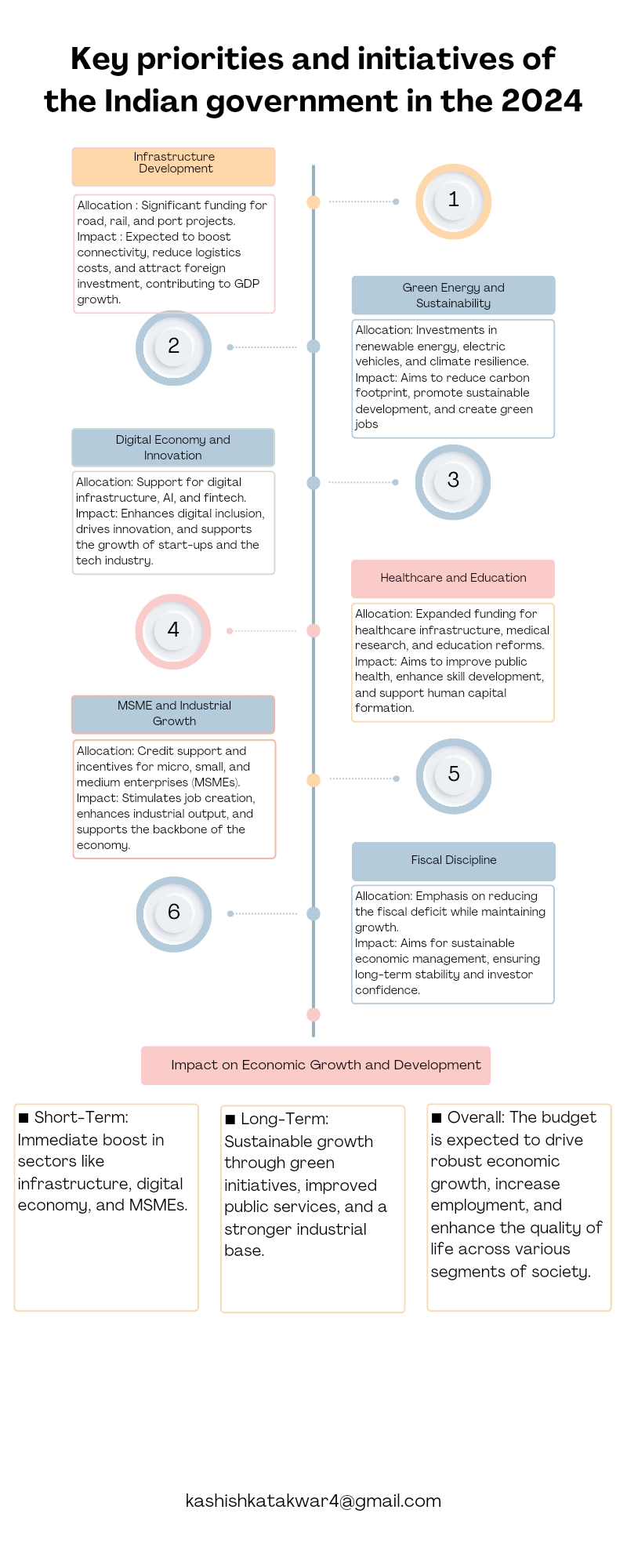
What are the key priorities and initiatives of the Indian government in the 2024 Union Budget, and how are they expected to impact the country's economic growth and development?
See less