

Do department-related parliamentary standing committees keep the administration on its toes and inspire reverence for parliamentary control? Evaluate the working of such committees with suitable examples.
Mains Answer Writing Latest Questions
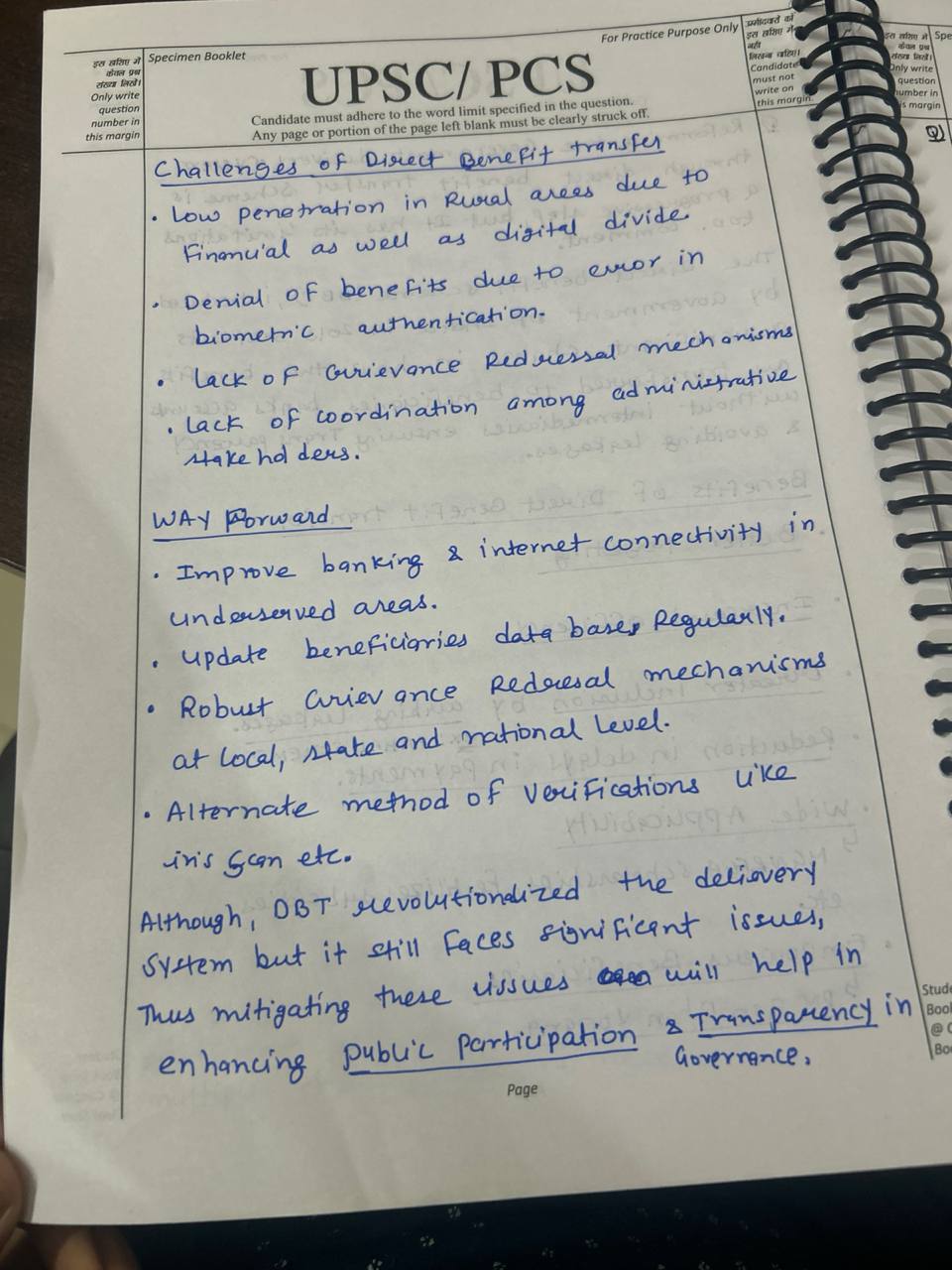
Reforming the government delivery system through the Direct benefit transfer scheme is progressive step, but it has its limitations too. Comment.


Anita DhruwLegend
The rights of persons with disabilities act, 2016 remains only a legal document without intense sensitization of government functionaries and citizens regarding disability. Comment.
-
The RPwD Act or the Rights of Persons with Disabilities Act, 2016, is an important law of India aimed at the safety, rights and dignity of persons with disabilities. It superseded the 1995 legislation, marking a significant step forward in legal advocacy for disability rights. While the act detailsRead more
The RPwD Act or the Rights of Persons with Disabilities Act, 2016, is an important law of India aimed at the safety, rights and dignity of persons with disabilities. It superseded the 1995 legislation, marking a significant step forward in legal advocacy for disability rights. While the act details the provisions the government should include in its planning, it remains a largely legal document that few outside the government are aware of.
Goals of the RPwD Act, 2016
The Act was enacted to comply with India’s obligations to the United Nations Convention on the Rights of Persons with Disabilities (UNCRPD). It is about being treated with dignity, equality and inclusion for people with disabilities. Key aspects of the act are:
Expanded Definition of Disability: The act broadens the definition of what constitutes a disability, covering more types of conditions, including certain learning disabilities, mental illnesses and chronic neurological disorders.
Prohibition against Discriminatory Practices: They cannot discriminate against people with disabilities in education, employment, and access to public services.
Equal Opportunities in All Aspects: The law obliges instituting job quotas in the public sector with special measures for education and training.
Strengthening Accessibility: It mandates both government and private organizations to provide accessible infrastructure, transportation, and communication.
Setting up monitoring and remedy frameworks: The act provides for the appointment of Central Disability Commissioner and State Disability Commissioners, creates mechanisms to redress complaints and punishes infractions.
The Importance of Awareness
A well-intentioned piece of legislation like the RPwD Act, 2016 is grounded in giving people with disabilities the chance to lead their life with dignity, but how far that has been translated depends on different stakeholders who are intrinsically connected to it. This is why awareness is so important:
Understanding the Law: Government workers, educators, employers and citizens must fully understand the law. They must understand the rights of people with disabilities, which parties owe them obligations and how the law is enforced and problems addressed.
Changing Perspectives: Perspective change in how we perception towards disability is a slow process. Raising awareness about both neurodiversity and accepted the nature of differences promotes the collapse of stereotypes, diminishes stigma, and create acceptance.
Training Staff Government employees need to be trained how to apply the law consistently. They must understand the needs of different disabilities, and create policies and programs that are inclusive.
Community Knowledge: People — particularly in areas with more disabilities — need to know their rights and where to get help. This knowledge enables them to self-advocate and seek help.
Collaborating: Awareness helps government, NGOs, and businesses to cooperate to support people with disabilities, exchanging best practices, resources, and skills.
Current Challenges
There are, however, several challenges to implementing the RPwD Act, 2016:
Awareness Deficiency: The act and its provisions are unknown to many of the government officials, educators, and employers leading to frequent violations and poor implementation of the act.
Lack of Training: Training for all government workers is short. Officials also may not know how to implement the act properly or know how to best support individuals with disabilities without proper training.
Stigma and Discrimination: Societal attitudes toward disability are major barriers. Despite legal protections, direct or indirect discrimination and stigma can underwrite barriers to the enjoyment of rights for persons with disabilities.
Shortage of Resources: There is a lack of financial and human resources available for implementation of the act Most organizations lack the resources or staff to develop inclusive infrastructure or provide specialized training.
Fragile Monitoring and Enforcement: There is no strong oversight机制。 Nothing guarantees that the act’s provisions will be enforced uniformly in different regions and in different industries, without robust supervision.
Methods to Enhance Awareness
With this in mind, the following strategies can help educate government employees and members of the public to address these issues:
Also Read: Integrated Training Sessions: Initiate in-depth training of government officials, teachers, employers and healthcare providers regularly. Such programs should also clarify legal requirements, disseminate best practices, and underscore the importance of being inclusive.
Public Awareness Campaigns: Implement mass media, community outreach, and educational initiatives to raise awareness of the rights of people with disabilities. Develop these campaigns for target audiences and highlight best practices and success stories.
School Curriculums: Include disability in school curriculums for education and inclusion at a young age This includes education about diverse disabilities, the rights of people with disabilities, and a need for accessibility.
Collaboration with Civil Society: Recognizing that the immediate stakeholders of the SDGs are NGOs, disability rights groups and advocacy organizations, and work with them to create awareness. They need their insights and first-hand experience to develop more effective policies and programs.
Strengthening legal and administrative structures: Better empower the Central and State Disability Commissioners and other legal institutions so that every law enacted has force and that grievances can be resolved expeditiously.
Policy: Institute omnibus public policy targeting inclusion of disability rights in all government programs. Make infrastructure projects, healthcare services, and social programs available to all.
Final Thoughts
The enactment of the Rights of Persons with Disabilities Act, 2016 is a milestone within the records of incapacity rights within the Indian subcontinent. But working together is key to making an impact. Education and training on disability rights for people within government as well as members of the public. Implementing awareness programs and integrating these rights into every social fabric are crucial. Not just a law that looks good on paper, but moves on to change the lives of all those with disabilities.
See less

Anita DhruwLegend
Account for the legal and political factors responsible for the reduced frequency of using Article 356 by the Union Governments since mid-1990s.
-
Introduction Article 356, or "President's Rule," of the Indian Constitution enables the President to assume the administration of a state if the government is not functioning. This is a controversial rule that the central government can misuse. Since mid-1990s, the imposition of Article 356 has seenRead more
Introduction
Article 356, or “President’s Rule,” of the Indian Constitution enables the President to assume the administration of a state if the government is not functioning. This is a controversial rule that the central government can misuse. Since mid-1990s, the imposition of Article 356 has seen a decline. This discussion examines the legal and political factors that have led to this decline.
Legal Factors
SW2023-A9 | Supreme Court Ruling (S. R. Bommai v. Union of India, 1994)
One of the major legal developments that had put a cap on the abuse of Article 356 is the Supreme Court’s 1994 judgement in S. R. Bommai v. Union of India. The court ruled that the invocation of President’s Rule necessitates the establishment of the failure of the government of a state. It also established judicial review, allowing the Supreme Court to judge the legality of such decisions. The ruling had made it difficult for the central government to use of Article 356 without strong justification.
Judicial Scrutiny and Later Cases
In the aftermath of the Bommai ruling, courts have adopted a more alert and vigorous stance towards the validity of grounds on which President’s Rule should be invoked. Many subsequent cases have only strengthened the principles established in Bommai, leading to a more cautious application of Article 356. The risk that any ruling could be overturned, and a new judicial intervention, has deterred the central government.
Legal Reforms and Guidelines
The central government was forced to issue clarification on the procedure for invoking Article 356 in the wake of the Bommai verdict. Under the new guidelines, the Governor must now report to the President in detail the situation and provide evidence of government failure. These processes have improved transparency and enhanced the legal structure applied to the action of Article 356.
Political Factors
Multi-Party Coalition Governments
Since the mid-1990s, the bjp only controls a portion of the government, the rest under the control of a coalition of other parties. These coalitions are more heterogeneous and less centralized than single-party governments. Since they need the support of regional parties, they do use Article 356 (clamp down on states) with caution. Antagonising coalition partners makes trouble and so the centre is loath to impose President’s Rule.
The Politics of State autonomy and Regional Hegemony
I have access to data until October 2023. States can be more proactive in asserting their rights under the Constitution, very often galvanizing public and political support against the imposition of President’s Rule. This assertiveness makes it political risky for the central government to use Article 356 without strong justification.
Public and Media Watchfulness
A key function of the media is to hold the central government accountable. The media has audited the implementation of individuals leaving the measures under Article 356. Negative media coverage and public outpouring has given the central government reason to hesitate to invoke President’s Rule.
Consequences And Effects Of Political Actors
Because implementing President’s Rule could make political fallout – e.g., a loss of voter trust, and credibility. In a democracy, such actions could hurt the central government in the elections. Moreover, political parties are cognizant of these adverse impacts and thus, frequently pursue alternative approaches to remedy governance challenges.
Shifts in the Political Scene
India’s political landscape has been transformed since the mid-1990s. The decline of single-party dominance and the rise of regional and caste-based politics have made it far harder for the central government to justify recourse to President’s Rule. The Lok Sabha and the Rajya Sabha comprise of diverse political interests who would not let the central government take such an action easily.
Conclusion
There have been both legal and political reasons, which has led to a decline in the application of Article 356 since the mid-1990s. Separated by law, S. R. Bommai v. Union of India and closer court scrutiny have made the central government more accountable, and the process more transparent. On the political front, the emergence of coalition governments and increasing state autonomy have made the application of President’s Rule more cautious. Public and media scrutiny also forces the government to proceed carefully. These developments have made for a more robust democracy with a better balance of power between the central government and the states.
See less
Anita DhruwLegend
How global capitalism creates economic zones? explain it.
-
How Global Capitalism Organizes Economic Zones Today, countries around the world open economic zones within their borders to attract foreign investment, increase economic activity, and grow the local economy. These include Special Economic Zones (SEZs), Free Trade Zones (FTZs), and Export ProcessingRead more
How Global Capitalism Organizes Economic Zones
Today, countries around the world open economic zones within their borders to attract foreign investment, increase economic activity, and grow the local economy. These include Special Economic Zones (SEZs), Free Trade Zones (FTZs), and Export Processing Zones (EPZs) — and are established by both rich and developing countries. These zones are a product of the movement of global capitalism, in which capital, goods, and services cross national lines without restraint. These economic zones are made possible by global capitalism, and this conversation discusses that and their impact on economic development.
The essence of Global Capitalism.
Global capitalism refers to an economic system where private corporations and market forces determine the allocation of resources and the production and distribution of goods and services. It functions on the basis of free trade, easily transported capital, and profit generation. One prominent physical manifestation of these concepts is known as economic zones, which are intended to create favorable conditions for companies and investors in specific areas.
We have also established economic zones to attract foreign investments.
Investor-Friendly: Economic zones are designed to attract foreign investors by providing tax reductions, lower import duties, administrative simplification, and good infrastructure. In fact, examples of slashing taxes and regulating light include China’s Special Economic Zones (SEZs) in Shenzhen and Guangzhou which were created to entice foreign businesses.
Zone Placement: These are often positioned close to porthole, border point, or on the outside of an industrial hub to facilitate international trade. This geographical positioning allows for lower shipping costs and better access to markets — all attractive qualities to foreign companies.
Making Business More Competitive
Cost Reduction Economic zones reduce business costs through cheaper labor, lower taxes, and less red tape. This is vital for labor-intensive or trade-sensitive industries.
Transfer of Technology & Expertise: Economic zones encourage technology and expertise transfer among nations. These companies also enhance the local skill set by introducing new technologies, management techniques, and training programs.
Boosting Regional Growth
Economic Diversification Economic zones promote the establishment of new industries, leading to diversification of the regional economy. This diversification decreases reliance on one particular industry, which lends stability to the region amid economic shocks.
Job opportunities: As businesses and foreign investment enter these zones, they will also create job opportunities that reduce the unemployment rate and poverty rate in the surrounding areas. This is especially important for developing countries where there are few job prospects.
Encouraging Export Growth
Export Oriented: Special economic areas are focused on exports for growth. They offer benefits like tax breaks, duty-free imports of raw materials and streamlined export procedures to businesses that sell products abroad.
Export Infrastructure: Companies in these zones can readily access international markets that increases their sales and hence profitability. This is particularly relevant for emerging markets seeking to solidify their foothold in international trade.
Regulatory Flexibility
Different Economic Rules: Economic zones have a different and often more business-friendly set of economic rules than the rest of the country. Such rules permit greater flexibility in labor laws and environmental standards, making the zones appealing to such companies that are looking for less rigid environments.
Pilot of Economic Changes: These areas serve as a testing ground for new economic policies. Governments can experiment with such reforms in these domains to see whether they work before scaling them up. China’s own zones, for example, were pivotal in experimenting with market reforms that became central to the nation’s economic strategy.
Affecting Economic Growth
Economic Growth
Positive GDP: One of the potential benefits of creating special economic zone can be used to boost the economy of a country, by attracting foreign investments, creating new industries and exporting goods.
Multiplier Effects: These zones can have positive effects for the broader economy. They attract investments and harvest jobs, increasing demand for goods and services, boosting business expansion.
Social Impact
Economic zones are attracted by businesses, providing employment opportunities, particularly for low-skilled workers, thus combating poverty and raising the living standards.
Gains from MNCs presence in these zones also aids in skill development as new training courses and education systems are adopted, allowing the future of the region to flourish economically.
Environmental Concerns
Sustainability Issues: Economic zones developed for growth may lead to environmental degradation, such as pollution and resource depletion. It must be regulation by governments to make this sustainable.
GreenZones: A few countries are creating eco-friendly, or green, zones that are designed to bring economic growth while also nurturing the environment.
Equity and Inequality
Regional Unequal development — Economic zones can create uneven regional development, where some parts of the economy benefit while others are left behind, increasing inequality.
Social Inequality: As the zones generate employment and create an eco-system around them, they may not equally benefit the poor, effectively increasing the rich and poor divide.
Democracy and Political Governance Issues
Corruption and Rent-Seeking: Special economic zones may become prey to corrupt practices where the financial incentives they provide to the entrepreneurs are misused, and they might also help in inefficient utilization of resources.
Separate Note: National governance structures are not designed for zones, making coordination more challenging. Lack of coordination gives rise to inefficiency and hampers development.
Conclusion
Economic zones play a crucial role in global capitalism as they aim to attract foreign investors, enhance competitiveness, and develop areas. Despite their great benefits for the economy, they are also associated with challenges and potential downsides. Governments and policymakers must make sure that these zones plan and operate in ways that support sustainable, fair economic development as one of the main drivers or purpose behind their existence. Striking a balanced approach is crucial for these zones to effectively enable developing nations to transition to global economy and ensure sustained economic growth in the long run.
See less
Anita DhruwLegend
Capitalism contributes towards unemployment. explain the statement.
-
Capitalism and Unemployment Capitalism is a type of economic system characterized by private ownership of businesses, that compete with one another in the market place, governed by efficiency and profit. It’s lauded for encouraging innovation, economic growth and individual liberty, but it’s also blRead more
Capitalism and Unemployment
Capitalism is a type of economic system characterized by private ownership of businesses, that compete with one another in the market place, governed by efficiency and profit. It’s lauded for encouraging innovation, economic growth and individual liberty, but it’s also blamed for causing joblessness. Structure and Cyclical reasons of how capitalism can lead to joblessness is the topic of this discussion.
Structural Factors
Technology and Automation
The rise of technology and automation: One of the most prevalent causes of unemployment in capitalist systems Profit-driven companies are always looking for ways to lower costs and increase efficiency. Automation — the use of machines and artificial intelligence — enables businesses to do more with fewer workers. While this may provide lower prices and higher productivity, it typically causes job losses. As machines take over their roles, workers in static sectors will lose their jobs, especially manufacturing and office administration.
You Learned About Globalization and Job Outsourcing
In its very essence, one of the defining characteristics of capitalism is globalization, which allows for the outsourcings of jobs to nations where labor is cheaper. Because of cheaper wages in developing nations, many large corporations outsource work to those countries, resulting in job losses for higher wage countries. It most often impacts factory and office workers; outsourcing is common in such fields as manufacturing, customer service and information technology.
Market Competition
Unemployment can also arise from the competitive side of capitalism. But to keep up with the competition, businesses are forced to innovate, resulting in mergers and acquisitions or the closure of inefficient businesses, thus leading to the loss of jobs. And new firms entering industries can unseat incumbents, leading to layoffs at older firms that are unable or unwilling to remain competitive.
Cyclical Factors
Economic Recessions
Recessions are part of the natural order of capitalism. (When they do occur, people spend less money, which causes businesses to scale back production and lay off workers). That rise in unemployment can cause even reduced spending, making the recession deeper. Recessions don’t last forever, but they can reshape the job landscape, because some positions may not return when the economy rebounds.
Boom and Bust Cycles
Capitalism tends to have boom and bust cycles. In boom times, the economy sprints, businesses grow and hire and hire. But in busts, such businesses can shrink their workforce to save cash. This cycle can create high unemployment in busts, and is especially hard on workers in more cyclical industries.
Rumors and Financial Crises
Financial bubbles caused by speculation in financial markets motivated by profit-seeking can trigger financial crises. Like all bubbles, they burst, and then financial institutions go under and affect the broader economy. The 2008 financial crisis, for instance, resulted in widespread job losses as banks and other financial firms reduced their workforces or failed altogether. By that, I mean that such crises can convert into major effects on labour markets, leading to a credit crunch and a deceleration of investment in the real economy.
Policy and Institutional Factors
Flexibility of Labor Markets In capitalist nations, economic performance is a priority, therefore flexibility of the job market comes first. It is easy for companies to hire and fire workers, so job hopping is common and job security is not guaranteed. This is good for businesses, as it allows them to adapt to shifts in the marketplace, but it can also contribute to unemployment under certain circumstances, especially when the economy contracts.
The Erosion of Labor Unions
Labor unions are vital for protecting workers’ rights and providing fair wages and working conditions. But in many capitalist societies, unions have been weakened, which allows companies to reduce wages or eliminate jobs more easily. Weakened unions have made it more difficult for workers to negotiate better job conditions, leading to potentially higher unemployment.
Government Policies
Policies in capitalist countries can have a major impact on unemployment. Those emphasizing deregulation and cutbacks in protections for workers might cause unemployment to rise. In highly appropriate fashion, government policy can offset the damage that laissez faire capitalism does to the job market. However, the impact of such policies is highly variable.
Conclusion
Capitalism is a powerful force for economic growth and innovation, but can also lead to unemployment. This grew beyond mere, simplistic factors such as technological change, globalization, market forces, economic downturns and financial crises, etc. And flexible labor markets and weaker unions can contribute to higher unemployment. We need to understand these characteristics to inform policies that lessen the adverse impact of capitalism on jobs, so we can work towards a fairer and more sustainable economy for all.
See less
Anita DhruwLegend
1857 के विद्रोह के पीछे क्या कारण था? 1857 का विद्रोह सफल क्यों नहीं हुआ? 1857 के विद्रोह के परिणाम
Anita DhruwLegend
What are the articles that deal with the organization, composition, duration, officers, producers, privileges, and power of the state legislature? explain.
-
This answer was edited.
Introduction The state legislature is a part of the machinery of government as provided by the Constitution of India. Its task is to write the laws of the state, to make sure that the machinery of governance runs in accordance with democracy and the rule of law. The Constitution describes how the goRead more
Introduction
The state legislature is a part of the machinery of government as provided by the Constitution of India. Its task is to write the laws of the state, to make sure that the machinery of governance runs in accordance with democracy and the rule of law. The Constitution describes how the government is intended to work in India by describing how state legislatures are constructed and what their powers are. This article will dissect these provisions in the Constitution to help contextualize how state legislatures are structured and the parameters of the arrangement.
Organization and Composition
Article 168 of the Constitution lays down how state legislatures will be structured. It allows for a bicameral (two chambers) system or unicameral (one chamber) system, depending on the each states discretion. With the exception of Andhra Pradesh, Bihar, Jammu and Kashmir, Karnataka, Maharashtra, Telangana and Uttar Pradesh, all states in India have unicameral legislatures.
Unicameral Legislature — one house, the Legislative Assembly
2 Houses — Program: Bicameral Legislature — Legislative Assembly and Legislative Council.
Article 171 Eligibility for the membership of State legislature Candidate must be an Indian national and over 25 for the Legislative Assembly or over 30 for the Legislative Council. They also have to meet other qualifications set by the state, and they cannot hold a paid governmental position.
Duration
As per Article 172, the state legislature has a five-year term, which means that the Legislative Assembly generally runs for this period, unless it is dissolved before that. This can be extended by one year at a time, if the state are under the President’s Rule, as per Article 356, but only up to a total of three years. In contrast, the Legislative Council is a permanent body and does not dissolve. Instead, every other year, one-third of its membership retires and elections are held to replace them.
Officers
As there are rules for many legislative meetings, the state legislature’s officers are important. In the Legislative Assembly, these are the Speaker and Deputy Speaker. In the Legislative Council they are the president and vice president.
Speaker and Deputy Speaker: Contributors of Legislative assembly go with a Speaker and a Deputy Speaker by means of the provisions of Article 178. The Speaker presides over assembly meetings and the Deputy Speaker assists him and acts on his behalf when the Speaker is not able to act.
Chairman and Deputy Chairman: Article 179 members of the Legislative Council elect a chairman and a Deputy Chairman. Chairman: Presides over Council conferences; the Deputy Chairman assists and fills in if the Chairman is unavailable.
Privileges and Powers
The state legislature has forms and oversight powers to keep an independent and honest legislative course. Article 194 of the Constitution gives these privileges and powers just like that of Parliament.
Entitlements: Members are entitled to certain protections to conduct their functions without fear. These include the right to speak freely during legislative meetings, protection from being sued for what they say there, and access to information and resources that they may need.
Powers: It can legislate on matters in the Seventh Schedule of the Constitution under the State List and the Concurrent List. Article 246 describes the subject matters over which the respective governments will legislate. The state parliament can also amend the state’s constitution, but to a lesser extent than the Union Parliament.
Addition of Provisions for Officers of the State Legislature
Removal of Officers: The procedure for removal of Speaker, Deputy Speaker, Chairman and Deputy Chairman is provided in Articles 178 and 179. They may be expelled by a majority vote of house members, with at least one-tenth of members qualifying in favor of the resolution.
Salaries and Allowances: Article 174 mentions the state legislature is responsible for determining the remuneration and allowances for the Speaker, Deputy Speaker, Chairman, and Deputy Chairman, all of which are financed from the state’s Consolidated Fund.
State Legislature: The Powers of the State Legislature
The state legislature has all necessary powers for governing the state, per the Constitution:
Law-Making Powers: The state legislature can make laws on subjects in the State List and Concurrent List under Articles 246 and 248 of the Constitution, except for subjects allocated to the Union Parliament.
Financial Powers: Articles 202 and 203 define financial powers of the state legislature, including approving the state budget, deciding on taxes and permitting government spending.
Executive Oversight: State legislature manages executive branch by approving budget, questioning ministers and passing vote of no confidence which can lead to government stepping down.
Constitutional Amendments: According to Article 368, the state legislature can amend the state constitution by following prescribed procedures in consonance with the Constitution.
Conclusion
The state legislature is an important institution that handles the work of the state in India. It has a well-defined method by which it will work, including its structure, composition, tenure, officers, privileges and powers, and this is how it gets its name, the Constitution. These provisions are useful to know for anyone interested in learning how laws are made and how states are, in turn, governed, in India.
See less
Anita DhruwLegend
Act of panchayat raj with rural development on 73rd constitutional. explain it and amendment.
-
The 73rd Amendment and Panchayati Raj: A Cornerstone in Rural Development Introduction The article discusses the 73rd Constitutional Amendment Act of 1992, also referred to as the Panchayat Raj Act, which was a significant legislation in India aimed at promoting local self-governance in rural areas.Read more
The 73rd Amendment and Panchayati Raj: A Cornerstone in Rural Development
Introduction
The article discusses the 73rd Constitutional Amendment Act of 1992, also referred to as the Panchayat Raj Act, which was a significant legislation in India aimed at promoting local self-governance in rural areas. This act acknowledges the importance of grassroots democracy and its fundamental role towards development and social justice through panchayats. The amendment sought to decentralize power and enhance grassroots participation by institutionalizing the system of Panchayat Raj.
Background and Context
Before the 73rd Amendment, Panchayati Raj institutions were regulated by state laws, which resulted in disparate laws and more or less autonomy for these bodies based on the respective state legislations. “Government of India felt the need to have a uniform framework for strengthening these institutions as partners in rural development.” It provided for three-tier system of rural local self government by way of 73rd amendment to constitution Zila parishad, Panchayat samiti and Gram panchayat.
Important Features of 73rd Amendment Act
Constitutional Recognition of Panchayats: Part IX of the Constitution of India, which contains the provisions regarding the Panchayat Raj institutions, was inserted in the Constitution of India by the 73rd Amendment Act. Articles 243 to 243-O are included in this part in which the constitutional and legal basis of the operation of panchayats is given.
Elections: The amendment makes provision for regular elections to the panchayats every five years. This keeps the panchayats responsible to the people and enforces an ongoing continuum of democratic engagement.
Reservations of Seats: One of the important provisions given by the act is that it reserves the seats for the Scheduled castes (SCs), Scheduled tribes (STs), and women. This promotes social inclusion to ensure marginalized communities have a voice at the local level. Women have been reserved at least one-third of the total number; as also, a certain number of seats have been reserved for SCs and STs in proportion to their numbers in the population.
Direct Election of Chair persons: The Act provide for direct election of chair persons of all levels of panchayat system. This will ensure that the leadership is elected by the people and answerable to them directly.
Devolution of powers and functions: The amendment requires the panchayats to devolve powers and functions. These include planning and implementing schemes for economic development and social justice in the fields of agriculture, education, health, watershed and water supply. According to the Constitution, the state governments must devolve certain functions to the panchayats as mentioned in the Eleventh Schedule.
Independent Finance Commission : It is to mandatorily constitute a State Finance Commission in each state to review the financial position of the panchayats and to recommend the panchayats the principle which are to be followed by the state when allocating the financial resources. It shall ensure that sufficient financial power is given to the panchayats to carry out their functions.
Superintendence, Direction, and Control: The State Election Commission shall direct the control the entire process of conducting elections to the panchayats. It also provides self-governance through the elected bodies at the village, intermediate and district levels and to ensure that the panchayats at each level are endowed with such powers and authority as may be necessary to enable them to function as units of self-government.
Impact on Rural Development
The 73rd Amendment Act, with its far reaching effects in Indian society is one of the landmark initiatives in rural development in India. Through empowering the Panchayat Raj institutions, it has:
Improved Local Involvement: The act has improved rural communities’ involvement in decision-making processes, rendering governance more inclusive and participatory. It has resulted in more diversity in interests and needs, as well as instilling the feeling of ownership and responsibility in the masses.
Social Inclusion: The reserved seats for the weaker sections of the society have facilitated social integration. Local governance now has considerable presence of women, SCs and STs which has integrated another dimension of empowerment and positive changes in social indicators.
Better Service Delivery: With the devolution of powers and functions, rural services and functions are being performed more efficiently and effectively. Panchayats have a better understanding of local requirements and can implement development schemes accordingly.
Nurtured Economic Development: It has enabled numerous economic development programs to be implemented at the grassroots level. Panchayats have also been instrumental in implementing rural electrification, road construction, and the promotion of small-scale industries in rural areas, thus leading to the overall economic development.
The direct elections of chairpersons through direct elections have strengthened the regularity of democracy in the works of democracy. This has enabled enhanced transparency and accountability which significantly diminishes the possibility for corruption and maladministration to take place.
Challenges and Limitations
While this has been beneficial, various challenges have confronted the implementation of the 73rd Amendment Act:
More Power To States: At times, states tend to retain central-axis power making it difficult to vest actual power with panchayats. It weakens the panchayat system, and hampers it from development.
Resource Deficiency: Most panchayats are under-resourced, both financially and in terms of human resources to properly carry out their functions. This is usually a consequence of underinvestment at the state government level, as well as a shortage of trained workers.
Bureaucratic Interference in Functioning Complex: Bureaucratic interference and unwillingness to grant panchayats the authority to function in an autonomous manner could stymie the institutions. And it was hardly a rugged promise, especially in areas with a resilient state bureaucracy.
Limited Awareness: The rural people have a limited awareness of their rights and responsibilities under the Panchayat Raj. This leads to low participation and ineffective mechanisms of review of panchayat activities.
Conclusion
The shallowness of India as a state brought on through the 73rd Constitutional Amendment Act, 1992, so, is one leap in the direction of decentralized governance via the tool of elected local bodies in village, block, district, and even out of the court places. It has enabled to introduce a more participatory and inclusive model of governance by affording constitutional standing to the Panchayat Raj institutions. Nonetheless the success of this Act will depend on the adequate enforcement of its provisions and the willingness of state governments to handover power and funds to the panchayats. There are challenges and shortcomings, but if those are countered, panchayats can become a true pillar of democracy and sustainable rural development.
See less
What are the major changes brought about in the taxation of capital gains by the Finance (No.2) Bill, 2024? -Introduction of Capital gain tax -categorized -applicability
-
Alterations to the Taxation of Capital Gains by the Finance (No.2) Bill, 2024 The FY2024 Finance (No.2) Bill 2024 makes radical changes to the taxation of capital gains and represents a watershed moment in the UK tax regime. The changes are designed to improve tax fairness and efficiency, making theRead more
Alterations to the Taxation of Capital Gains by the Finance (No.2) Bill, 2024
The FY2024 Finance (No.2) Bill 2024 makes radical changes to the taxation of capital gains and represents a watershed moment in the UK tax regime. The changes are designed to improve tax fairness and efficiency, making the tax system more attuned to the realities of modern economic conditions and investment norms. This article discusses the salient changes brought about by the bill, including capital gains tax, its classification and applicability.
Capital Gains Tax
The introduction of a full Capital Gains Tax (CGT) regime is finally cemented in the Finance (No.2) Bill, 2024. Capital gains tax is a profit between the buying and selling of property shares or other investments. Before this bill, the UK’s capital gains treatment within its tax code was lacking in organization, often leading to inconsistencies and inefficiencies. CGT will be brought in to fix these problems and create a fairer, more transparent tax regime.
The GBP intends to ensure that all individuals and entities benefitting from capital gains make their proportionate contribution to public coffer. It is however worth noting that this tax would be based on the profit obtained from the sale of an asset, taking into consideration a number of deductible costs and exemptions. So the CGT rate would be a progressive tax with higher income brackets paying higher rates, queuing up with the principle of vertical equity in taxation.
Classification of Capital Gains
In order to better reflect the more-crafted nature of capital assets and to appropriately apply the tax, the bill divides capital gains into multiple separate categories. The classification plays a key role in deciding what rate of tax applies and which reliefs or allowances may be available. The main categories include:
Deduction Threshold on Residential Properties: The profit on the disposal of residential properties (primary and second homes) will still be handled separately from SMEs There are specific rules on this category of gains, such as the Principal Private Residence (PPR) relief, which means you do not have to pay CGT on the sale of your principal home if certain criteria are met.
Commercial Property Gains: This would cover gains from commercial property investments which may range from office buildings, retail spaces to even industrial properties. Commercial property gains have a tax rate, as a rule, that is higher than for residential properties so as not to encourage speculative buying in commercial real estate.
Share gains: The sale of shares and other securities will be considered share gains. This comprises public and private equity. The tax rate on share profits is intended to be competitive with other asset classes so that people are encouraged to invest in the equity market which drives economic growth.
Business Assets Sale: Assets Sale from business, like machinery, IP and Business Goodwill, will now be treated as different. There are specific reliefs available for entrepreneurs and businesses, such as Entrepreneurs’ Relief (now known as Business Asset Disposal Relief), which continues to allow individuals a reduced capital gains tax rate when selling qualifying business assets.
Other Capital Assets: This category includes a variety of other capital assets, including art, collectibles, and certain financial instruments. Tax on these assets are generally a fixed rate, but specific rules and exemptions can be applied.
How the Capital Gains Tax Will Work
The new CGT regime applies to a wide variety of persons; both individuals and entities. Some key points of applicability include:
Individuals: All individuals are liable to CGT on their capital gains if they are UK residents. For example, non-residents could also be subject to capital gains tax on certain categories of capital gains, notably those derived from UK property and business assets.
Trusts and estates: These are subject to CGT too. Tax is an important trust issue, and the bill ensures the CGT payable is fair, by confirming the specific rules that apply to trusts with regard to the calculation and payment of CGT.
Companies: Capital gains by companies will be taxed under Corporation Tax, but the Finance (No.2) Bill, 2024 proposes an alternative basis of assessment for capital gains for companies, as well as a simplified reporting regime intended to lower compliance costs.
Exemptions and Allowances: Several exemptions and allowances are provided by the bill to reduce the tax liability. For instance, there is the Annual Exempt Amount (AEA) which permits individuals to form a specific sum of capital gains with out paying tax on it every year. Special reliefs exist for particular classes of investment/situation, e.g. rollover relief for re-investment in qualifying assets.
New Reporting Requirements : The bill includes new reporting requirements to help ensure compliance. Taxpayers will have to report their capital gains every year, and the tax authority will be better equipped to audit and enforce. The goal is to make the tax system more transparent and fair by eliminating tax avoidance and evasion.
Conclusion
Act of Rock Streams: The Finance (No.2) Bill 2024 — Removing Trampoline Springs — A Radical Rejigging of Capital Gains Tax in the UK The bill aims to address this by establishing a comprehensive CGT regime, segmenting it based on three classifications of capital gains and determining the benchmark for the tax’s applicability. These reforms are aimed at generating more revenue for the state, whilst also promoting responsible investment and supporting economic development. Given the complexity of the regulations, taxpayers are encouraged to review the new rules and they should seek professional assistance to ensure they comply with the new regulations as well as take full advantage of the available exemptions and allowances.
See less
The Committees Standing, especially those that are related to government departments, assist in ensuring that the administration is made to answer and operate correctly in line with the laws. These Committees act as connecting links between the legislature and the executive branch of the governmentRead more
The Committees Standing, especially those that are related to government departments, assist in ensuring that the administration is made to answer and operate correctly in line with the laws. These Committees act as connecting links between the legislature and the executive branch of the government in facilitating continuous oversight and scrutiny of them. In assessing the working of the committees, we may tell if they indeed keep the administration in a living scrutiny and would, additionally, instill a greater respect for parliamentary control.
The Role of the Department-Related Parliamentary Standing Committees
Department-related parliamentary standing committees are permanent functional bodies of Parliament focusing on and dealing with the business of specific governmental departments or policy areas. The standing committees essentially initiate with consideration of legislation, monitoring government actions and programs, examining proposals for the budget, and inquiring into other matters of public concern. Standing committees are usually composed of elected Members of Parliament representing different political parties and viewpoints.
The activities of the committees include oversight and holding accountable the government for its organization of affairs and will never be subserved. The Public Accounts Committee has laid down an inflexible examination of public expenditure. It is empowered to summon witnesses-including most importantly, high-ranking government officials and chief officers of departments-to give their testimonies and reasoning for variations on the books relating to public spending or inefficiencies in the management. The constant oversight carries with it the continued discovery of possibilities for reform and improvement in the administration, therefore keeping it on its toes.
Legislative Consideration:The Department-related committees, in this case, review and provide recommendations concerning proposed legislation. The Department-Related Standing Committees are crucial to this function in India. For example, the DRSC on Home Affairs reviewed the Citizenship (Amendment Bill), 2019, and put together a detailed report raising myriad concerns and offering suggestions. The process forces the government to explain and refine its bills, compelling them into line with the public interest and the constraints of legality.
Policy Monitoring:Let there be these committees to further oversight the implementations of government policies and programs. In Australia, for example, Senate Standing Committees on Finance and Public Administration follow that regular examination of the soundness of government initiatives. Their inquiry into the implementation of the National Disability Insurance Scheme had it highlighted quite a number of issues that subsequently led to recommendations for policy readjustments. The never-ending strictures of such monitoring assure the administration would stick to accomplishing the outcomes it has pledged.
Inspiring Respect for Parliamentary Control
Public Trust: Works of department-related committees generally inspire greater public trust where the legislative process and government accountability take shape. Live broadcasts and dissemination of reports of committee hearings can offer better insight into how parliamentary control functions. In the United States, the House Committee on Oversight and Reform has garnered media attention as a result of its preferential inquiries, leading to reforms and quite a few notable changes in policy.
Bipartisan Cooperation: Most of the time, the committees are thus bipartisan; they happen to bring together individuals from opposing political parties in a partnership that helps find a common cause. Through such a path of cooperation, respect for parliamentary procedures and the rule of law could gain an impetus. An example includes the Canadian Standing Committee on Public Accounts, which has always been characterized by bipartisan cooperation critical to maintaining the integrity of the committee’s work and holding the government to the same standards, regardless of the party in power.
Power to Initiate Inquiries: It can be said that department-related committees yield an extensive impact with their improved public awareness initiatives, culminating in findings and recommendations of resounding worth. The thorough probing of certain administrative actions and decisions can serve as a specific deterrent to officeholders’ misbehavior and also serve to inspire good governance. An example of this would be a lot of inquiries conducted by the Portfolio Committee on Police on police brutality and corruption in South Africa that in all instances led to policy changes and the outworking of new oversight mechanisms.
Challenges and Limitations
In addition to being a critical part for the democratic nature of governance with their beneficial functions and operational advice are fraught with various challenges:
Resource Constraints: From time to time, with little space to manoeuvre, these Committees can make it less effective from-the-core attention and frequency in terms of their oversight. Sufficient funding and appropriate staffing can mediate the effective functioning of a Committee.
Political Interference: There is the possibility of political interference whereby committee members might prioritize the interest of the party over that of public scrutiny. This can be tackled through balanced party representation within the Committee with a stringent code of conduct in place.
Executive Resistance: Occasionally, answers to committee interrogatories are rejected or delayed by the executive, to the detriment of profitable operations on the part of the committee itself. Stronger parliamentary rules and support from legislative leadership are most required to address such resistance.
Conclusion
See lessThe parliamentary standing committees, related to concerned ministries or departments, have been the right balance of power existing between the legislature and executive branches of government. Continuous oversight, review of legislations, and monitoring of policies keep the administration quite alert. In the course of time, this work has mostly nurtured a State respect for parliamentary control, showcasing its credibility and accountability in matters of governance. However, for their optimal functioning with the fullest potential being attained, overcoming resource constraints, political interference, and executive resistance is important. When this happens, they can prove to be significant in enhancing the effectiveness and legitimacy of governance so that it functions with great diligence towards serving public interests.