
Home/Science & Technology/Achievements of Indians/Page 6
Achievements of Indians
Share
Lost your password? Please enter your email address. You will receive a link and will create a new password via email.
Please briefly explain why you feel this question should be reported.
Please briefly explain why you feel this answer should be reported.
Please briefly explain why you feel this user should be reported.
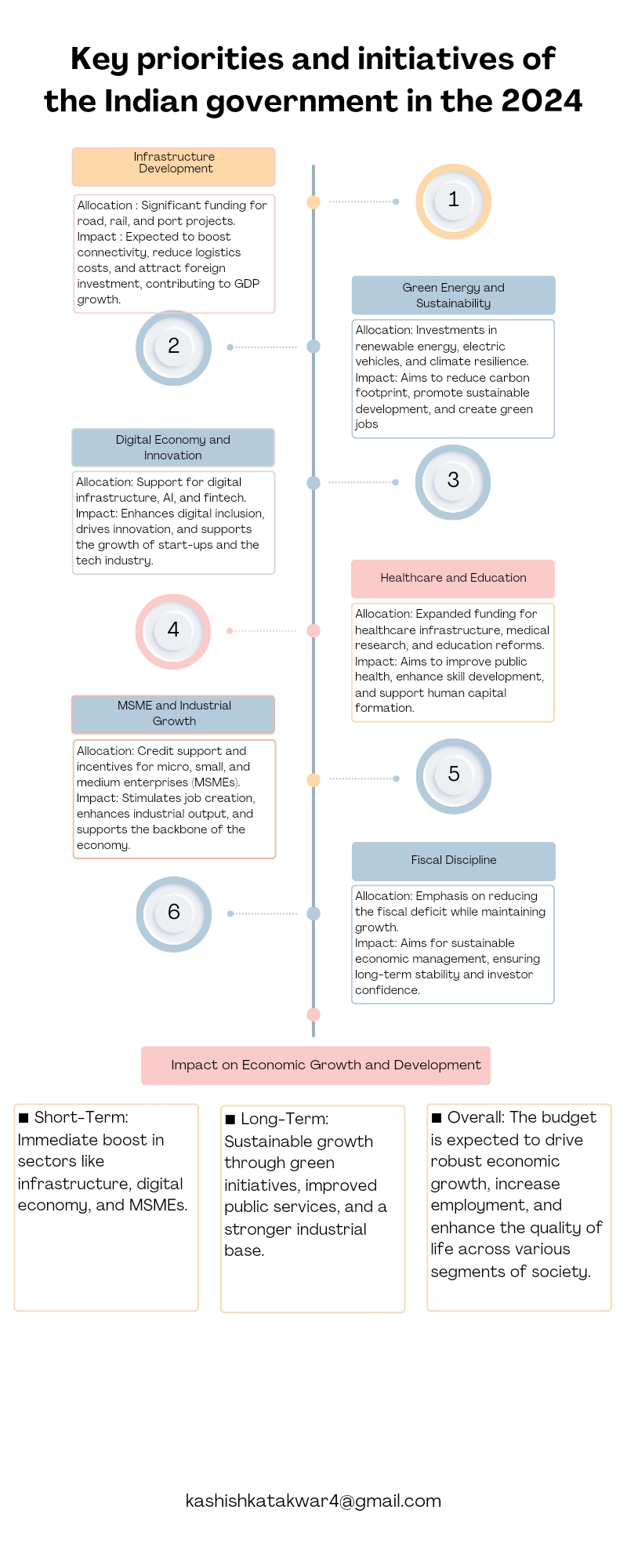
What are the key priorities and initiatives of the Indian government in the 2024 Union Budget, and how are they expected to impact the country's economic growth and development?
See lessHow is India addressing climate change and environmental sustainability in 2024, and what are some significant policies or actions being taken to combat environmental issues?
In 2024, India is actively addressing climate change and environmental sustainability through various policies and actions. Here are six significant measures being taken: 1. National Action Plan on Climate Change (NAPCC) Enhancement: India has updated its NAPCC to include more ambitious targets forRead more
In 2024, India is actively addressing climate change and environmental sustainability through various policies and actions. Here are six significant measures being taken:
1. National Action Plan on Climate Change (NAPCC) Enhancement: India has updated its NAPCC to include more ambitious targets for renewable energy, energy efficiency, and climate resilience. This includes expanding the scope of the existing missions and introducing new missions focused on sustainable agriculture and green transport.
2. Renewable Energy Expansion: India continues to invest heavily in renewable energy, with a target to achieve 500 GW of renewable energy capacity by 2030. Significant investments are being made in solar and wind power projects, along with initiatives to promote the use of biofuels and hydrogen as alternative energy sources.
3. Afforestation and Reforestation Programs: Initiatives like the Green India Mission and state-level programs aim to increase forest cover and restore degraded ecosystems. These efforts contribute to carbon sequestration, biodiversity conservation, and the enhancement of ecosystem services.
4. Promotion of Electric Vehicles (EVs): To reduce carbon emissions from the transportation sector, India is promoting the adoption of electric vehicles through subsidies, tax incentives, and the development of EV charging infrastructure. Policies aim to make EVs more affordable and accessible to the general population.
5. Waste Management and Plastic Ban: India is enforcing stricter regulations on waste management, including solid waste and electronic waste. Additionally, the government has implemented a nationwide ban on single-use plastics, encouraging the use of sustainable alternatives and promoting recycling.
6. Climate-Resilient Infrastructure: Investments are being made in developing infrastructure that can withstand the impacts of climate change, such as extreme weather events and rising sea levels. This includes building climate-resilient urban infrastructure, improving water management systems, and enhancing disaster preparedness and response mechanisms.
See lessWhat are your thoughts on India's taxation system?
India's Taxation System: A Comprehensive Overview Introduction India's taxation system is crucial for revenue generation and economic development. It involves a mix of direct and indirect taxes, with significant reforms and challenges influencing its effectiveness and fairness. Key Features of the TRead more
India’s Taxation System: A Comprehensive Overview
Introduction
India’s taxation system is crucial for revenue generation and economic development. It involves a mix of direct and indirect taxes, with significant reforms and challenges influencing its effectiveness and fairness.
Key Features of the Taxation System
Direct Taxes
Income Tax: This is levied on individuals and corporations based on their earnings. Recent reforms include the introduction of new income tax slabs and reduction in corporate tax rates.
Corporate Tax: The rate for domestic companies was reduced to 22% in the 2019-20 budget, aimed at boosting investment. Additionally, new manufacturing companies were offered a lower rate of 15%.
Indirect Taxes
Goods and Services Tax (GST): Implemented in July 2017, GST aims to unify the tax structure by merging various central and state taxes into a single tax. This has simplified the tax regime but has faced criticism for its complexity and high compliance burden.
Customs Duty: This tax is levied on imports and exports. Recent changes include the increase in customs duties on certain products to promote domestic manufacturing under the Atmanirbhar Bharat initiative.
Recent Reforms and Developments
GST Reforms: The introduction of the GST e-invoicing system and amendments in the GST Act aim to streamline compliance and reduce tax evasion. The GST Compensation Cess for states was extended till 2026 to compensate for the revenue losses due to GST implementation.
Faceless Tax Assessment: The Faceless Assessment Scheme, introduced in 2020, aims to reduce human interface and improve transparency in tax administration. This initiative is part of the broader Digital India push.
Amendments to Direct Tax Laws: The Finance Act, 2024, brought several changes, including a reduction in tax rates for certain income brackets and enhanced deductions for taxpayers, reflecting the government’s focus on increasing compliance and easing tax burdens.
Challenges Facing the Taxation System
Complexity and Compliance Burden: Despite GST’s intent to simplify, many businesses struggle with its compliance requirements. The frequent changes and varying state-level rules contribute to this complexity.
Revenue Collection and Evasion: The effectiveness of tax collection is hindered by evasion and the informal economy. Measures like the Pradhan Mantri Garib Kalyan Yojana (PMGKY) and Income Disclosure Schemes have been introduced to address these issues, but challenges remain.
Economic Disparities: The current tax structure has been criticized for not adequately addressing income inequality. There is ongoing debate about whether the tax system sufficiently redistributes wealth and provides support to lower-income groups.
Conclusion
India’s taxation system has evolved significantly, with substantial reforms aimed at improving efficiency and fairness. However, challenges related to complexity, compliance, and revenue collection persist. Continued reforms and effective implementation are crucial for ensuring that the taxation system supports equitable economic growth and development.
See lessIlliteracy
Illiteracy is a major barrier to personal and societal advancement, affecting millions worldwide. Those who cannot read or write struggle with everyday tasks such as accessing information, securing employment, and managing finances, which perpetuates poverty and limits opportunities for personal groRead more
Illiteracy is a major barrier to personal and societal advancement, affecting millions worldwide. Those who cannot read or write struggle with everyday tasks such as accessing information, securing employment, and managing finances, which perpetuates poverty and limits opportunities for personal growth.In many developing countries, illiteracy rates remain high, particularly among women and marginalized groups. Cultural biases, economic constraints, and inadequate educational facilities often prevent these groups from receiving proper education. This gender and socio-economic disparity exacerbates inequality and hinders progress towards a more inclusive society.The impacts of illiteracy are far-reaching. Illiterate individuals face difficulties in understanding health-related information, which can lead to poorer health outcomes. They also have limited access to legal resources and government services, affecting their ability to advocate for their rights and participate fully in civic life.Efforts to address illiteracy need to focus on improving access to education for all, including adult literacy programs and community-based learning initiatives. Technological innovations, such as online courses and educational apps, can also play a crucial role in reaching underserved populations.Combating illiteracy is essential for fostering economic development, enhancing health and well-being, and promoting social equity, ultimately contributing to a more just and thriving global society.
See lessHow women empower ourselves by breaking the social stereotype?
Women are challenging and breaking social stereotypes in numerous ways.By pursuing careers traditionally dominated by men, they're proving their capabilities and shattering glass ceilings. They're advocating for equal pay and challenging gender biases in the workplace. Women are also leading sociaRead more
Women are challenging and breaking social stereotypes in numerous ways.By pursuing careers traditionally dominated by men, they’re proving their capabilities and shattering glass ceilings. They’re advocating for equal pay and challenging gender biases in the workplace. Women are also leading social movements, raising awareness about issues like domestic violence and sexual harassment. They’re embracing their individuality, challenging beauty standards, and promoting body positivity.By breaking free from societal expectations, women are empowering themselves, gaining confidence, and inspiring others to do the same. This creates a ripple effect, leading to a more just and equitable society for all.
See lessIndia
India, officially known as the Republic of India, is a country located in South Asia. It is the seventh-largest country by land area and has a population of over 1.4 billion people, making it the second-most populous country in the world. India is a federal constitutional republic governed under a pRead more
India, officially known as the Republic of India, is a country located in South Asia. It is the seventh-largest country by land area and has a population of over 1.4 billion people, making it the second-most populous country in the world. India is a federal constitutional republic governed under a parliamentary system and is divided into 29 states and 7 union territories. The country has a diverse geography, which includes the Himalayan mountains, the Indo-Gangetic Plain, and the Deccan Plateau. India is also home to a rich cultural heritage, including various languages, religions, and cuisines. It is a rapidly developing country with a growing economy and a prominent player in global affairs. India is also known for its vibrant culture, including music, dance, art, and literature, and is home to many UNESCO World Heritage Sites.
See lessHere's a more precise question based on your interest in the achievements of Indians: **Question:** "What are some of the significant achievements of Indians in various fields such as science, technology, literature, and arts? Provide examples of at least two notable individuals and their contributions in each field."
There has been immense contribution of the Indians in the field of science, technology, art and literature. From perceiving life in plant to composing Gitanjali, Indians have continued to contribute the finest of the works. Two examples of such contributions are Mr.Satyendranath Bose, who simultaneoRead more
There has been immense contribution of the Indians in the field of science, technology, art and literature. From perceiving life in plant to composing Gitanjali, Indians have continued to contribute the finest of the works.
Two examples of such contributions are Mr.Satyendranath Bose, who simultaneously worked with Einstein to discover the Boson particle and Oscar winner Mr. Satyajit Ray, who is well known for creating notable films ever and inspiring Stephen Spielberg to make E.T.
See lessCertainly! Here's a question related to Indian cricket: **Question:** "What are some of the most significant achievements in the history of Indian cricket? Highlight key milestones, notable players, and memorable matches that have shaped the sport in India."
Introduction: Indian cricket has a rich history marked by remarkable achievements, iconic players, and unforgettable matches that have left an indelible mark on the sport. Understanding the significant milestones, players, and matches that have shaped Indian cricket is crucial to appreciating the evRead more
Introduction:
Indian cricket has a rich history marked by remarkable achievements, iconic players, and unforgettable matches that have left an indelible mark on the sport. Understanding the significant milestones, players, and matches that have shaped Indian cricket is crucial to appreciating the evolution and impact of the game in the country.
1. Early Milestones:
1952 Test Debut: India played its first Test match in 1932 against England at Lord’s, marking the beginning of a storied journey in international cricket.
First Test Victory: India secured its first Test victory in 1952 against England at Chennai, a historic moment that laid the foundation for future successes.
2. World Cup Triumphs:
1983 World Cup: India’s iconic victory in the 1983 Cricket World Cup under Kapil Dev’s captaincy, defeating the mighty West Indies in the final, marked a watershed moment in Indian cricket history.
2011 World Cup: The 2011 Cricket World Cup win on home soil, led by MS Dhoni, solidified India’s status as a cricketing powerhouse and brought immense pride to the nation.
3. Notable Players:
Sachin Tendulkar: Widely regarded as one of the greatest batsmen in cricket history, Sachin Tendulkar’s record-breaking career and sheer consistency have made him an icon of Indian cricket.
Kapil Dev: The legendary all-rounder, Kapil Dev’s leadership during the 1983 World Cup victory and his contributions to Indian cricket have solidified his legacy.
4. Memorable Matches:
Eden Gardens Test 2001: The iconic Test match between India and Australia at Kolkata in 2001, where VVS Laxman and Rahul Dravid staged a remarkable partnership to secure an improbable victory, is etched in cricketing folklore.
T20 World Cup 2007: India’s triumph in the inaugural ICC T20 World Cup in 2007, led by a young MS Dhoni, showcased India’s prowess in the shorter format and sparked a T20 revolution in the country.
Recent Examples:
2018 Australia Test Series: India’s historic Test series win in Australia in 2018-19, the first-ever by an Asian team on Australian soil, highlighted India’s growing dominance in Test cricket.
See less2021 Border-Gavaskar Trophy: India’s resilient victory in the Border-Gavaskar Trophy against Australia in 2020-21, overcoming injuries and adversity, showcased the depth and determination of the Indian team.
Conclusion:
The history of Indian cricket is a tapestry woven with remarkable achievements, legendary players, and unforgettable matches that have shaped the sport’s narrative in the country. From historic Test victories to World Cup triumphs and individual brilliance, Indian cricket stands as a testament to the passion, resilience, and talent that define the game in the nation. Understanding and celebrating these milestones, players, and matches is essential to appreciate the enduring legacy and impact of Indian cricket on the global stage.
Education
The lack of adequate recognition for Olympic winners in India stems from several factors. Firstly, cricket's dominance in Indian sports culture overshadows other sports. The immense popularity and commercial success of cricket divert media attention, sponsorship, and public interest away from OlympiRead more
The lack of adequate recognition for Olympic winners in India stems from several factors. Firstly, cricket’s dominance in Indian sports culture overshadows other sports. The immense popularity and commercial success of cricket divert media attention, sponsorship, and public interest away from Olympic sports. Consequently, athletes from other disciplines often struggle to gain visibility and support.
Secondly, systemic issues in sports administration contribute to this problem. Bureaucratic inefficiencies, lack of transparency, and inadequate infrastructure hamper the development of Olympic sports. Athletes frequently face challenges in accessing quality training facilities, coaching, and financial support, which affects their performance and recognition.
Moreover, societal attitudes play a role. Sports other than cricket are often not seen as viable career options, leading to less encouragement for young talent to pursue them seriously. This lack of grassroots support results in fewer success stories that could inspire wider recognition and change perceptions.
While there have been improvements in recent years, with some athletes receiving significant rewards and accolades, the overall ecosystem still falls short. Comprehensive reforms in sports governance, increased investment, and a broader cultural shift towards valuing diverse sports are necessary to ensure that Olympic winners in India receive the recognition and support they deserve.
See lesswhy there is no device to manage stress?/
There is no single device to manage stress due to the complex and individualized nature of stress. Stress is influenced by a myriad of psychological, physiological, and environmental factors, making a one-size-fits-all solution impractical. Firstly, individuals experience and respond to stresRead more
There is no single device to manage stress due to the complex and individualized nature of stress. Stress is influenced by a myriad of psychological, physiological, and environmental factors, making a one-size-fits-all solution impractical.
Firstly, individuals experience and respond to stress uniquely. Personalized stress management techniques, which consider individual preferences, stressors, and coping mechanisms, are often necessary. Secondly, stress encompasses emotional, cognitive, and physical elements, requiring a multifaceted approach. Effective stress management typically involves a combination of mindfulness, exercise, therapy, and medication, which a single device cannot provide.
Moreover, managing stress involves addressing biological, psychological, and social factors. While devices can monitor physical symptoms (like heart rate) and provide relaxation exercises, they may not tackle underlying psychological issues or social stressors. Additionally, behavioral and lifestyle changes, such as improving sleep, nutrition, and exercise habits, are crucial for stress management and require ongoing effort beyond what a device can offer.
Professional mental health support is often essential for managing chronic or severe stress. Devices can aid by providing tools and resources but cannot replace personalized guidance from therapists or counselors. In summary, the multifaceted nature of stress and the need for comprehensive, personalized approaches make a single stress-management device impractical.
See less