

How theory of relativity depends on time and gravity ?
Mains Answer Writing Latest Questions


M GoshBegginer
-
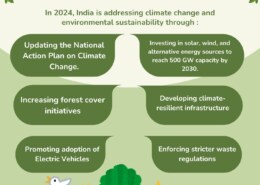
In 2024, India is actively addressing climate change and environmental sustainability through various policies and actions. Here are six significant measures being taken: 1. National Action Plan on Climate Change (NAPCC) Enhancement: India has updated its NAPCC to include more ambitious targets forRead more
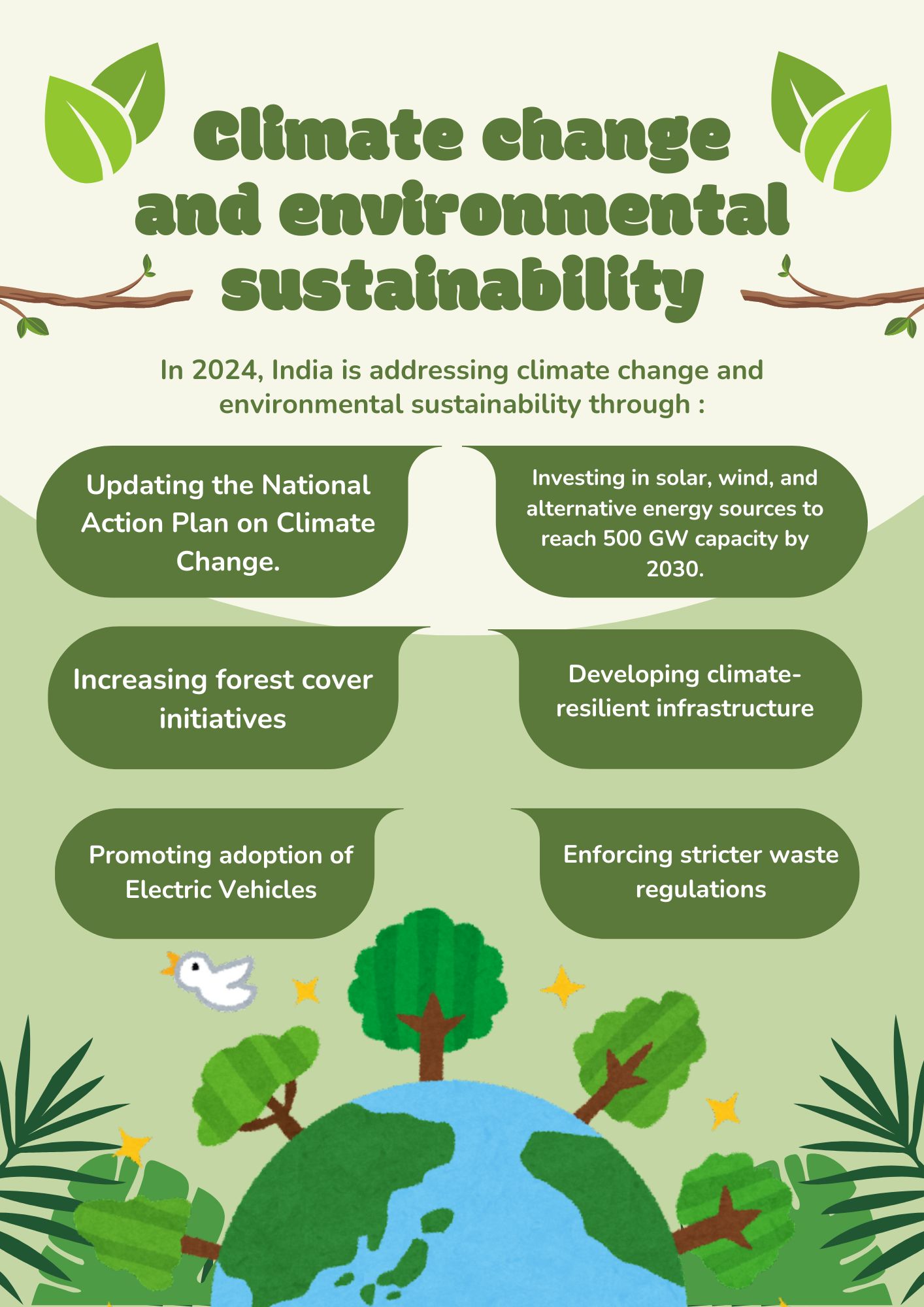
In 2024, India is actively addressing climate change and environmental sustainability through various policies and actions. Here are six significant measures being taken:
1. National Action Plan on Climate Change (NAPCC) Enhancement: India has updated its NAPCC to include more ambitious targets for renewable energy, energy efficiency, and climate resilience. This includes expanding the scope of the existing missions and introducing new missions focused on sustainable agriculture and green transport.
2. Renewable Energy Expansion: India continues to invest heavily in renewable energy, with a target to achieve 500 GW of renewable energy capacity by 2030. Significant investments are being made in solar and wind power projects, along with initiatives to promote the use of biofuels and hydrogen as alternative energy sources.
3. Afforestation and Reforestation Programs: Initiatives like the Green India Mission and state-level programs aim to increase forest cover and restore degraded ecosystems. These efforts contribute to carbon sequestration, biodiversity conservation, and the enhancement of ecosystem services.
4. Promotion of Electric Vehicles (EVs): To reduce carbon emissions from the transportation sector, India is promoting the adoption of electric vehicles through subsidies, tax incentives, and the development of EV charging infrastructure. Policies aim to make EVs more affordable and accessible to the general population.
5. Waste Management and Plastic Ban: India is enforcing stricter regulations on waste management, including solid waste and electronic waste. Additionally, the government has implemented a nationwide ban on single-use plastics, encouraging the use of sustainable alternatives and promoting recycling.
6. Climate-Resilient Infrastructure: Investments are being made in developing infrastructure that can withstand the impacts of climate change, such as extreme weather events and rising sea levels. This includes building climate-resilient urban infrastructure, improving water management systems, and enhancing disaster preparedness and response mechanisms.
See less

M GoshBegginer
-
Reforming India’s healthcare system is a multifaceted challenge that requires comprehensive policy reforms and effective strategies. India’s current healthcare system is characterized by the dual burden of communicable and non-communicable diseases, lack of public health resources, and wide disparitRead more
Reforming India’s healthcare system is a multifaceted challenge that requires comprehensive policy reforms and effective strategies. India’s current healthcare system is characterized by the dual burden of communicable and non-communicable diseases, lack of public health resources, and wide disparities in access to and access to healthcare services between urban and rural areas. As proposed in the National Health Policy 2017, the key to economic transformation is to increase public healthcare expenditure as a share of GDP to at least 2.5%. There is a severe shortage of doctors. Improving the use of technology through digital health initiatives such as telemedicine and health information can address inequalities in service delivery and increase efficiency.
Additionally, integrating traditional and modern medicine with quality control syst ems can increase access to and affordability of healthcare for all. Public-private partnerships, investment in healthcare, and a focus on preventive care are also critical to healthcare reform. Addressing health determinants such as sanitation, nutrition, and education is essential to improving overall health and realizing India’s health vision.
See less


-
India's taxation system is quite complex, but it's essential for the country's development. There are two main types of taxes: direct and indirect. Direct taxes include income tax, which individuals and businesses pay based on their earnings. Indirect taxes are collected on goods and services, likeRead more
India’s taxation system is quite complex, but it’s essential for the country’s development. There are two main types of taxes: direct and indirect. Direct taxes include income tax, which individuals and businesses pay based on their earnings. Indirect taxes are collected on goods and services, like GST (Goods and Services Tax).
Key Points about India’s Taxation System:
- Income Tax:
- People have to pay income tax based on how much they earn. There are different slabs or categories for different income levels. The more you earn, the higher percentage of tax you pay.
- Businesses also pay income tax on their profits.
- GST (Goods and Services Tax):
- GST replaced many other taxes like VAT, service tax, and excise duty. It’s a single tax applied to the supply of goods and services.
- There are different rates of GST for different items. Essential items like food grains have lower rates, while luxury items have higher rates.
- Tax Filing:
- Individuals and businesses need to file their tax returns every year. For individuals, the deadline is usually July 31st.
- Filing taxes can be a bit tricky because it involves a lot of paperwork and understanding various exemptions and deductions.
Challenges:
- Complexity:
- The tax system can be complicated for ordinary people to understand. Many rely on accountants or tax professionals to help them file their returns.
- Compliance:
- Ensuring everyone pays their fair share of taxes is a challenge. Some people and businesses try to evade taxes, which affects the revenue that the government can use for development projects.
- Frequent Changes:
- Tax laws and rates often change, which can confuse taxpayers. Keeping up with these changes requires effort and sometimes professional help.
Benefits:
- Revenue for Development:
- Taxes are the primary source of revenue for the government. This money is used to build infrastructure, provide public services like healthcare and education, and support welfare programs.
- Redistribution of Wealth:
- Progressive taxation (where higher earners pay a higher percentage) helps in reducing income inequality by redistributing wealth.
Thoughts for Improvement:
- Simplification:
- Making the tax system simpler and more straightforward can encourage more people to comply and reduce the need for professional help.
- Technology Use:
- Increasing the use of technology for tax filing and compliance can make the process smoother and more transparent.
- Education and Awareness:
- Educating people about the importance of paying taxes and how to do it correctly can improve compliance and reduce evasion.
In summary, while India’s tax system has its challenges, it’s crucial for the country’s growth and development. Efforts to simplify the system, increase transparency, and educate taxpayers can make a big difference.
See less - Income Tax:


Arun MaheshwariBegginer
-
Businesses can balance profit-making with ethical responsibilities by integrating corporate social responsibility (CSR) into their operations. This means adopting sustainable practices, such as minimizing environmental impact, ensuring fair labor practices, and supporting community initiatives. By sRead more
Businesses can balance profit-making with ethical responsibilities by integrating corporate social responsibility (CSR) into their operations. This means adopting sustainable practices, such as minimizing environmental impact, ensuring fair labor practices, and supporting community initiatives. By setting ethical standards and maintaining transparency, businesses can align their profit goals with societal values. Engaging in regular stakeholder dialogue and addressing social concerns can further enhance this balance. Ultimately, embedding ethical considerations into business strategies helps build trust and long-term success, benefiting both the company and society.
See less

Arun MaheshwariBegginer
-
Increasing trust and respect : boosts the company culture by creating trustworthy and respectful environment among the employes Job Satisfaction : when leaders act as ethical , employees feel valued and satisfied with their work Engagment and strong Environment : acting as ethical leader leads to hRead more
Increasing trust and respect : boosts the company culture by creating trustworthy and respectful environment among the employes
Job Satisfaction : when leaders act as ethical , employees feel valued and satisfied with their work
Engagment and strong Environment : acting as ethical leader leads to higher engagment and teamwork . This gives a strong and positive environment which leads to less conflicts and making better working place
See less


Jasleen KaurBegginer
-
The most serious offense with regard to the privacy of the individual is the unauthorized acquisition of personal information. This means that the users must have full of control for their information as well as how it can be utilized. In fairness, although some have indicators of truthfulness aboutRead more
The most serious offense with regard to the privacy of the individual is the unauthorized acquisition of personal information. This means that the users must have full of control for their information as well as how it can be utilized.
In fairness, although some have indicators of truthfulness about their methods that, honestly, range from dismal to nonexistent, the same cannot be said about another key area: There is a total absence, as well, of truthful disclosure with respect to what they do with their data collected from their users for purposes of targeted advertising. A significant violation of the expectations of the users for companies;.
-Possibility of Manipulation: Adverts linked to users may exploit the loophole so as to make self-serving decisions, in a way that is not beneficial to the users.
-Questionable Morality: Callous and non-indicated collection and use of personal data raise questions concerning justice, freedom, and likelihood of discrimination.
These include the General Data Protection Regulation (GDPR) in the European Union, the California Consumer Privacy Act (CCPA) and so many others; these laws state that the organization needs to seek permission before it can collect and use an individual’s personal information to deliver personalized ads.
Transparency and Control: The practice should declare on the acquisition and uses of its data with respect to users and the latter should be given full freedom to turn off those targeted advertisements.
-Data Minimization: The relevant authorities should advise companies to gather and employ customer data in its barest form sufficient to serve its advertising function.
See less


Srishti RoyBegginer
-
Democratization of Science and Technology: A Precondition for Sustainable Human Development It is therefore true that phrase ‘democratization of science and technology’ is a necessary for democratization of growth and development. It means to share SC knowledge and technological technologies with grRead more
Democratization of Science and Technology: A Precondition for Sustainable Human Development
It is therefore true that phrase ‘democratization of science and technology’ is a necessary for democratization of growth and development. It means to share SC knowledge and technological technologies with greater number of people, to promote innovations and make sure that the outcome of innovation will be rather helpful for majority of people.
Here’s how it contributes to inclusive growth:
1. It empowers the person by extending from him/her various information and tools, thus empowering the knowledge-based economy and the problem-solving capabilities of the given individual to make proper decisions.
2. This approach puts forward challenges and ideas from a more diverse population and works collaboratively to solve these issues for the improvement of more innovative solutions to social issues.
3. It has reduced the digital disparity in that it has provided equal technology chances equality for the disadvantaged.
4. Social Issues: Through science and technological advancement it is very possible to solve the biggest social problems like poverty, hunger and diseases, in the third world countries.
Democratizing Sustainable Development: Freeing clean energy technologies and sustainable approaches brings huge environmental and climate change solutions.Democratizing Strategies:
Open Access: Read access to scientific articles and other types of publications containing research material.
-Education and Skill Development: Educational commitment in STEM to prepare workforce most efficiently.
-Digital Literacy: Raising awareness on the use of technology to improve on the efficiency of a person’s usage of technology.
-Community Engagement: Engaging people in the matter of its decision-making concerning science and technology.
-Ethical Considerations: Guaranteeing use of technology for appropriate purposes and right purposes.Democratisation of science and technology empowers nation to drive the poor out of poverty and improve the quality of population.
See less

Simran ThakurBegginer
Democratization of science and technology is pre-requisite for inclusive growth and development of a country. Comment.
-
Democratization of Science and Technology: An Anticipate of the Populace Emancipation Senator Cabalfin strongly emphasized that true growth and development for the Filipino people will not only need ‘democratization of science and technology’. It implies translating scientific information and technoRead more
Democratization of Science and Technology: An Anticipate of the Populace Emancipation
Senator Cabalfin strongly emphasized that true growth and development for the Filipino people will not only need ‘democratization of science and technology’. It implies translating scientific information and technology into design, encouraging more invention, and guaranteeing technology serves the public good.
Here’s how it contributes to inclusive growth:
1. It empowers the person by giving him/her inputs and tools hence the problem solving skills and the knowledge based economy get to make the right decisions.
2. This democratized approach puts forward everyone’s opinions allowing for collective work on improving innovative solutions of societal issues.
3. It erases the digital gap, making equal chances in technology for the less fortunate.
4. Social Issues: It highlights application of science and technology for helping the society in terms of major social problems including poverty, hunger or diseases within the developing world.
5. Democratization of Sustainable Development: Making clean energy technologies and sustainable practices visible and affordable to communities fosters environmental sustainability and climate change.Important Strategies for Democratization:
Open Access to Information: Full and immediate availability of scientific articles and datasets.
-Education and Skill Development: Spendings to develop human capital of STEM education for cultivating skilled human capital.
-Digital Literacy: Using technology, the social chapter seeks to enhance digital literacy to enable individuals embraced the technology.
-Community Engagement: Engaging communities in the decision-making processes of Science and Technology.
-Ethical Considerations: Maintaining that technologies are employed properly and rightly.While disseminating the knowledge about science and technology, countries can enhance the development of the society, decrease the number of poor people, and make people’s lives better.
See less
According to relativity Gravity or Gravitational force is an illusion. Suppose a Astronaut is traveling on a geodesic (a straight line path) but when you observe it appears like helix it only look circular when you forget time dimension So acceleration or acceleration due to gravity is just a deviRead more
According to relativity Gravity or Gravitational force is an illusion. Suppose a Astronaut is traveling on a geodesic (a straight line path) but when you observe it appears like helix it only look circular when you forget time dimension
So acceleration or acceleration due to gravity is just a deviation from geodesic.
Now suppose you are in rocket and a beam of light pass in rocket from one point to another and when your rocket move with uniform velocity than for you light is move in straight line and also for distinct observer but if you accelerate your rocket with 9.8 m/s then you saw light path is not straight (curve) but for distinct observer light path is still straight. This explain Einstein General theory of relativity .
According to this group due to bending of space time curve due to mass of planet the path of light or any object move along that mass change to helix. That’s why light coming from stars is not straight you can observe it during Solar eclipse .Thus time for straight path is less as compare to helix. By time dilation for high gravity your time increase and for less gravity your time decrease which occur in space
T=T0/(1-v²/c²)^1/2
T=T0/(1-2gR/c²)^1/2
See less