


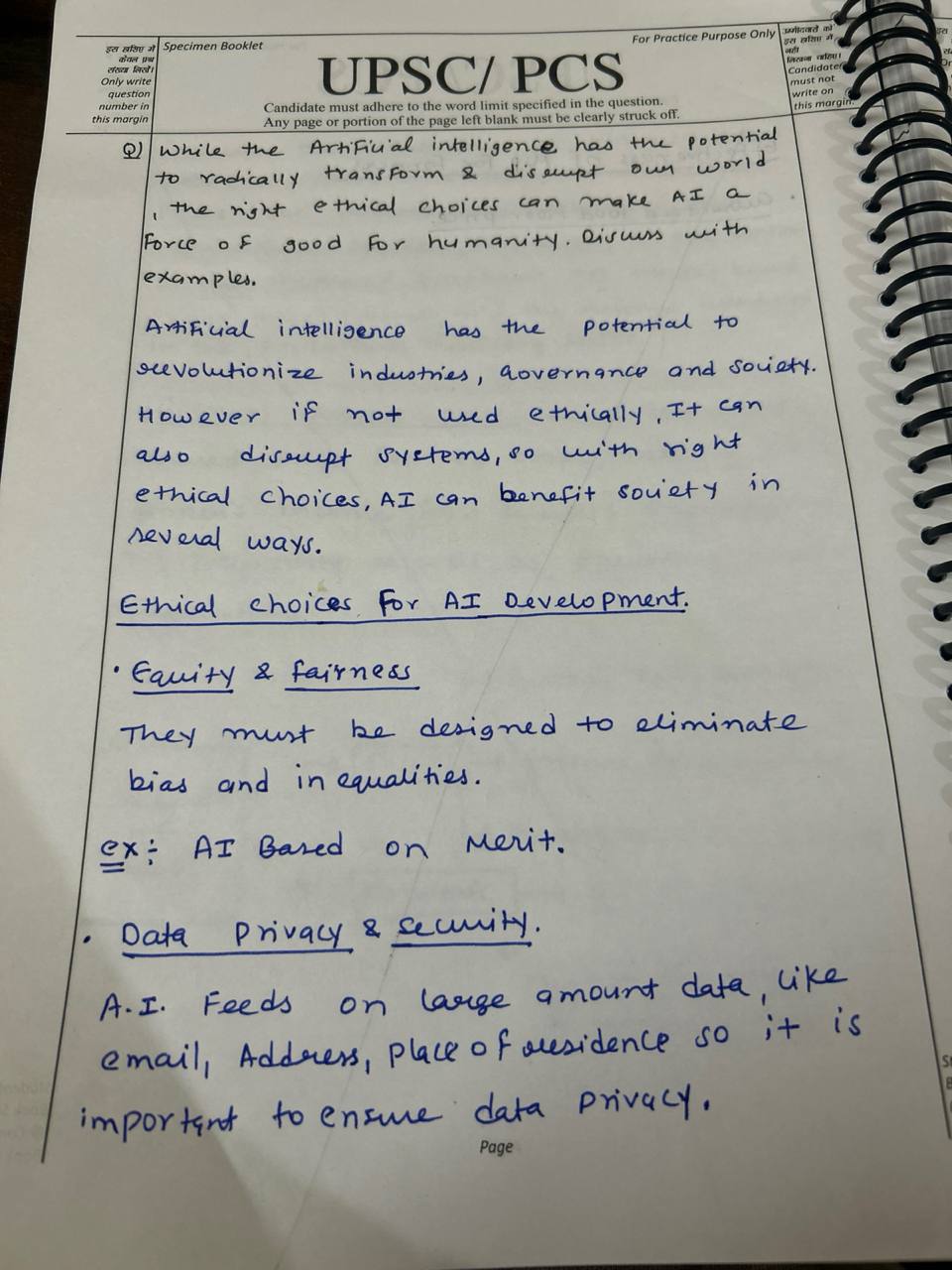
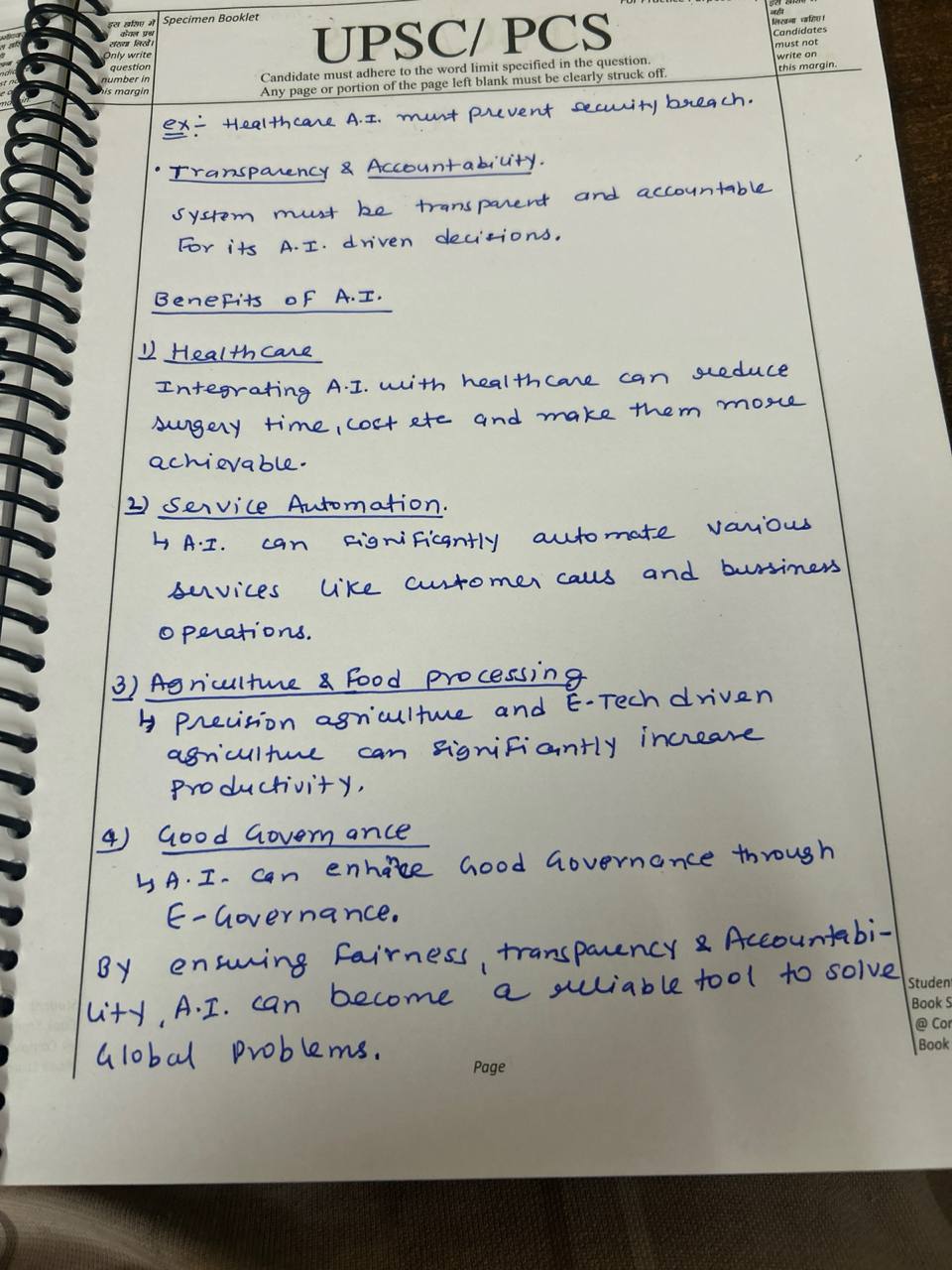
Despite the fact that artificial intelligence (AI) has the power to drastically alter and upend our world, Al can be a positive force for humanity if it makes the correct moral decisions. Talk about it with examples.(Answer in 150 words)


Answer: Transparency in administration is a sine qua non of participatory democracy and has gained prominence as a commitment of the state towards its citizens. It has the following significance for governance: Good governance: Disseminating information is crucial to good governance as it reflects aRead more
Answer: Transparency in administration is a sine qua non of participatory democracy and has gained prominence as a commitment of the state towards its citizens. It has the following significance for governance:
- Good governance: Disseminating information is crucial to good governance as it reflects and captures the government’s activities and processes. It also leads to accountability.
- Participative democracy: Every citizen of the state has the right to access information under the control of public authorities and evaluate whether it is in consonance with public interest.
- Economic and social progress: Transparency is the key not only to the architecture of good governance but also to a country’s ability to usher in rapid economic and social progress.
- Balancing power: Transparency can empower marginalized communities to battle the circumstances in which they find themselves and help balance the unequal power dynamics that exist between them and the government.
In this regard, the Indian government has come up with several initiatives towards open and transparent governance over the years like the Right To Information Act, 2005 (RTI Act), the National e-Governance Plan, 2006, National Data Sharing and Accessibility Policy, 2012, the Whistle Blowers Protection Act, 2014, etc. Despite the importance of transparency, withholding of information from the public becomes important due to the following reasons:
- National security: The RTI Act provides that certain sensitive information may be withheld from the public if the public authority in possession of the information thinks that the same is likely to jeopardize national interest or violate trade secrets. Also, the Official Secrets Act, of 1923 states that spying, sharing ‘secret’ information, interference with the armed forces in prohibited/restricted areas, etc. are punishable offenses.
- Privacy: Information that unnecessarily violates the privacy and confidentiality rights of individuals should be curtailed. For instance, sensitive information like the identity of victims of sexual abuse.
- Maintaining public order: Sometimes released information might lead to undue stigmatization of individuals or groups within the society and create issues with regard to public order. For instance, during violent upsurges, certain sensitive information is withheld to ensure peace and stability in society.
- Preventing misinformation: Some information, if released, might lead to the spread of rumors and consequently lead to panic and chaos. For instance, the spread of misinformation was rampant during the COVID-19 pandemic.
Thus, there is some merit in withholding information from the public. However, before withholding critical information, other issues must also be addressed such as reducing the misuse of RTI exceptions, broadly defining ‘national security’ and ambiguous terms used in the Official Secrets Act, 1923, etc.
See less


 (i) The Mediterranean climatic regions are found in the western parts of the continents within the latitudinal zone of 30°-45° in both hemispheres. The Sub-Tropical High-Pressure Belts extending between 30°-35° latitudes are characterized by dry trade winds during the summer season and anti-cyclonic conditions. This belt extends up to 40° latitudes in the Northern hemisphere at the time of summer solstice and in the Southern hemisphere at the time of winter solstice. Thus, the western parts of the continents within the zone of 30°-40° latitudes do not receive rainfall during the summer season. On the other hand, the Sub-Tropical Belt shifts towards the Equator at the time of winter solstice in the Northern hemisphere and at the time of summer solstice in the Southern hemisphere. Consequently, the zone is characterized by the Westerlies, which lead to precipitation during the winter season. The Mediterranean type of climate is thus characterized by dry summers and wet winters. (ii) The regions lying between 60°-70° latitudes are characterized by two types of winds in a year. With the northward migration of the sun at the time of summer solstice, the Polar Easterlies are weakened because the Westerlies extend over these areas due to the northward shifting of Sub-Polar Low-Pressure Belts. The situation is reversed at the time of winter solstice when there is southward migration of the sun. The Polar Easterlies are re-established between 60°-70°N because of the shifting of the belt of the Westerlies southward. Consequently, it creates a climate characterized by wet summers through the Westerlies and associated cyclones and dry winters due to Polar Easterlies. (iii) Monsoon climate is also the result of the shifting of pressure and wind belts. Due to the northward migration of the sun in the Northern hemisphere at the time of summer solstice, the North Inter-Tropical Convergence Zone (NITCZ) is extended up to 30°N latitude over the Indian subcontinent, Southeast Asia, and parts of Africa. Thus, the Equatorial Westerlies are also extended over the aforesaid regions, which become the southwest or summer monsoons. These southwest monsoon winds bring much rain because they come from over the ocean and are associated with tropical cyclones. The NITCZ is withdrawn from the Indian subcontinent and Southeast Asia because of the southward shifting of pressure and wind belts due to the southward migration of the sun at the time of winter solstice. Thus, north-east trades are re-established which leads to the north-east or winter monsoons. Since they come from over the lands, they are dry.


See less